1987Discovery
Neutrinos from supernova SN 1987A
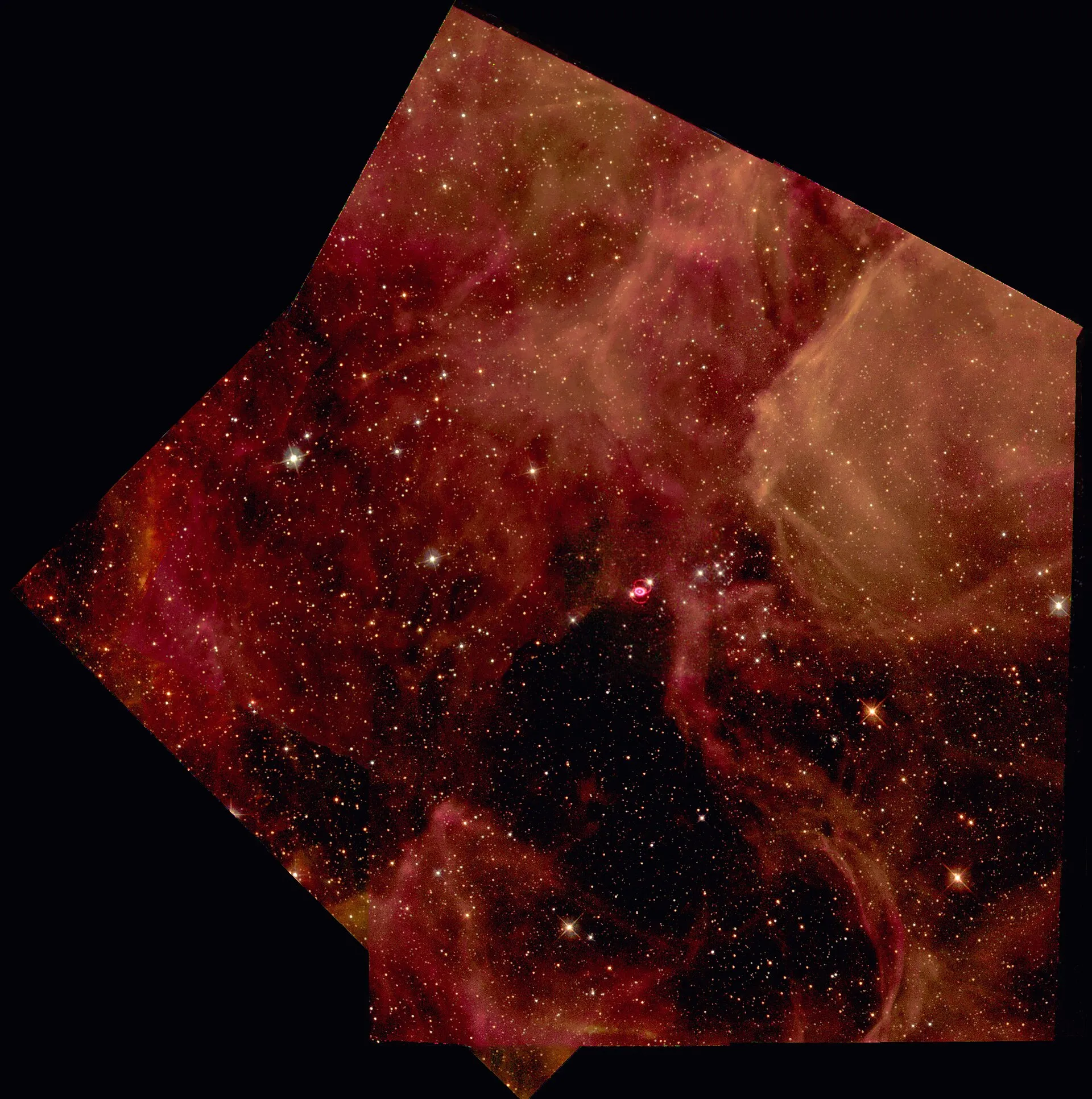
At 07:35 UT on 23 February 1987, Kamiokande-II recorded 11 and IMB 8 neutrino events within about 13 seconds, and the Baksan Scintillation Telescope saw 5. They came from the collapse of a star in the Large Magellanic Cloud, about 168,000 light-years away, hours before the supernova was seen optically. The roughly two dozen events confirmed that core collapse releases about 10⁵³ erg mostly as neutrinos. It was the birth of neutrino astronomy beyond the Sun.
- Date
- 23 February 1987
- Kind of event
- Discovery
The situation before
Theory had predicted since the 1960s that a collapsing stellar core releases almost all its energy as neutrinos; Stirling Colgate was among the first to argue that they shape the explosion. Nobody had ever seen such a burst. The last supernova visible to the naked eye had been Kepler's in 1604, and a collapse in the Milky Way was expected only a few times per century. The detectors that might see one, Kamiokande-II in Japan and IMB in Ohio, had been built to look for proton decay. Kamiokande had just been upgraded to lower its energy threshold for solar neutrinos, with electronics supplied by Alfred Mann's group at the University of Pennsylvania.
What happened
On the night of 23 to 24 February 1987, Ian Shelton and Oscar Duhalde at Las Campanas Observatory in Chile noticed a new bright star in the Large Magellanic Cloud, and Albert Jones in New Zealand found it independently. The International Astronomical Union announced it on 24 February in Circular 4316. It was the nearest supernova seen in almost four centuries, about 168,000 light-years away.
The underground groups then searched their recorded data. At Kamiokande, data tapes were analysed in Tokyo, and the team led by Masatoshi Koshiba, with young physicists such as Masayuki Nakahata, found a cluster of 11 events within about 13 seconds starting at 07:35 UT on 23 February. Kamiokande's clock was accurate only to about a minute; IMB's clock was precise, and its 8 events began at 07:35:41 UT. The Baksan Scintillation Telescope in the Caucasus reported 5 events in the same window. The burst arrived a few hours before the first optical brightening was recorded.
Both results were published in Physical Review Letters on 6 April 1987, side by side: Hirata and colleagues for Kamiokande-II and Bionta and colleagues for IMB, the latter including Lawrence Sulak and Henry Sobel. The events had energies of about 7 to 40 MeV and were mostly electron antineutrinos absorbed by protons in water.
Reaction
The two dozen events were analysed in hundreds of papers within a year. Their number, energies and spread over about ten seconds matched the predicted emission of a few times 10⁵³ erg from a forming neutron star, confirming the core-collapse picture. That neutrinos of different energies arrived within seconds after 168,000 years gave an upper limit on the electron-antineutrino mass of roughly 10–20 eV. That the burst was not shorter limited any extra cooling by unknown light particles such as axions. A cluster of five events in the Mont Blanc detector, about five hours earlier, did not match the other detectors and is generally not counted as part of the signal.
Why it matters
- It was the first detection of neutrinos from a source other than the Sun, and it is still the only supernova neutrino signal ever recorded; details are given under SN 1987A detection.
- In 2002 Koshiba shared the Nobel Prize in Physics with Raymond Davis Jr. for the detection of cosmic neutrinos, together with Riccardo Giacconi for X-ray astronomy.
- It showed that detectors built for one purpose must be ready for rare events. The SNEWS network, set up in the following decades, links detectors worldwide to send an alert within minutes of the next burst.
- Today Super-Kamiokande, IceCube, JUNO and later DUNE and Hyper-Kamiokande would record thousands to hundreds of thousands of events from a supernova in the Milky Way.
The remnant itself has been followed by telescopes ever since; in 2024 observations with the James Webb Space Telescope gave evidence for a neutron star at its centre, the object whose birth the neutrinos had announced.
Frequently asked questions
When were the SN 1987A neutrinos detected?
At about 07:35 UT on 23 February 1987, a few hours before the supernova was first seen optically.
How many neutrinos were seen?
About two dozen: 11 at Kamiokande-II, 8 at IMB and 5 at the Baksan Scintillation Telescope, all within about 13 seconds.
Why was the detection important?
It confirmed that core-collapse supernovae release most of their energy as neutrinos and marked the beginning of neutrino astronomy beyond the Sun.
Original papers
- DiscoveryK. Hirata et al. (Kamiokande-II), Observation of a neutrino burst from the supernova SN1987A, Phys. Rev. Lett. 58, 1490 (1987)DOI 10.1103/PhysRevLett.58.1490
- DiscoveryR. M. Bionta et al. (IMB), Observation of a neutrino burst in coincidence with supernova 1987A in the Large Magellanic Cloud, Phys. Rev. Lett. 58, 1494 (1987)DOI 10.1103/PhysRevLett.58.1494
Concepts
Mentioned in 3 pages
Last updated: · Editorial standard
Cite this page
Text
Neutrino Atlas (2026). “1987: Neutrinos from supernova SN 1987A”. Retrieved 22 November 2026, from https://neutrino-atlas.com/timeline/1987-sn1987a-neutrinos/BibTeX
@misc{neutrinoatlas2026line1987sn1987aneutrinos,
  title        = {1987: Neutrinos from supernova SN 1987A},
  author       = {{Neutrino Atlas}},
  year         = {2026},
  url          = {https://neutrino-atlas.com/timeline/1987-sn1987a-neutrinos/},
  note         = {Accessed 2026-11-22},
  language     = {english}
}