Hyper-Kamiokande
The next-generation water Cherenkov detector, about 8 times larger than Super-K, under construction in Japan.
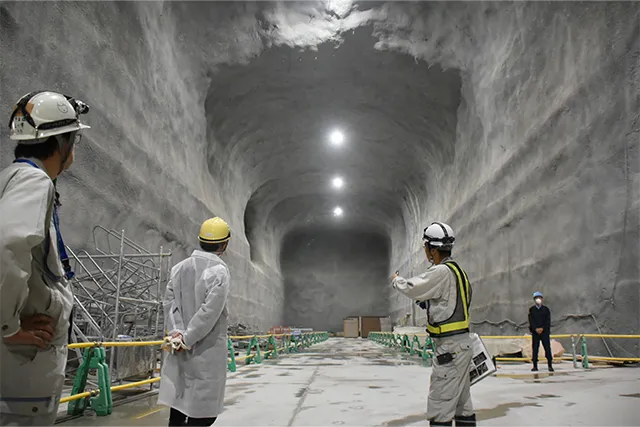
A cavern 600 m underground in the Tochibora mine, completed in July 2025, will hold about 260,000 m³ of ultra-pure water viewed by about 20,000 new high-efficiency 50-cm PMTs. As the far detector for the upgraded J-PARC beam (T2HK, 295 km), it targets CP violation, plus proton decay, supernova, solar and atmospheric neutrinos. Operations are scheduled to begin in 2028.
Compare all experiments → · World map →
In plain words
Hyper-Kamiokande scales up the proven Super-Kamiokande design: a much larger underground tank of pure water, lined with new, more sensitive light detectors. Its main task is to compare how muon neutrinos and muon antineutrinos turn into electron-type particles over 295 kilometres. A difference between the two would be evidence that neutrinos violate the symmetry between matter and antimatter.
How the detector works
The detector is under construction about 650 metres below Mount Nijuugo in the Tochibora mine near Kamioka, Gifu Prefecture; excavation of the main cavern was completed in July 2025. The cylindrical tank, 68 metres in diameter and 71 metres high, will hold about 258,000 tonnes of water, about five times Super-K's total and about eight times its fiducial volume. The inner detector will carry at least 20,000 new 50-centimetre photomultipliers with box-and-line dynodes, about twice as efficient at detecting single photons as Super-K's tubes, plus about 800 multi-PMT modules of nineteen 8-centimetre tubes each. An outer detector with at least 3600 small tubes acts as a veto.
The neutrino beam comes from J-PARC in Tokai, 2.5 degrees off axis as for T2K, with the beam power being raised towards about 1.3 megawatts. Besides the upgraded near detector ND280, a new Intermediate Water Cherenkov Detector about 750 metres from the target will sample off-axis angles from 1 to 4 degrees to control interaction systematics.
Physics goals
- Leptonic CP violation: after about ten years, a 5σ discovery for more than half of the possible values of δCP.
- Mass ordering from beam and atmospheric neutrinos combined.
- Proton decay, with sensitivity to lifetimes around 10³⁵ years for p → e⁺ π⁰.
- Supernova neutrinos, about 40 events from the diffuse supernova background over ten years, and solar and geoneutrino studies.
Status today
Japan approved construction in February 2020, and the international collaboration, with institutes from more than 20 countries, formed in the same year. Francesca Di Lodovico and Masato Shiozawa serve as co-spokespersons. Data taking is planned to start in 2028, a few years before DUNE, which will address the same questions with a different technique and longer baseline.
Frequently asked questions
How does Hyper-K differ from DUNE?
Hyper-K uses water Cherenkov detection, a 295-kilometre baseline and a narrow-band off-axis beam, where matter effects are small. DUNE uses liquid argon, a 1300-kilometre baseline and a wide-band beam, which gives strong sensitivity to the mass ordering. The two are complementary.
Will Hyper-Kamiokande replace Super-Kamiokande?
Not directly. Hyper-K is a new detector in its own cavern in the Tochibora mine, not a conversion of the Super-K tank, and it is designed to take over Super-K's role as the far detector of the J-PARC beam.
Original papers
- ProposalK. Abe et al. (Hyper-Kamiokande Proto-Collaboration), Hyper-Kamiokande Design Report (2018)arXiv:1805.04163
Related terms
People
- Kōichirō Nishikawa
- Masataka Fukugita
- Masayuki Nakahata
- Serguey Todorov Petcov
- M. Belén Gavela
- Silvia Pascoli
- Francesca Di Lodovico
- Henry W. Sobel
- Masato Shiozawa
- Nicola Cabibbo
- Hitoshi Murayama
- Tsuyoshi Nakaya
Latest research on this topic
- Probing the Supersymmetric Grand Unified Theories with Anomaly Mediation at the Future Proton-Proton Colliders and Hyper-Kamiokande ExperimentAhmed, Waqas, Li, Tianjun, Raza, Shabbar · 8 November 2026
- Exploring the Supersymmetric Grand Unified Theories with Gauge Mediation at the Future Proton-Proton Colliders and Hyper-Kamiokande ExperimentAhmed, Waqas, Li, Tianjun, Raza, Shabbar · 4 October 2026
- Assessment of Super- and Hyper-Kamiokande Sensitivity to the DSNBBlanco-Mas, Pablo, de Gouvêa, André, Martínez-Soler, Iván · 15 September 2026
- Multi-PMT electronics and DAQ system in WCTE operationHyper-Kamiokande Collaboration · 22 August 2026
- Moving a Detector to Probe New Neutrino Interactions: IWCD at Hyper-KamiokandeSchwemberger, Thomas, Takhistov, Volodymyr · 4 August 2026
- Evaluating position dependence of detection performance for 50-cm Hyper-Kamiokande photomultiplier tubeHyper-Kamiokande Collaboration · 4 June 2026
On the timeline
- 2020Hyper-Kamiokande construction is approved
- 2025Hyper-Kamiokande cavern excavation completed
- 2026Super-Kamiokande sees a first hint of the supernova neutrino background
Mentioned in 143 pages
Lessons 9
FAQ 8
Comparisons 6
Milestones 22
- 1962 · Maki, Nakagawa and Sakata introduce neutrino mixing
- 1978 · Wolfenstein: matter changes neutrino oscillations
- 1983 · Large water Cherenkov detectors begin operation
- 1986 · Fukugita and Yanagida propose leptogenesis
- 1987 · Neutrinos from supernova SN 1987A
- 1996 · Super-Kamiokande begins operation
- 1999 · K2K starts the first long-baseline experiment
- 2001 · Implosion chain destroys most Super-K photomultipliers
14 more
- 2011 · T2K finds hints of electron-neutrino appearance
- 2012 · Daya Bay discovers a non-zero θ₁₃
- 2012 · RENO confirms θ₁₃
- 2015 · Breakthrough Prize honours five oscillation experiments
- 2015 · OPERA establishes tau-neutrino appearance
- 2016 · NOvA reports its first oscillation results
- 2017 · Groundbreaking for LBNF and DUNE
- 2020 · Hyper-Kamiokande construction is approved
- 2020 · T2K constrains CP violation in neutrinos
- 2025 · Hyper-Kamiokande cavern excavation completed
- 2025 · JUNO begins data taking
- 2025 · NOvA and T2K publish a joint analysis
- 2026 · DUNE begins installing detector support structures
- 2026 · Super-Kamiokande sees a first hint of the supernova neutrino background
People 22
Terms 76
- 2001 PMT implosion accident
- Accelerator Long-baseline experiments
- Accelerator neutrino beams
- Accelerator neutrinos
- ANNIE
- Appearance measurement
- Appearance vs disappearance
- Atmospheric & Large water Cherenkov experiments
68 more
- Atmospheric neutrinos
- Axial form factor and axial mass
- Beta beam
- Boron-8 neutrinos
- Charge conjugation
- Cherenkov radiation (detection)
- Cherenkov ring imaging (e-like vs µ-like)
- CP violation
- CP-Violating phase δCP
- CP-Violation sensitivity (δCP)
- Cross sections
- Cross-section & Nuclear-model uncertainty
- Day-night asymmetry
- Day-night asymmetry measurement
- Diffuse supernova neutrino background
- DUNE
- ESSnuSB
- Fiducial volume
- Flavour symmetries
- Grand unification
- Interaction cross section
- Inverted ordering
- J-PARC Neutrino Beam
- Jarlskog invariant
- Kamioka Observatory
- L/E (baseline over energy)
- LBNF (Long-Baseline Neutrino Facility)
- Leptonic CP violation
- Major neutrino beamlines
- Mass eigenstates
- Mass-ordering sensitivity
- Matter-antimatter asymmetry
- Mixing angle θ13
- Mixing angle θ23
- Monte Carlo simulation & event generators
- NA61/SHINE
- Neutrino factory
- Neutrino oscillation physics
- Neutrino tomography
- Neutrino vs antineutrino mode
- Neutronization burst
- Nuclear effects
- Nuclear models for neutrino scattering
- Off-axis beam (facility)
- Open questions in oscillations
- Oscillation observables
- Oscillation parameter degeneracies
- Oscillogram
- Parametric resonance in the Earth
- Photocathode coverage
- Photomultiplier tube (PMT)
- PMNS unitarity tests
- Proton decay
- Protons on target (POT)
- Quantum efficiency
- Sensitivity
- SNEWS (SuperNova Early Warning System)
- Solar neutrino experiments
- Strong interaction
- Super-Kamiokande
- Supernova early warning
- Supernova neutrino detection
- Symmetries and their violation
- Systematic uncertainty
- T2K
- Water Cherenkov detector
- Zenith angle
- θ23 octant
Last updated: · Editorial standard
Cite this page
Text
Neutrino Atlas (2026). “Hyper-Kamiokande”. Retrieved 22 November 2026, from https://neutrino-atlas.com/terms/hyper-kamiokande/BibTeX
@misc{neutrinoatlas2026termshyperkamiokande,
  title        = {Hyper-Kamiokande},
  author       = {{Neutrino Atlas}},
  year         = {2026},
  url          = {https://neutrino-atlas.com/terms/hyper-kamiokande/},
  note         = {Accessed 2026-11-22},
  language     = {english}
}