1996Experiment
Super-Kamiokande begins operation
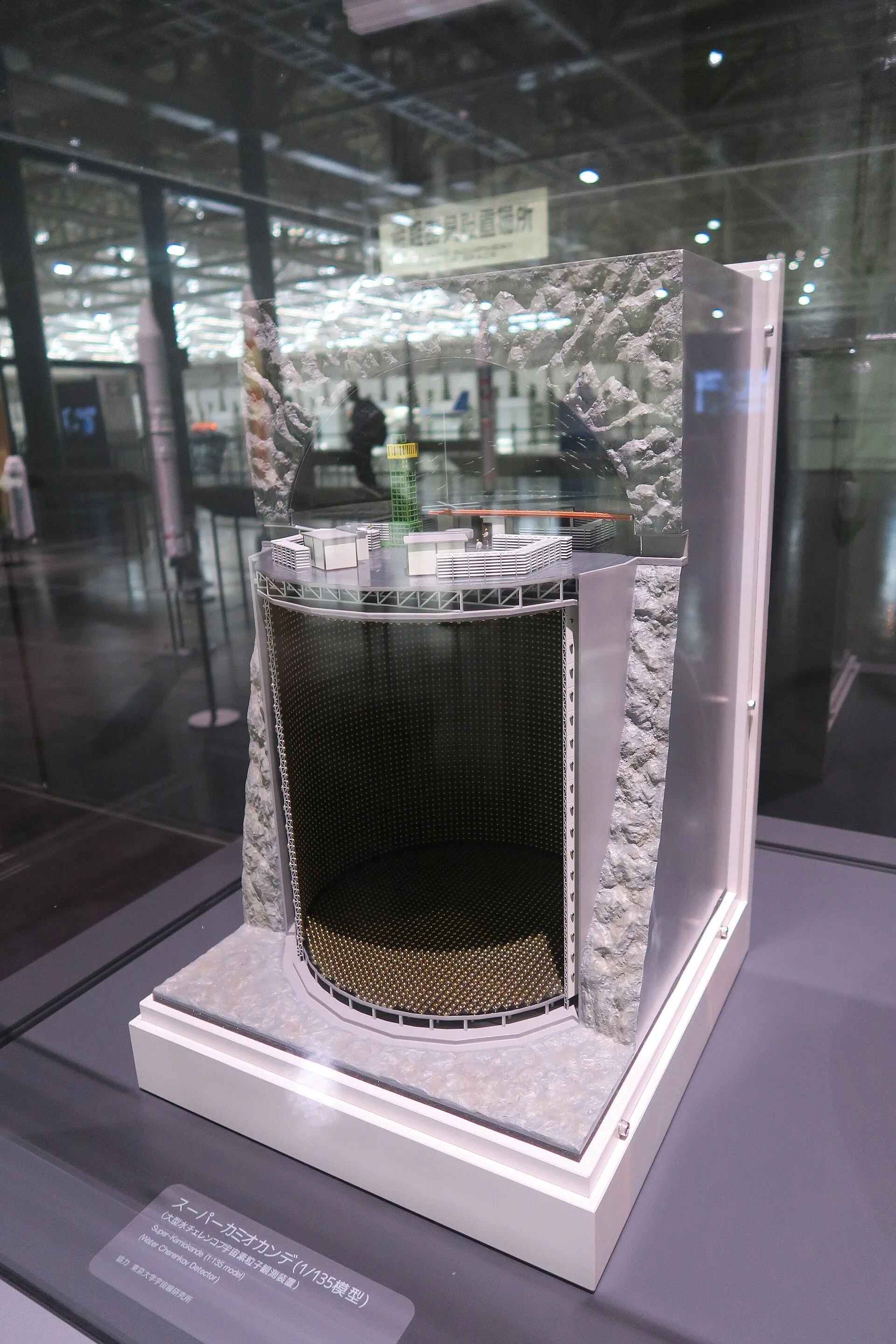
Super-Kamiokande, a 50,000-tonne water Cherenkov detector 1,000 m underground in the Kamioka mine, started taking data on 1 April 1996. Its inner detector was viewed by about 11,000 20-inch photomultipliers. Led by Yoji Totsuka, it was designed for proton decay, solar, atmospheric and supernova neutrinos. It became the far detector for K2K and T2K and remains one of the most productive neutrino experiments.
- Date
- 1 April 1996
- Kind of event
- Experiment
- People involved
- Yoji Totsuka, Yōichirō Suzuki, Masatoshi Koshiba
- Experiments
- Super-Kamiokande, Kamioka Observatory
The situation before
By the early 1990s Kamiokande had seen neutrinos from SN 1987A, boron-8 solar neutrinos in real time and an unexplained deficit of atmospheric muon neutrinos. Each result was limited by statistics: the detector had a fiducial mass of about 1,000 tonnes. To settle the atmospheric anomaly and measure the solar spectrum, and to push proton-decay searches further, a much larger detector was needed. Masatoshi Koshiba had proposed such a project in the early 1980s; it was funded by the Japanese government at the start of the 1990s.
What happened
Construction began in 1991 in the Mozumi mine near Kamioka, under about 1,000 m of rock. Miners excavated a cavern for a stainless-steel cylinder about 39 m in diameter and 41 m high. It was filled with 50,000 tonnes of ultrapure water, of which 22,500 tonnes formed the fiducial volume. The inner detector was lined with 11,146 photomultipliers 20 inches in diameter, giving about 40 percent coverage of the wall; an outer detector with about 1,900 smaller tubes served as a veto. The collaboration, led by Yoji Totsuka of the University of Tokyo's Institute for Cosmic Ray Research, included more than a hundred physicists from Japan and the United States, among them many former Kamiokande and IMB members.
Super-Kamiokande started taking data on 1 April 1996.
Reaction
Super-Kamiokande was by far the largest water Cherenkov detector ever built, and its first two years of data were awaited with great interest. Within months it was recording about ten atmospheric neutrino events a day and about fifteen solar neutrino events a day, far more than Kamiokande.
Consequences
- On 5 June 1998 the collaboration presented evidence for atmospheric muon-neutrino oscillation, the discovery of neutrino mass.
- Its precise boron-8 measurements, combined with SNO in 2001, showed that solar neutrinos change flavour.
- It served as the far detector for K2K from 1999 and for T2K from 2010.
- On 12 November 2001 a chain reaction of implosions destroyed more than half of the photomultipliers, the Super-K PMT accident. The detector resumed with half the coverage in 2002 and was fully restored in 2006.
- Its limits on proton decay, above 10³⁴ years for p → e⁺π⁰, are the strongest of any experiment.
- Since 2020 gadolinium dissolved in the water has improved neutron tagging, aimed at the diffuse supernova neutrino background.
Its successor, Hyper-Kamiokande, with about eight times the fiducial mass, is under construction nearby.
Frequently asked questions
When did Super-Kamiokande start?
On 1 April 1996.
How big is Super-Kamiokande?
It holds 50,000 tonnes of ultrapure water, viewed by about 11,000 photomultipliers 20 inches in diameter, about 1,000 m underground.
What has Super-Kamiokande discovered?
Atmospheric neutrino oscillation in 1998, which proved that neutrinos have mass, and, together with SNO, the flavour change of solar neutrinos.
Original papers
- MeasurementS. Fukuda et al. (Super-Kamiokande), The Super-Kamiokande detector, Nucl. Instrum. Meth. A 501, 418 (2003)
Concepts
Mentioned in 3 pages
Last updated: · Editorial standard
Cite this page
Text
Neutrino Atlas (2026). “1996: Super-Kamiokande begins operation”. Retrieved 22 November 2026, from https://neutrino-atlas.com/timeline/1996-super-kamiokande-start/BibTeX
@misc{neutrinoatlas20261996superkamiokandestart,
  title        = {1996: Super-Kamiokande begins operation},
  author       = {{Neutrino Atlas}},
  year         = {2026},
  url          = {https://neutrino-atlas.com/timeline/1996-super-kamiokande-start/},
  note         = {Accessed 2026-11-22},
  language     = {english}
}