Kamiokande
Japan's first water Cherenkov detector, which observed SN1987A and pioneered real-time solar neutrino detection.
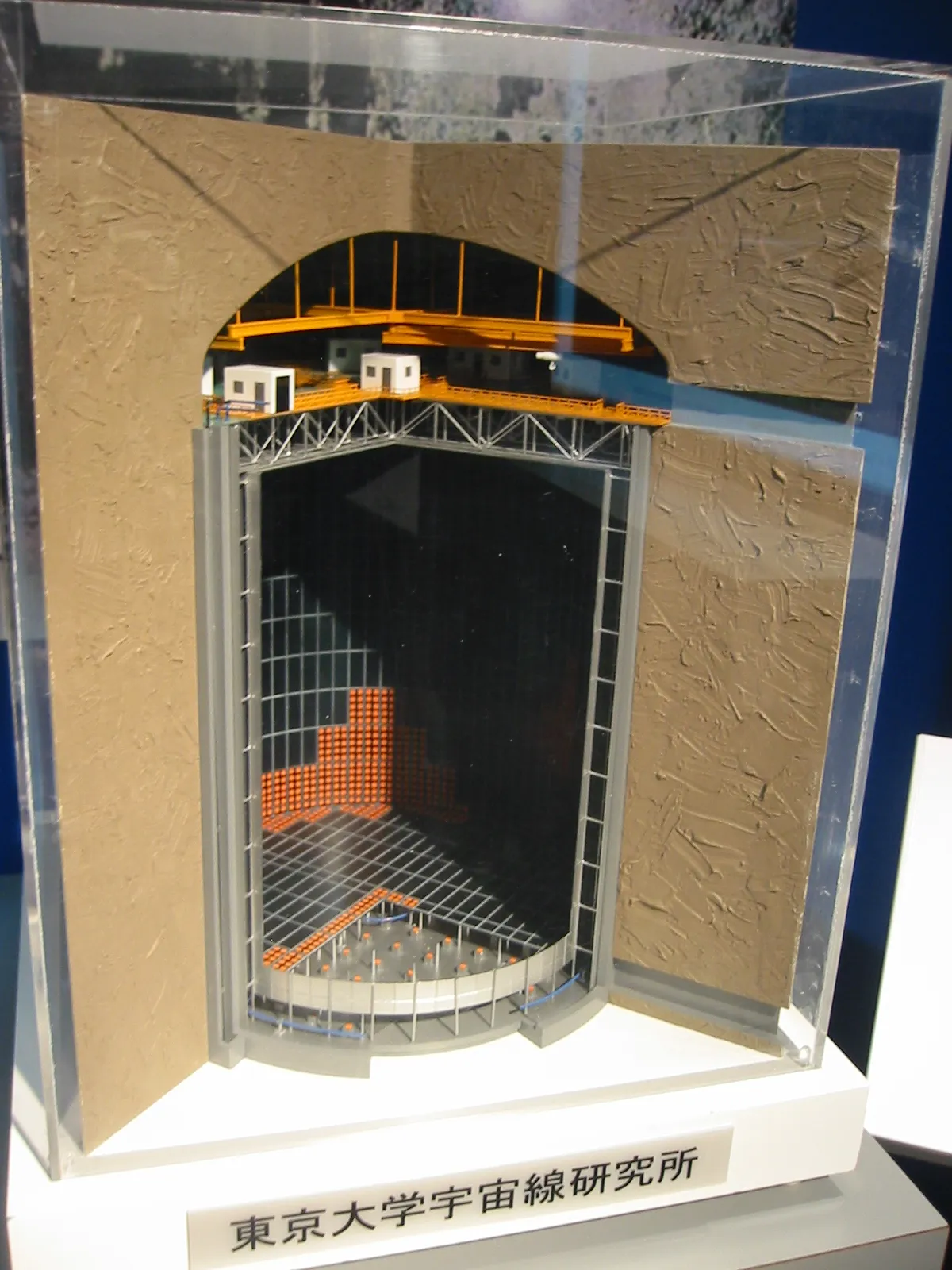
Built for proton decay (Kamioka Nucleon Decay Experiment), its 3000 tonnes of water and 1000 20-inch PMTs were upgraded (Kamiokande-II) for low-energy neutrinos. It confirmed the solar ⁸B deficit with directionality pointing to the Sun, saw the atmospheric ν_µ/νe anomaly, and recorded 11 SN1987A events. Masatoshi Koshiba shared the 2002 Nobel Prize.
Compare all experiments → · World map →
In plain words
Kamiokande was a tank of 3000 tonnes of pure water deep in a Japanese zinc mine, lined with the largest light sensors built at the time. It was meant to catch protons decaying, which it never saw. Instead it became the detector that turned neutrinos into a tool of astronomy: it saw neutrinos arriving from the direction of the Sun and, on 23 February 1987, a burst of neutrinos from an exploding star.
How the detector works
The cylindrical tank, about 16 metres high and 15.6 metres across, sat about 1000 metres underground in the Kamioka mine in Gifu Prefecture. About 1000 photomultipliers with 20-inch photocathodes, developed with Hamamatsu Photonics for this experiment, recorded the Cherenkov light of charged particles. The pattern and timing of hit tubes gave the direction and energy of each event, and the sharpness of the ring separated muons from electrons.
Operation began in 1983 as the Kamioka Nucleon Decay Experiment. From 1985 the Kamiokande-II upgrade added an outer veto layer, better electronics and much lower radioactive background, lowering the energy threshold to below about 10 MeV. A further stage, Kamiokande-III, ran from 1990 until the detector closed in 1996, when Super-Kamiokande took over.
Key results
- SN1987A: 11 neutrino events within about 13 seconds, the first neutrinos detected from outside the solar system. Masayuki Nakahata first found the signal in the data.
- Solar neutrinos (1989): real-time detection of ⁸B neutrinos whose directions point back to the Sun, at about half the predicted rate, confirming the Homestake deficit with an independent technique.
- Atmospheric anomaly (1988): fewer muon-like events relative to electron-like events than expected, and in 1994 a hint that the deficit depended on zenith angle.
- Proton decay: no signal, setting limits that ruled out the simplest grand unified theory together with IMB.
Legacy
Masatoshi Koshiba, who led the project, shared the 2002 Nobel Prize in Physics for the detection of cosmic neutrinos. Many of his students, among them Yoji Totsuka and Takaaki Kajita, went on to build Super-Kamiokande. The original cavern now houses KamLAND.
Frequently asked questions
What does the name Kamiokande mean?
Originally Kamioka Nucleon Decay Experiment; after its success in neutrino physics, the letters were reinterpreted as Kamioka Neutrino Detection Experiment.
Did Kamiokande ever see a proton decay?
No. Its limits on the proton lifetime, together with those of IMB, excluded the minimal SU(5) grand unified theory.
Original papers
- DiscoveryK. Hirata et al. (Kamiokande-II Collaboration), Observation of a neutrino burst from the supernova SN1987A, Phys. Rev. Lett. 58, 1490 (1987)DOI 10.1103/PhysRevLett.58.1490
- MeasurementK. S. Hirata et al. (Kamiokande-II Collaboration), Experimental study of the atmospheric neutrino flux, Phys. Lett. B 205, 416 (1988)
- MeasurementK. S. Hirata et al. (Kamiokande-II Collaboration), Observation of 8B solar neutrinos in the Kamiokande-II detector, Phys. Rev. Lett. 63, 16 (1989)DOI 10.1103/PhysRevLett.63.16
Related terms
People
- Atsuto Suzuki
- Frederick Reines
- Hans Bethe
- John Norris Bahcall
- Masatoshi Koshiba
- Raymond Davis Jr.
- Takaaki Kajita
- Yoji Totsuka
- Georg G. Raffelt
- James Ricker Wilson
- John G. Learned
- Lawrence R. Sulak
- Masayuki Nakahata
- Richard H. White
- Soo-Bong Kim
- Stirling Auchincloss Colgate
Latest research on this topic
- 8B Solar Neutrino Measurements of Solar Core Size and Temperature from 5805 Days of Super-KamiokandeSuper-Kamiokande Collaboration · 13 November 2026
- Probing the Supersymmetric Grand Unified Theories with Anomaly Mediation at the Future Proton-Proton Colliders and Hyper-Kamiokande ExperimentAhmed, Waqas, Li, Tianjun, Raza, Shabbar · 8 November 2026
- Indication of Electron Antineutrinos from the Diffuse Supernova Neutrino BackgroundSuper-Kamiokande Collaboration · 26 October 2026
- Exploring the Supersymmetric Grand Unified Theories with Gauge Mediation at the Future Proton-Proton Colliders and Hyper-Kamiokande ExperimentAhmed, Waqas, Li, Tianjun, Raza, Shabbar · 4 October 2026
- First observation of electron antineutrinos from nuclear reactors at Super-KamiokandeSuper-Kamiokande Collaboration · 2 October 2026
- Search for the 16O(ppp) → 13C π+ π+ e+ Decay Mode in Super-Kamiokande Using Machine Learning TechniquesSuper-Kamiokande Collaboration · 22 September 2026
On the timeline
- 1983Large water Cherenkov detectors begin operation
- 1987Neutrinos from supernova SN 1987A
- 1988Kamiokande finds an atmospheric neutrino anomaly
- 1989Kamiokande sees solar neutrinos in real time
- 2002Nobel Prize for neutrino astrophysics
Mentioned in 97 pages
Lessons 5
FAQ 5
Comparisons 1
Milestones 18
- 1965 · First detection of atmospheric neutrinos
- 1966 · Neutrinos proposed to drive supernova explosions
- 1968 · Homestake finds too few solar neutrinos
- 1983 · Large water Cherenkov detectors begin operation
- 1985 · Chen proposes a heavy-water solar detector
- 1987 · Neutrinos from supernova SN 1987A
- 1988 · Kamiokande finds an atmospheric neutrino anomaly
- 1989 · Kamiokande sees solar neutrinos in real time
10 more
- 1991 · SAGE begins the gallium measurements
- 1992 · GALLEX observes solar pp neutrinos
- 1996 · Super-Kamiokande begins operation
- 1998 · CHOOZ sees no reactor antineutrino disappearance
- 1998 · Homestake publishes its final solar result
- 1998 · Super-Kamiokande discovers neutrino oscillation
- 2001 · SNO shows solar neutrinos change flavour
- 2002 · KamLAND sees reactor antineutrinos disappear
- 2002 · Nobel Prize for neutrino astrophysics
- 2015 · Nobel Prize for neutrino oscillations
People 31
- Adam Burrows
- Alfred K. Mann
- Atsuto Suzuki
- Eugene W. Beier
- Evgeny Kh. Akhmedov
- Francesca Di Lodovico
- Frederick Reines
- Georg G. Raffelt
23 more
- Henry W. Sobel
- James Ricker Wilson
- Jogesh C. Pati
- John G. Learned
- John Norris Bahcall
- Kōichirō Nishikawa
- Kunio Inoue
- Lawrence R. Sulak
- Masatoshi Koshiba
- Masayuki Nakahata
- Raymond Davis Jr.
- Richard H. White
- Sheldon Lee Glashow
- Soo-Bong Kim
- Stanley Wojcicki
- Stephen J. Parke
- Stuart Jay Freedman
- Takaaki Kajita
- Thomas K. Gaisser
- Till A. Kirsten
- Vladimir N. Gavrin (Vladimir Nikolaevich Gavrin)
- Yōichirō Suzuki
- Yoji Totsuka
Terms 37
- Atmospheric & Large water Cherenkov experiments
- Atmospheric neutrinos
- Baksan Neutrino Observatory
- Baksan Underground Scintillation Telescope
- Baryon number
- Boron-8 neutrinos
- Case–Witwatersrand–Irvine (East Rand) experiment
- Cherenkov radiation
29 more
- Cherenkov radiation (detection)
- Cherenkov ring imaging (e-like vs µ-like)
- Detection principles & detector technology
- Discovery of neutrino oscillations
- Elastic scattering (ES) channel
- Experiments & detectors
- Fréjus detector
- Grand unification
- Gravity
- IMB (Irvine–Michigan–Brookhaven)
- Kamioka Observatory
- KamLAND
- Laboratoire Souterrain de Modane (LSM)
- LVD (Large Volume Detector)
- Neutrino astronomy
- Neutrino-electron elastic scattering
- NUSEX
- Photodetection
- Photomultiplier tube (PMT)
- Proton decay
- SN 1987A
- SN1987A neutrino burst
- Solar neutrino experiments
- Solar neutrino problem
- Solar neutrinos
- Soudan 2
- Supernova neutrino signal phases
- Underground laboratories
- Water Cherenkov detector
Last updated: · Editorial standard
Cite this page
Text
Neutrino Atlas (2026). “Kamiokande”. Retrieved 22 November 2026, from https://neutrino-atlas.com/terms/kamiokande/BibTeX
@misc{neutrinoatlas2026termskamiokande,
  title        = {Kamiokande},
  author       = {{Neutrino Atlas}},
  year         = {2026},
  url          = {https://neutrino-atlas.com/terms/kamiokande/},
  note         = {Accessed 2026-11-22},
  language     = {english}
}