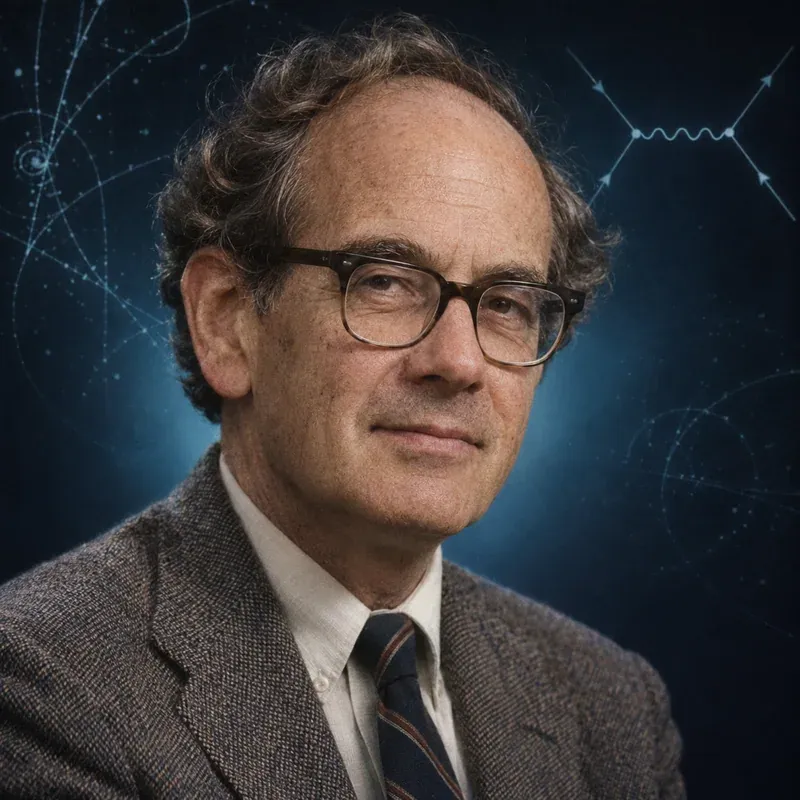
 Illustration
James Ricker Wilson
Wilson's Livermore supernova simulations found that, after the bounce shock stalls, neutrinos streaming from the hot proto-neutron star can reheat the material behind the shock and relaunch the explosion over a fraction of a second. Published with Hans Bethe in 1985, this delayed neutrino-heating mechanism has been the main framework of core-collapse supernova theory for decades.
- Born
- 21 October 1922
Berkeley, California, USA - Died
- 14 August 2007
Livermore, California, USA - Nationality
- American
- Field
- Computational astrophysics; numerical relativity
- Institutions
- Lawrence Livermore National Laboratory, University of California, Berkeley, University of Notre Dame (adjunct)
Early life and education
James Ricker Wilson was born in Berkeley, California, in 1922. He took a bachelor's degree in chemistry at the University of California, Berkeley, in 1942. During the Second World War he served in the US Army and from 1944 to 1946 had a minor role in the Manhattan Project at Los Alamos. He then returned to Berkeley and in 1952 received his PhD in physics with a thesis on problems in meson theory, supervised by Roland Good.
Path to neutrino physics
After a year at Sandia Laboratory in Albuquerque, Wilson joined the young Livermore laboratory in 1953 and stayed there for the rest of his working life. For about two decades he applied large-scale computing to classified weapons physics, developing numerical methods for hydrodynamics and radiation transport that later carried over to astrophysics. A sabbatical at the University of Cambridge in 1968–69 turned his interest to stars. In 1971 he published a numerical study of gravitational stellar collapse with neutrino transport, building on the earlier Livermore calculations of Stirling Colgate and Richard White.
Key contributions
The central difficulty of core-collapse supernova theory in the 1970s was that the shock wave launched when the collapsing core rebounds does not get out. It loses energy breaking up iron nuclei in the infalling layers and stalls a few hundred kilometres from the centre.
In simulations run in the early 1980s Wilson found that if the model was followed for longer, several tenths of a second after the bounce, the stalled shock could be revived. The hot proto-neutron star radiates an enormous flux of neutrinos from its neutrinosphere. A small fraction is absorbed by free neutrons and protons in the layer just below the shock, mainly through the charged-current reactions νe + n → p + e⁻ and ν̄e + p → n + e⁺. The deposited energy raises the pressure behind the shock until it moves outward again. With Hans Bethe, Wilson analysed this delayed neutrino-heating mechanism in the 1985 Astrophysical Journal paper 'Revival of a stalled supernova shock by neutrino heating'.
Two years later the neutrino burst of SN 1987A, recorded by Kamiokande-II, IMB and Baksan, confirmed the premise of the mechanism: a collapsing core releases most of its energy as neutrinos over roughly ten seconds.
Later work and legacy
Wilson was also one of the founders of numerical relativity. He wrote some of the first codes that followed matter in strong gravitational fields, including fluid flow around rotating Kerr black holes. In the 1990s, with Grant Mathews, he simulated close binary neutron stars; their claim that such stars might collapse before merging prompted much follow-up work.
From 1996 he was an adjunct professor at the University of Notre Dame. He received the Marcel Grossmann Award in 1994 and the American Physical Society's Hans A. Bethe Prize in 2007, a few months before his death in Livermore in August 2007.
The delayed neutrino-heating picture remains the basis of supernova theory. Modern three-dimensional simulations, for example by the group of Hans-Thomas Janka, show that convection and shock instabilities help the neutrinos do their work, but the energy source is still the one Wilson identified.
Known for
- Delayed neutrino-heating supernova explosion mechanism
- Bethe & Wilson 1985 shock-revival paper
- Pioneering numerical relativity and supernova codes
Chronology
- 1953Joins Livermore
- 1985Bethe & Wilson: revival of stalled shock by neutrino heating
- 1994Marcel Grossmann Prize
- 2007APS Hans A. Bethe Prize
Original papers
- H. A. Bethe, J. R. Wilson, Revival of a stalled supernova shock by neutrino heating, Astrophys. J. 295, 14 (1985)DOI 10.1086/163343
Experiments
Connected people
Frequently asked questions
What is the Bethe–Wilson mechanism?
It is the idea that a supernova explodes not through the bounce shock alone but because neutrinos from the hot proto-neutron star reheat the matter behind the stalled shock over a few hundred milliseconds. Only a small percentage of the neutrino energy needs to be absorbed to power the explosion.
Was Wilson's mechanism confirmed by observation?
The neutrino signal of SN 1987A, about two dozen events in three detectors, confirmed that core collapse emits the expected energy in neutrinos over seconds. The heating phase itself could not be resolved with so few events; a future galactic supernova seen by Super-Kamiokande, IceCube or DUNE should test it in detail.
On the timeline
Mentioned in 11 pages
Lessons 1
Milestones 2
Last updated: · Editorial standard
Cite this page
Text
Neutrino Atlas (2026). “James Ricker Wilson”. Retrieved 22 November 2026, from https://neutrino-atlas.com/people/james-r-wilson/BibTeX
@misc{neutrinoatlas2026peoplejamesrwilson,
  title        = {James Ricker Wilson},
  author       = {{Neutrino Atlas}},
  year         = {2026},
  url          = {https://neutrino-atlas.com/people/james-r-wilson/},
  note         = {Accessed 2026-11-22},
  language     = {english}
}