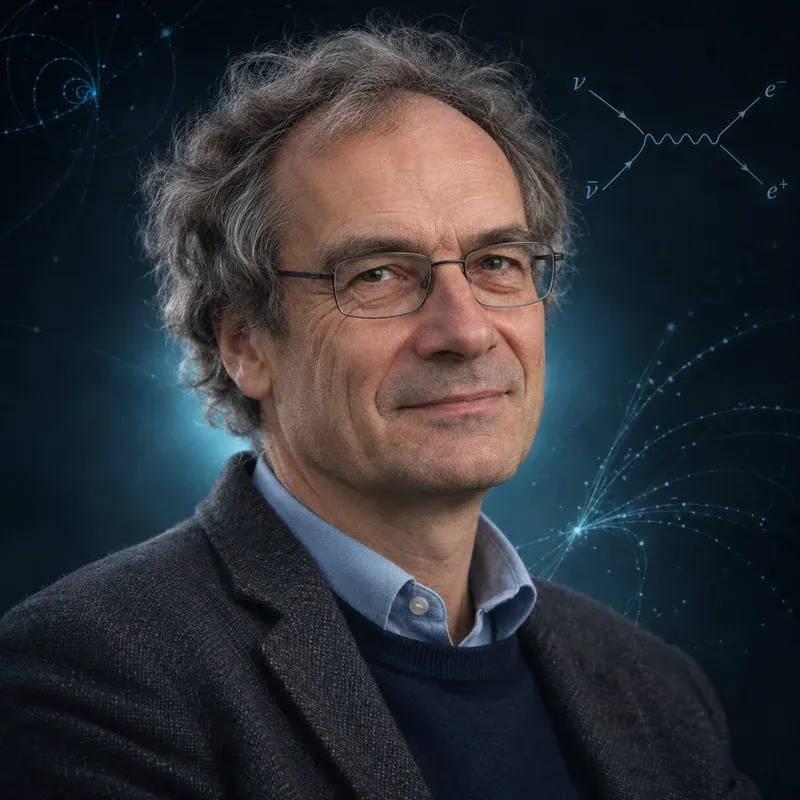
 Illustration
Hans-Thomas Janka
Janka's group at MPA Garching develops multidimensional hydrodynamic simulations with detailed neutrino transport, showing how neutrino heating together with convection and the standing accretion shock instability can drive core-collapse explosions. Their models give predicted neutrino light curves and spectra for detectors such as Super-Kamiokande and IceCube and study neutrino effects in neutron-star mergers.
- Born
- 1960
- Nationality
- German
- Field
- Theoretical astrophysics; supernova and neutrino astrophysics
- Institutions
- Max Planck Institute for Astrophysics (MPA), Garching, Technical University of Munich (TUM), University of Chicago (visiting)
Education and career
Hans-Thomas Janka, born in 1960, studied physics at the Technical University of Munich (TUM), where he received his diploma in 1987. He carried out his doctoral research at the Max Planck Institute for Astrophysics (MPA) in Garching under Wolfgang Hillebrandt and obtained his PhD from TUM in 1991, receiving the Otto Hahn Medal of the Max Planck Society for it. In 1994–95 he was a visiting scholar and Otto Hahn Fellow at the University of Chicago. He then returned to MPA, where he leads a research group on stellar explosions and neutron stars. He completed his habilitation at TUM in 2002 and became an adjunct professor there in 2016.
The problem he works on
When the iron core of a massive star collapses, it forms a hot proto-neutron star and releases about 3×10⁴⁶ joules of gravitational binding energy, roughly 99 per cent of it as neutrinos of all flavours. The outgoing shock wave that should blow the star apart stalls within a fraction of a second. Since the work of Hans Bethe and James R. Wilson in 1985, the leading explanation is that a small fraction of the neutrinos is absorbed behind the shock and heats the matter enough to restart it. Testing this idea requires solving the equations of hydrodynamics together with the transport of neutrinos through matter that is opaque near the neutrinosphere and transparent further out, one of the most demanding problems in computational astrophysics.
Key contributions
Janka's group developed some of the most detailed codes for this problem, combining multidimensional hydrodynamics with energy-dependent neutrino transport and modern nuclear and weak-interaction physics. Their simulations showed that spherically symmetric models generally fail to explode, while in two and three dimensions convection and the standing accretion shock instability (SASI), a sloshing motion of the shock, keep matter longer in the heating region and allow neutrino-driven explosions. Their 2015 three-dimensional model of a 20-solar-mass star exploded once a small, physically motivated correction to neutrino–nucleon scattering was included, illustrating how sensitive the outcome is to the microphysics. Together with collaborators including Georg Raffelt, the group also discovered a large-scale asymmetry in lepton-number emission in three-dimensional models, called LESA.
A second strand of the work concerns what detectors would see. The simulations predict the time evolution of neutrino luminosities and energies, from the short neutronization burst to the cooling phase of several seconds. They show that SASI motions would imprint fast oscillations on the signal, which IceCube and Super-Kamiokande could measure for a supernova in our Galaxy. Such predictions guide the design of supernova analyses at JUNO, DUNE and Hyper-Kamiokande and the early-warning network SNEWS. The group has also studied neutrino effects in neutron-star mergers, where neutrino absorption sets the neutron richness of the ejected matter and therefore the yield of the r-process.
His reviews, including 'Theory of core-collapse supernovae' (Physics Reports, 2007, with Langanke, Marek, Martínez-Pinedo and Müller) and 'Explosion mechanisms of core-collapse supernovae' (Annual Review of Nuclear and Particle Science, 2012), are widely used introductions to the field.
Recognition
Janka received the Heinz Billing Prize for Scientific Computing in 1993, an ERC Advanced Grant in 2013, and the Hanno and Ruth Roelin Prize for science writing in 2011, reflecting his work in public outreach on astronomy.
Known for
- Multidimensional simulations of neutrino-driven supernova explosions
- Neutrino transport in supernovae and neutron-star mergers
- Predictions of supernova neutrino signals
Chronology
- 1991PhD at TUM (MPA); Otto Hahn Medal
- 2007Physics Reports review 'Theory of core-collapse supernovae'
- 2013ERC Advanced Grant
- 2016Adjunct professor at TUM
Original papers
- H.-T. Janka, K. Langanke, A. Marek, G. Martínez-Pinedo, B. Müller, Theory of core-collapse supernovae, Phys. Rep. 442, 38 (2007)DOI 10.1016/j.physrep.2007.02.002
- H.-T. Janka, Neutrino emission from supernovae, in Handbook of Supernovae, Springer, p. 1575 (2017)arXiv:1702.08713
Experiments
Connected people
Frequently asked questions
What do supernova simulations tell us about neutrinos?
They predict how many neutrinos of each flavour a collapsing star emits, with what energies and how the signal changes over the first seconds. Comparing a future galactic supernova with these predictions will test both the supernova mechanism and neutrino properties.
Are supernovae really driven by neutrinos?
Modern multidimensional simulations by Janka's and other groups produce explosions through neutrino heating aided by convection and shock instabilities, and the SN 1987A neutrino burst confirmed that neutrinos carry away most of the energy. Details such as explosion energies for different stars are still being worked out.
On the timeline
Mentioned in 9 pages
Last updated: · Editorial standard
Cite this page
Text
Neutrino Atlas (2026). “Hans-Thomas Janka”. Retrieved 22 November 2026, from https://neutrino-atlas.com/people/hans-thomas-janka/BibTeX
@misc{neutrinoatlas2026peoplehansthomasjanka,
  title        = {Hans-Thomas Janka},
  author       = {{Neutrino Atlas}},
  year         = {2026},
  url          = {https://neutrino-atlas.com/people/hans-thomas-janka/},
  note         = {Accessed 2026-11-22},
  language     = {english}
}