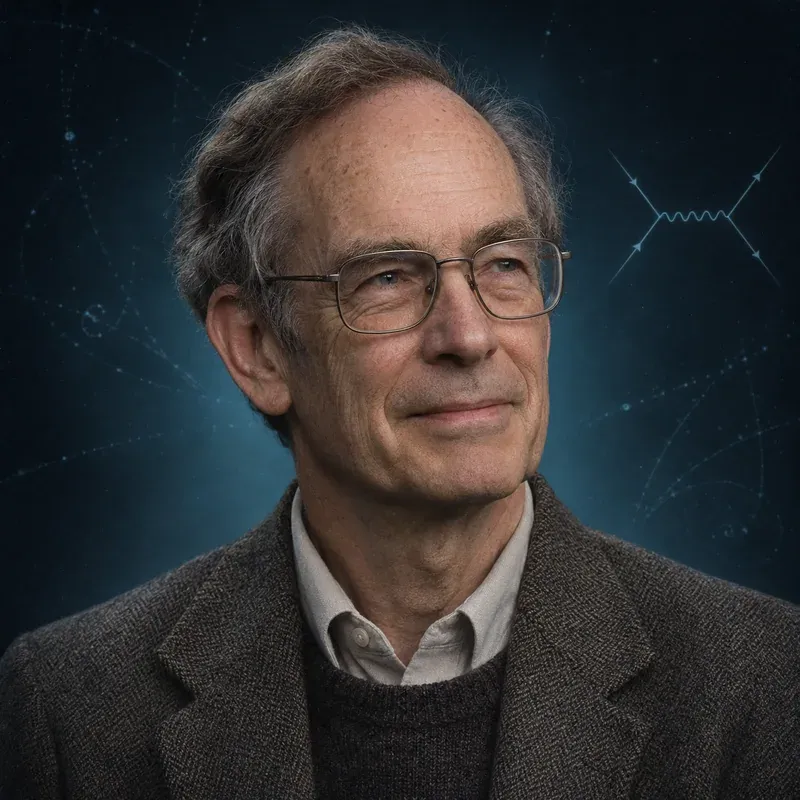
 Illustration
Adam Burrows
With James Lattimer, Burrows modelled in 1986 how a newly formed neutron star cools by radiating neutrinos over several seconds. When Kamiokande-II and IMB detected the SN 1987A burst, their 1987 analysis showed that the observed total energy, mean energy of about 10 MeV and burst duration matched these models, and that most events were electron-antineutrino captures. In 1995, with John Hayes and Bruce Fryxell, he showed in two-dimensional simulations that neutrino-driven convection behind the stalled shock helps launch the explosion. His group's Fornax code has since produced successful three-dimensional neutrino-driven explosion models.
- Nationality
- American
- Field
- Theoretical and computational astrophysics
- Institutions
- Princeton University (BS), Massachusetts Institute of Technology (PhD), University of Arizona, Princeton University (professor of astrophysical sciences)
Career
Adam Burrows studied physics at Princeton University and received his PhD from the Massachusetts Institute of Technology. He worked at the University of Arizona in Tucson, where he was based at the time of SN 1987A, before returning to Princeton as professor of astrophysical sciences. His research spans supernova theory, nuclear and computational astrophysics, and the theory of brown dwarfs and exoplanet atmospheres. He is a member of the National Academy of Sciences and has chaired the National Research Council's Board on Physics and Astronomy.
Neutrinos from a newborn neutron star
When a massive star's core collapses, about 99 per cent of the released gravitational energy leaves as neutrinos. In 1986 Burrows and James Lattimer calculated how the hot proto-neutron star radiates these neutrinos from its neutrinosphere over several seconds. A year later SN 1987A exploded in the Large Magellanic Cloud and Kamiokande-II and IMB recorded a few dozen events (see SN 1987A detection).
Burrows and Lattimer's analysis, submitted within weeks, compared the data with their models. The total energy of roughly 3–5 × 10⁵³ erg matched the binding energy of a neutron star, the mean detected energy of about 10 MeV and the burst length of several seconds pointed to neutrinos diffusing out of a dense core, and the lack of a directional signal showed that most events were inverse beta decays of electron antineutrinos. They concluded that the standard picture of core collapse was confirmed and derived a tentative limit of about 6.5 eV on the electron-neutrino mass from the arrival-time spread.
How neutrinos drive the explosion
Simple models left the outgoing shock stalled. In 1995 Burrows, John Hayes and Bruce Fryxell showed in two-dimensional simulations that neutrino heating drives convection between the neutrinosphere and the shock, enlarging the shock radius and making explosions easier, a result shared with work by Hans-Thomas Janka and others. His group later developed Fornax, a three-dimensional radiation-hydrodynamics code with detailed neutrino transport, and in 2019 reported a successful 3D explosion of a 16-solar-mass star. Such models predict the neutrino light curves that detectors like DUNE and Hyper-Kamiokande aim to measure from the next Galactic supernova.
Known for
- Theory of neutrino emission from newborn neutron stars (with J. Lattimer)
- Interpretation of the SN 1987A neutrino burst
- Neutrino-driven convection in core-collapse supernovae
- Three-dimensional supernova simulations with the Fornax code
- Models of brown dwarfs and giant exoplanets
Chronology
- 1986'The birth of neutron stars' with James Lattimer
- 1987Analysis of the SN 1987A neutrino signal
- 1992Fellow of the American Physical Society
- 1995Two-dimensional simulations of neutrino-driven convection
- 2010Elected to the American Academy of Arts and Sciences
- 2019Successful 3D explosion model with Fornax
Original papers
- A. Burrows, J. M. Lattimer, Neutrinos from SN 1987A, Astrophys. J. Lett. 318, L63 (1987)
- A. Burrows, J. Hayes, B. A. Fryxell, On the nature of core-collapse supernova explosions, Astrophys. J. 450, 830 (1995)DOI 10.1086/176188
- D. Vartanyan, A. Burrows, D. Radice, M. A. Skinner, J. Dolence, A successful 3D core-collapse supernova explosion model, Mon. Not. R. Astron. Soc. 482, 351 (2019)DOI 10.1093/mnras/sty2585
Experiments
Connected people
Frequently asked questions
What did Adam Burrows conclude about SN 1987A?
With James Lattimer he showed in 1987 that the detected neutrino burst agreed in energy and duration with models of a cooling proto-neutron star, confirming the basic theory of core collapse.
What is the Fornax code?
A three-dimensional radiation-hydrodynamics code developed by Burrows's group to simulate core-collapse supernovae with neutrino transport; it has produced successful neutrino-driven explosions.
Last updated: · Editorial standard
Cite this page
Text
Neutrino Atlas (2026). “Adam Burrows”. Retrieved 22 November 2026, from https://neutrino-atlas.com/people/adam-burrows/BibTeX
@misc{neutrinoatlas2026peopleadamburrows,
  title        = {Adam Burrows},
  author       = {{Neutrino Atlas}},
  year         = {2026},
  url          = {https://neutrino-atlas.com/people/adam-burrows/},
  note         = {Accessed 2026-11-22},
  language     = {english}
}