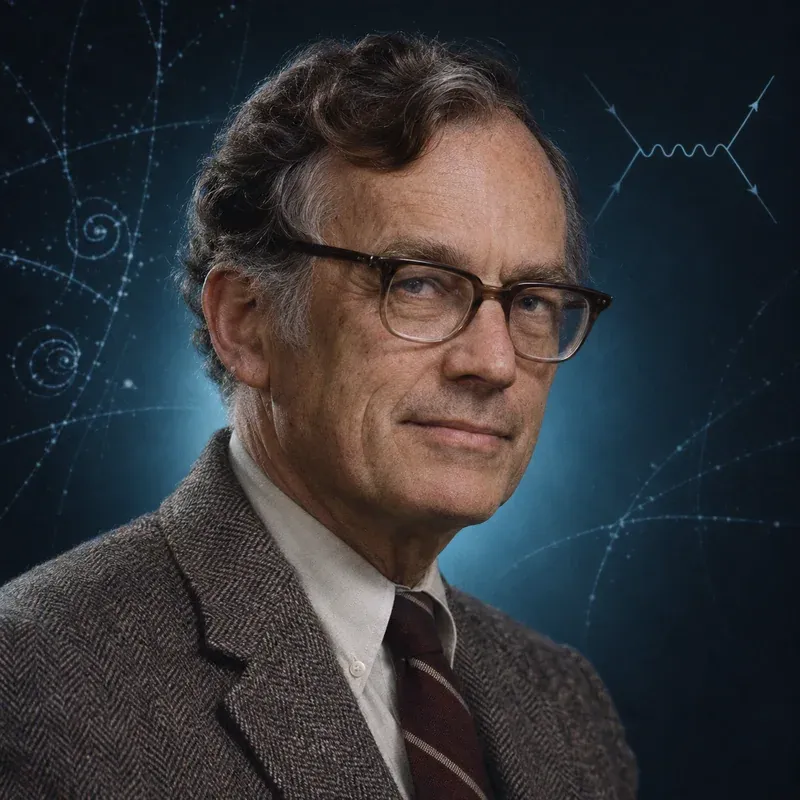
 Illustration
Stirling Auchincloss Colgate
In 1966 Colgate and Richard H. White published the first hydrodynamic computer simulations of stellar core collapse, proposing that the huge neutrino emission from the collapsing core deposits energy in the outer layers and drives the supernova explosion, leaving a neutron star. This put neutrinos at the centre of supernova theory; the neutrino burst was confirmed with SN 1987A.
- Born
- 14 November 1925
New York City, USA - Died
- 1 December 2013
Los Alamos, New Mexico, USA - Nationality
- American
- Field
- Astrophysics; plasma physics; nuclear weapons physics
- Institutions
- Lawrence Livermore National Laboratory, Los Alamos National Laboratory, New Mexico Institute of Mining and Technology
Early life and education
Stirling Auchincloss Colgate was born in New York City in 1925 into the family that founded the Colgate toothpaste company. He attended the Los Alamos Ranch School in New Mexico until it closed in 1942, when the site was taken over for the Manhattan Project. He entered Cornell University in 1943 to study electrical engineering, served in the merchant marine from 1944 to 1946, and returned to Cornell for a bachelor's degree in 1948 and a PhD in nuclear physics in 1951, followed by a postdoctoral position at Berkeley.
Weapons physics and test monitoring
In 1952 Colgate joined the new Livermore laboratory founded by Edward Teller. He worked on diagnostic measurements for hydrogen-bomb tests, analysing radioactive debris collected by aircraft and measuring neutron and gamma-ray energies, including at the 1954 Castle Bravo test. Teller then encouraged him to work on fusion and plasma physics. In 1959 he advised the US State Department at the Geneva test-ban talks. He proposed detecting nuclear explosions in space with satellites, the idea behind the later Vela satellites, and warned that supernovae could produce false alarms. That question led him to ask how supernovae actually explode.
Key contributions
With Montgomery Johnson he published 'Hydrodynamic origin of cosmic rays' in 1960, proposing that supernova shocks accelerate cosmic rays. To test the idea, Colgate started a computing project with Richard White at Livermore in 1961. White's simulations showed that the shock alone was too weak, and the team revised its picture. In a core-collapse supernova the iron core of a massive star collapses within a fraction of a second to nuclear density. The gravitational energy released, around 10⁴⁶ joules, is far more than the visible explosion needs, and almost all of it is carried off by neutrinos.
Colgate and White's 1966 paper in the Astrophysical Journal proposed that the neutrinos escaping from the newly formed neutron star deposit part of their energy in the surrounding layers and push them outward. This was the first neutrino-driven supernova mechanism, and it made neutron stars, still hypothetical at the time, the natural remnant. Later work by James Wilson and Hans Bethe refined it into the delayed neutrino-heating mechanism. The neutrino burst of SN 1987A in 1987 confirmed that core collapse releases its energy as supernova neutrinos.
Colgate also worked on the other main type of supernova. In 1969, with Christopher McKee, he showed that the light of thermonuclear (Type Ia) supernovae can be powered by the radioactive decay of nickel-56 to cobalt-56 and then iron-56, an explanation still accepted.
Later work
From 1965 to 1974 Colgate was president of the New Mexico Institute of Mining and Technology, where he also led research in astrophysics and atmospheric physics. From 1975 he worked at Los Alamos National Laboratory, and in 1984 he was one of the founders of the Santa Fe Institute. He received the Bruno Rossi Prize of the American Astronomical Society in 1990. He kept working, partly in his own laboratory at New Mexico Tech, until mid-2013 and died in Los Alamos on 1 December 2013.
Known for
- Neutrino-driven core-collapse supernova model (Colgate & White 1966)
- Early numerical supernova simulations
- President of New Mexico Tech
Chronology
- 1961Starts supernova simulation project with White at Livermore
- 1966Colgate & White, ApJ paper on neutrino-driven supernovae
- 1987SN 1987A neutrino burst observed
- 1990Bruno Rossi Prize
Original papers
- S. A. Colgate, R. H. White, The hydrodynamic behavior of supernovae explosions, Astrophys. J. 143, 626 (1966)DOI 10.1086/148549
Experiments
Connected people
Frequently asked questions
Was Stirling Colgate related to the toothpaste company?
Yes. He was a member of the Colgate family that founded the company, though he spent his career in physics.
What did Colgate predict about supernovae and neutrinos?
With Richard White he predicted in 1966 that a collapsing stellar core forms a neutron star and emits most of its energy as neutrinos, and that these neutrinos help drive the explosion. The first part was confirmed directly by the SN 1987A neutrino detection.
How did nuclear test monitoring lead him to supernovae?
While advising on test-ban verification in 1959 he realised that satellites built to detect nuclear explosions in space might also be triggered by supernovae. This made him study supernova physics in detail.
On the timeline
Mentioned in 11 pages
Lessons 1
Milestones 3
Last updated: · Editorial standard
Cite this page
Text
Neutrino Atlas (2026). “Stirling Auchincloss Colgate”. Retrieved 22 November 2026, from https://neutrino-atlas.com/people/stirling-colgate/BibTeX
@misc{neutrinoatlas2026peoplestirlingcolgate,
  title        = {Stirling Auchincloss Colgate},
  author       = {{Neutrino Atlas}},
  year         = {2026},
  url          = {https://neutrino-atlas.com/people/stirling-colgate/},
  note         = {Accessed 2026-11-22},
  language     = {english}
}