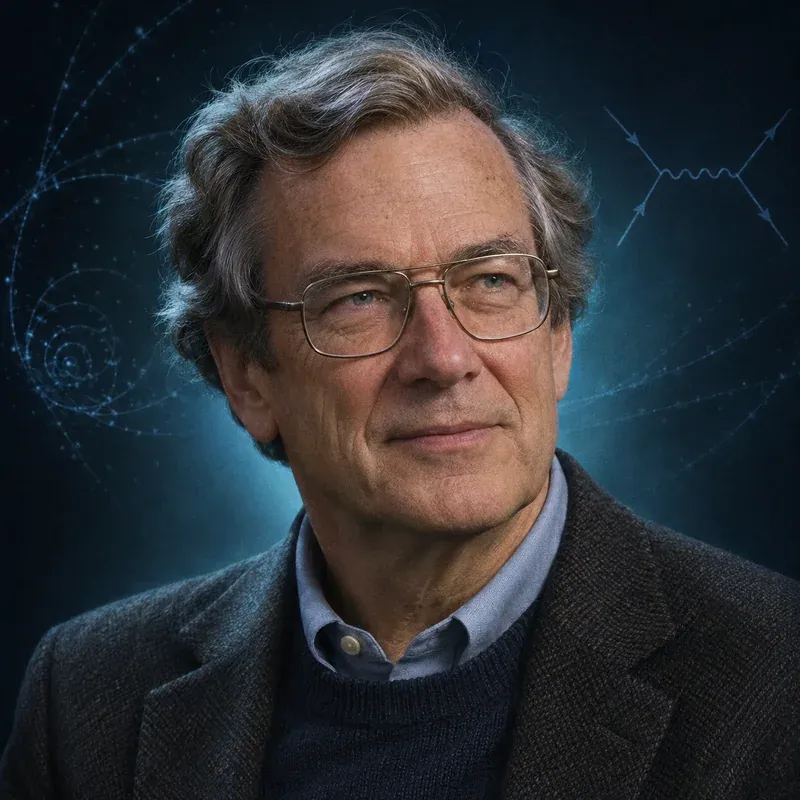
 Illustration
Richard H. White
At Livermore, White adapted weapons-physics hydrodynamics codes, adding gravity and dense-matter physics, to simulate collapsing stellar cores. These simulations, published with Stirling Colgate in 1966, predicted a large neutrino release during core collapse and proposed neutrino energy deposition as the explosion mechanism.
- Nationality
- American
- Field
- Computational physics; astrophysics
- Institutions
- Lawrence Livermore National Laboratory
Background
Richard Harold White was born on 9 November 1934 in Salem, Oregon. He studied physics at Pomona College in California and graduated with honours in 1956. The same year he joined the nuclear weapons laboratory at Livermore, now Lawrence Livermore National Laboratory, where he would spend about forty years, completing graduate work at the University of California, Berkeley, alongside his job. In the 1950s and 1960s Livermore had some of the most powerful scientific computers in the world, and White became an expert in the hydrodynamics codes written to model nuclear explosions.
Simulating a collapsing star
In 1961 Stirling Colgate proposed using Livermore's computers to model the shock waves of a supernova, which he suspected were a source of cosmic rays. White took on the computing. He adapted the weapons-physics techniques by adding gravity and the properties of matter expected in the dense core of a star about to explode, first with Newtonian gravity and then with electron capture and neutron physics.
The results did not match the picture then current, the model of Fred Hoyle and William Fowler, in which the outer layers ignite and blow off. In White's calculations the core simply kept collapsing, and the explosion was directed inward. They also showed that a collapsing core must release an enormous number of neutrinos, since electron capture on protons turns the core into neutron-rich matter and the gravitational binding energy has to go somewhere.
Colgate and White's 1966 Astrophysical Journal paper 'The hydrodynamic behavior of supernovae explosions' drew the conclusion: the core collapses to a neutron star, and the neutrinos streaming out of it deposit part of their energy in the overlying layers and drive the explosion. It was the first time neutrinos were given an active role in the supernova mechanism. Their simple treatment of neutrino transport overestimated the energy deposited, and later work by James Wilson and Hans Bethe showed that the heating acts more slowly, after the shock has stalled. The basic idea, however, survived.
Relativistic collapse and black holes
White also helped bring general relativity into these calculations. In 1963 he helped organise a summer institute at Livermore that brought in John Wheeler and several of his students. By the end of 1964 he had a program that followed stellar collapse using Einstein's equations, and with Michael May he published 'Hydrodynamic calculations of general-relativistic collapse' in Physical Review in 1966. The calculations showed that some cores settle into stable neutron stars, while more massive ones collapse without limit. Together with Roger Penrose's 1965 singularity theorem, this supported the conclusion that the most massive cores end as what Wheeler would later call black holes.
Legacy
In February 1987 the SN 1987A supernova produced about two dozen neutrino events in Kamiokande-II, IMB and Baksan, matching the burst predicted by collapse calculations of the kind White had pioneered. He retired from Livermore in 1996, appeared in a PBS Nova episode about his work, and died in May 2024 at the age of 89.
Known for
- Colgate–White neutrino-driven supernova simulations (1966)
- Early numerical relativistic gravitational collapse
Chronology
- 1961Begins supernova modelling with Colgate
- 1966Colgate & White supernova paper
Original papers
- S. A. Colgate, R. H. White, The hydrodynamic behavior of supernovae explosions, Astrophys. J. 143, 626 (1966)DOI 10.1086/148549
Experiments
Connected people
Frequently asked questions
What did Colgate and White show in 1966?
That the collapse of a massive star's core should produce a neutron star and a huge burst of neutrinos, and that energy deposited by these neutrinos in the outer layers could make the star explode. This put supernova neutrinos at the centre of supernova theory.
Was the Colgate–White mechanism correct?
In outline. Their neutrino heating acted too fast and too strongly because of simplified transport. The modern delayed neutrino-heating mechanism of Bethe and Wilson keeps the core idea but has the neutrinos revive a stalled shock over a few hundred milliseconds.
On the timeline
Mentioned in 8 pages
Last updated: · Editorial standard
Cite this page
Text
Neutrino Atlas (2026). “Richard H. White”. Retrieved 22 November 2026, from https://neutrino-atlas.com/people/richard-h-white/BibTeX
@misc{neutrinoatlas2026peoplerichardhwhite,
  title        = {Richard H. White},
  author       = {{Neutrino Atlas}},
  year         = {2026},
  url          = {https://neutrino-atlas.com/people/richard-h-white/},
  note         = {Accessed 2026-11-22},
  language     = {english}
}