1985Theory
Delayed neutrino-heating supernova mechanism
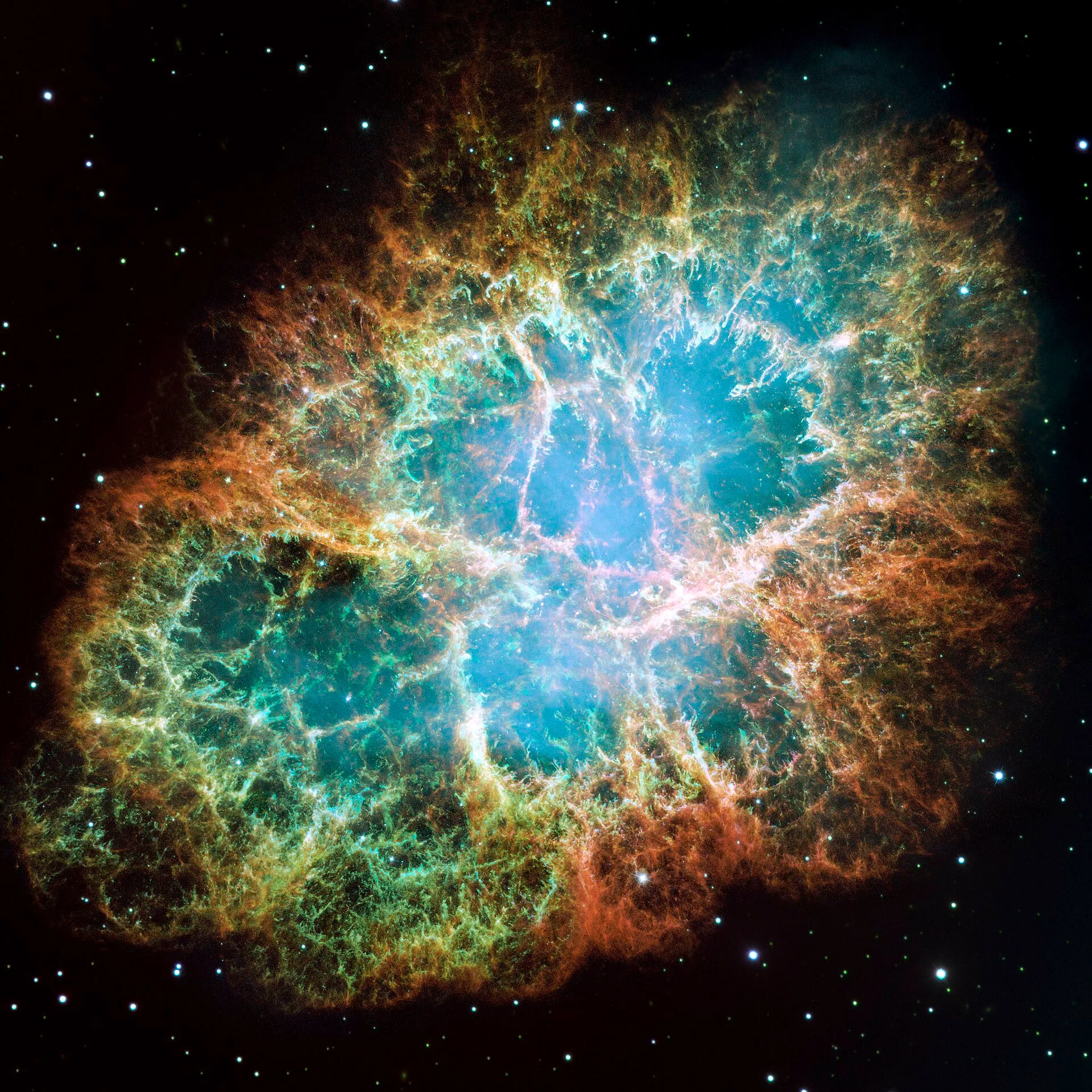
Using simulations by James Wilson, Hans Bethe and Wilson argued that a stalled supernova shock can be revived about a second after core bounce by neutrinos depositing energy behind it. This 'delayed neutrino-driven' mechanism is the leading paradigm for core-collapse supernovae. Modern three-dimensional simulations, including work by Hans-Thomas Janka's group, now achieve explosions with it, though details are still being studied.
- Date
- 1985
- Kind of event
- Theory
- People involved
- Hans Bethe, James Ricker Wilson, Hans-Thomas Janka
The situation before
In 1966 Stirling Colgate and Richard H. White had suggested that neutrinos from a collapsing stellar core blow off the outer layers. Around 1980 the favoured picture was a different one, the 'prompt' explosion: the inner core overshoots nuclear density, bounces, and the resulting shock wave carries the star apart directly. Work in which Hans Bethe took part, together with Gerald Brown and others, made this picture quantitative. But as computer models improved, the prompt shock kept failing. It lost energy breaking iron nuclei into free nucleons and to neutrino emission, and stalled within a few hundred kilometres of the centre.
What happened
At Lawrence Livermore National Laboratory, James R. Wilson ran one-dimensional hydrodynamic simulations with neutrino transport. In calculations around 1982 he followed a model for longer than usual and saw that the stalled shock began to move outward again after several hundred milliseconds. The cause was heating: a small fraction of the electron neutrinos and antineutrinos streaming from the newly formed neutron star was absorbed by nucleons in the region just behind the shock.
Bethe, then at Cornell, analysed why this worked. In 1985 Bethe and Wilson published 'Revival of a stalled supernova shock by neutrino heating' in The Astrophysical Journal. They identified a 'gain region' between the neutrinosphere and the shock where heating by neutrino absorption outweighs cooling by emission, and showed that only about one percent of the neutrino energy needs to be deposited there to give an explosion of the observed strength, about 10⁵¹ erg.
Reaction
The paper turned the supernova mechanism debate towards neutrinos. Two years later the detection of about two dozen neutrinos from SN 1987A confirmed that a core collapse emits a few times 10⁵³ erg in neutrinos over about ten seconds, exactly the reservoir the delayed mechanism draws on. However, the detected events could not show how the explosion itself was driven, and later spherical models with improved physics usually failed to explode, so the mechanism remained debated.
Consequences
- In the 1990s two-dimensional simulations by several groups, among them Hans-Thomas Janka and Ewald Müller in Garching, showed that convection behind the shock makes neutrino heating more efficient.
- In the 2000s the standing accretion shock instability was found to help further.
- Since the 2010s fully three-dimensional models with detailed neutrino transport, from Garching, Princeton and other groups, obtain explosions for many progenitor stars.
- Open questions include the explosion energies, the role of rotation and magnetic fields, and collective neutrino oscillations.
A future galactic supernova seen by large detectors would record the time structure and flavour content of supernova neutrinos in detail and test the delayed mechanism directly.
Frequently asked questions
Who proposed the delayed neutrino-driven supernova mechanism?
James R. Wilson found it in his simulations in the early 1980s, and he and Hans Bethe described and explained it in The Astrophysical Journal in 1985.
Why does the shock stall?
It loses energy by breaking up iron nuclei and through neutrino emission, and stops a few hundred kilometres from the centre.
Is the mechanism proven?
It is the leading explanation and modern 3D simulations produce explosions with it, but details are still studied, and no supernova has yet been observed with enough neutrinos to test it directly.
Original papers
- TheoryH. A. Bethe, J. R. Wilson, Revival of a stalled supernova shock by neutrino heating, Astrophys. J. 295, 14 (1985)DOI 10.1086/163343
Concepts
Mentioned in 1 page
Lessons 1
Last updated: · Editorial standard
Cite this page
Text
Neutrino Atlas (2026). “1985: Delayed neutrino-heating supernova mechanism”. Retrieved 22 November 2026, from https://neutrino-atlas.com/timeline/1985-bethe-wilson-delayed-explosion/BibTeX
@misc{neutrinoatlas2026hewilsondelayedexplosion,
  title        = {1985: Delayed neutrino-heating supernova mechanism},
  author       = {{Neutrino Atlas}},
  year         = {2026},
  url          = {https://neutrino-atlas.com/timeline/1985-bethe-wilson-delayed-explosion/},
  note         = {Accessed 2026-11-22},
  language     = {english}
}