1988Award
Nobel Prize for the muon neutrino
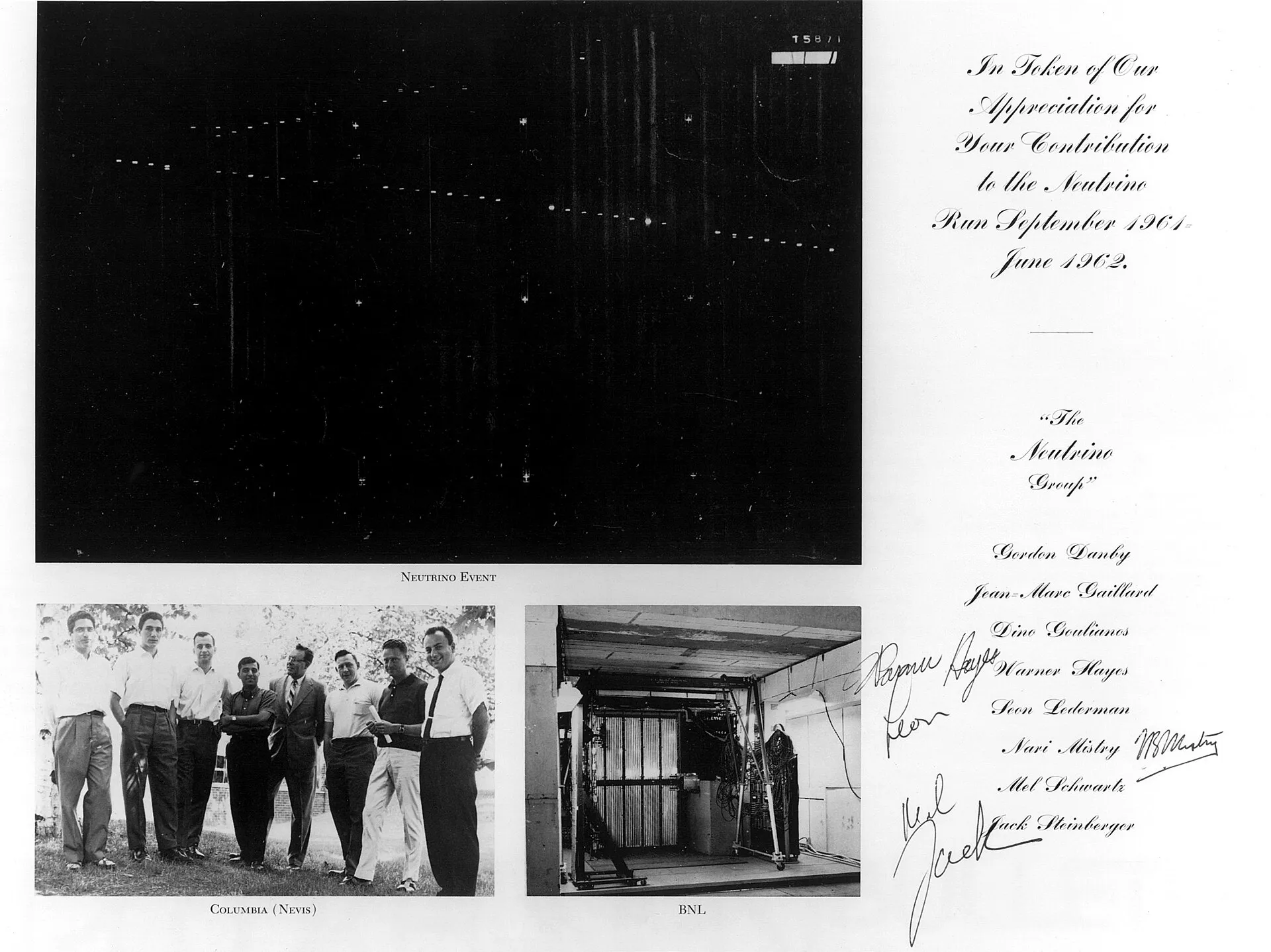
Leon Lederman, Melvin Schwartz and Jack Steinberger received the 1988 Nobel Prize in Physics 'for the neutrino beam method and the demonstration of the doublet structure of the leptons through the discovery of the muon neutrino'. Their 1962 Brookhaven experiment created the first accelerator neutrino beam. The method underpins all modern long-baseline oscillation experiments.
- Date
- 1988
- Kind of event
- Award
- People involved
- Leon M. Lederman, Melvin Schwartz, Jack Steinberger
- Experiments
- Brookhaven Two-Neutrino Experiment
The situation before
When the prize was announced, the experiment it honoured was 26 years old. In the late 1950s two problems blocked progress in weak interactions. Theories predicted that weak cross sections grow with energy, but there was no way to send high-energy neutrinos into a detector. And physicists wondered why the muon never decays into an electron and a photon. One explanation was that the neutrino emitted with a muon differs from the one emitted with an electron. In 1959 and 1960 Bruno Pontecorvo and, independently, Melvin Schwartz proposed making a neutrino beam from the decay of pions produced at an accelerator.
What was honoured
In 1962 Schwartz, Leon Lederman and Jack Steinberger, all then at Columbia University, carried out the idea at Brookhaven's new Alternating Gradient Synchrotron with four colleagues. Protons struck a beryllium target; the pions flew 21 m and decayed into muons and neutrinos. A wall of steel 13.5 m thick, cut from scrapped warships, stopped everything except the neutrinos. Behind it stood a 10-tonne spark chamber of aluminium plates. Over several months a few dozen neutrino interactions were recorded. They produced long, penetrating muon tracks but essentially no electron showers. The neutrinos from pion decay therefore made only muons: they were a distinct muon neutrino. The result appeared in Physical Review Letters in July 1962.
The award
On 19 October 1988 the Royal Swedish Academy of Sciences awarded the Nobel Prize in Physics jointly to Lederman, Schwartz and Steinberger 'for the neutrino beam method and the demonstration of the doublet structure of the leptons through the discovery of the muon neutrino'. The press release stressed two achievements: a method for high-energy neutrino experiments, and the evidence for families of paired particles, with the electron and muon each having their own neutrino. By then the third family had been found as well, through the tau lepton in 1975 and the bottom quark, discovered by Lederman's group at Fermilab in 1977.
Reaction
The long delay was widely remarked upon. By 1988 each laureate had gone on to other major work: Lederman had been director of Fermilab since 1979; Steinberger led the ALEPH experiment at CERN's LEP collider, which began taking data the following year; Schwartz had left research for business. Pontecorvo, who had proposed the same beam idea and the two-neutrino hypothesis independently, was not among the laureates.
Why it matters
- Neutrino beams became a standard tool. At CERN in 1973 the Gargamelle bubble chamber used one to discover neutral currents, a key confirmation of electroweak theory.
- Beam experiments probed the inner structure of protons and neutrons through deep inelastic scattering, as the press release noted.
- The same basic layout – target, focusing, decay tunnel, shielding, detector – underlies the long-baseline experiments K2K, MINOS, T2K, NOvA and DUNE.
- The idea that each charged lepton has its own neutrino became lepton flavour; oscillation experiments later showed that this flavour is not conserved as neutrinos travel.
Frequently asked questions
Who won the 1988 Nobel Prize in Physics?
Leon Lederman, Melvin Schwartz and Jack Steinberger, for the neutrino beam method and the discovery of the muon neutrino.
When was the experiment done?
In 1962 at Brookhaven National Laboratory, 26 years before the prize.
Why was the muon neutrino important?
It showed that leptons come in pairs, each charged lepton with its own neutrino, the pattern on which the three-generation Standard Model is built.
Original papers
- DiscoveryG. Danby et al., Observation of High-Energy Neutrino Reactions and the Existence of Two Kinds of Neutrinos, Phys. Rev. Lett. 9, 36 (1962)DOI 10.1103/PhysRevLett.9.36
Concepts
Mentioned in 1 page
Lessons 1
Last updated: · Editorial standard
Cite this page
Text
Neutrino Atlas (2026). “1988: Nobel Prize for the muon neutrino”. Retrieved 22 November 2026, from https://neutrino-atlas.com/timeline/1988-nobel-lederman-schwartz-steinberger/BibTeX
@misc{neutrinoatlas2026ermanschwartzsteinberger,
  title        = {1988: Nobel Prize for the muon neutrino},
  author       = {{Neutrino Atlas}},
  year         = {2026},
  url          = {https://neutrino-atlas.com/timeline/1988-nobel-lederman-schwartz-steinberger/},
  note         = {Accessed 2026-11-22},
  language     = {english}
}