1989Discovery
Kamiokande sees solar neutrinos in real time
After upgrades to reduce radioactive backgrounds, Kamiokande-II detected boron-8 solar neutrinos through elastic scattering on electrons, recording the time, energy and direction of each event. The direction pointed back to the Sun, proving the neutrinos were solar. The measured flux was about half the solar-model prediction, independently confirming the solar neutrino problem.
- Date
- 1989
- Kind of event
- Discovery
- People involved
- Masatoshi Koshiba, Yoji Totsuka, Yōichirō Suzuki
- Experiments
- Kamiokande
The situation before
For twenty years the only solar neutrino measurement came from Raymond Davis's chlorine detector at Homestake. It counted argon atoms extracted every few weeks, so it could say neither when a neutrino had arrived nor from which direction. Its rate, about a third of the prediction, was doubted by some who suspected the radiochemistry or the standard solar model. Some also read a possible anticorrelation with the sunspot cycle into the Homestake data. An independent technique was needed.
What happened
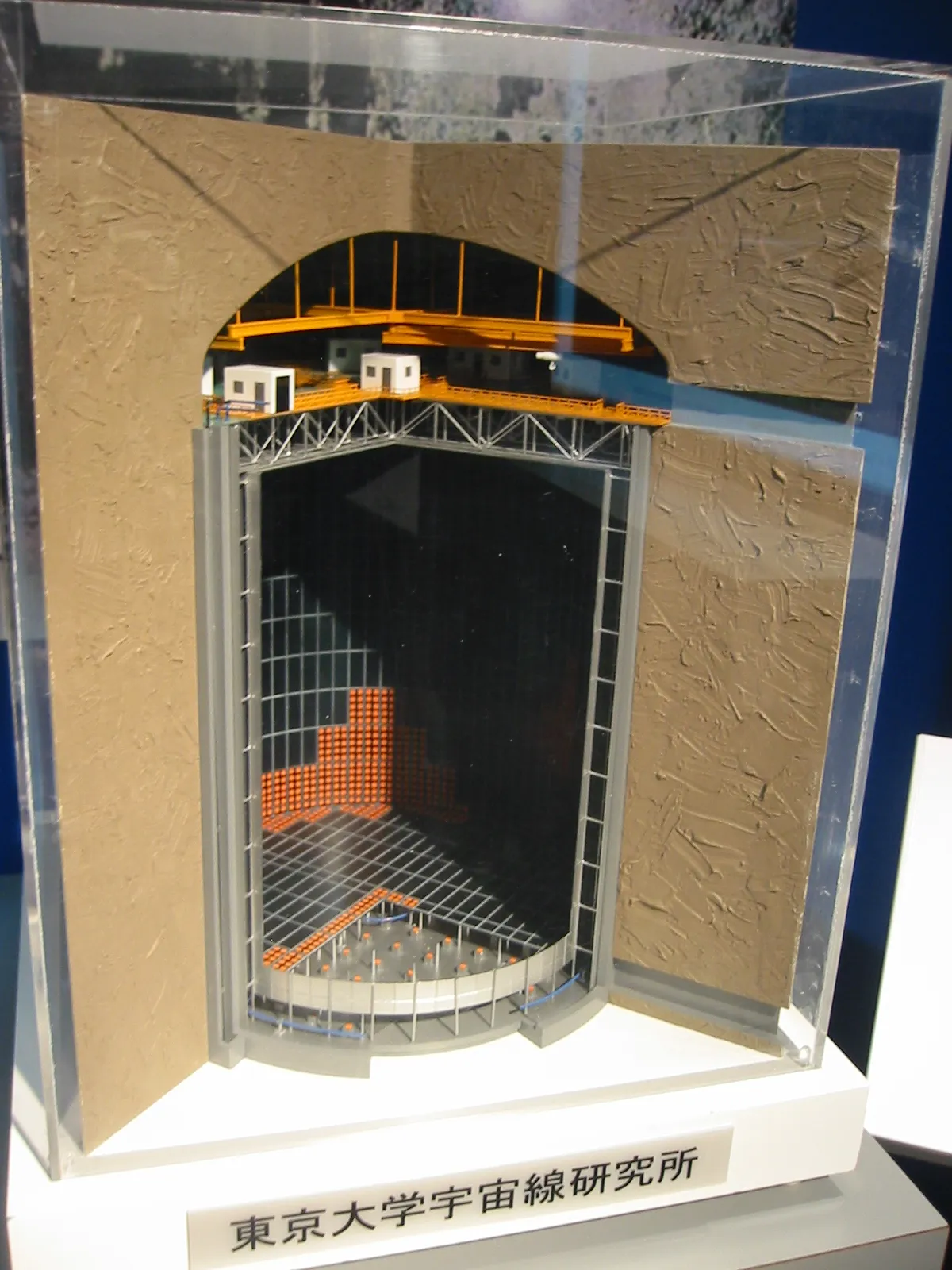
Kamiokande had been built to search for proton decay. To reach the energies of boron-8 solar neutrinos, up to about 15 MeV, the collaboration under Masatoshi Koshiba, with Yoji Totsuka and Yoichiro Suzuki among its leaders, upgraded the detector to Kamiokande-II between 1984 and 1986. They sealed the tank against radon from the mine air, purified the water, added an outer detector against gamma rays from the rock, and installed new electronics from the University of Pennsylvania group. The trigger threshold fell to a few MeV.
Solar neutrinos scatter elastically on electrons in water and push them forward, nearly in the neutrino's direction. Each recoil electron produces a Cherenkov ring, giving time, energy and direction. In data taken from January 1987 to May 1988, the collaboration found a clear excess of events pointing away from the Sun, on top of an isotropic background. The paper 'Observation of ⁸B solar neutrinos in the Kamiokande-II detector' appeared in Physical Review Letters in July 1989. The measured flux was
Reaction
The peak in the angular distribution settled one question at once: the neutrinos came from the Sun. Their deficit, now measured with a completely different method, made the solar neutrino problem much harder to attribute to the Homestake technique. The two numbers did not match exactly, though. Kamiokande saw about half of the predicted boron-8 flux, while Homestake, sensitive also to lower-energy neutrinos, saw about a third. Kamiokande found no time variation of the flux with solar activity, weakening explanations based on a neutrino magnetic moment. In 1990 the collaboration published 'Results from one thousand days of real-time, directional solar-neutrino data', which confirmed the deficit with smaller uncertainties.
Why it matters
- It was the first real-time, directional observation of solar neutrinos, and Koshiba's share of the 2002 Nobel Prize in Physics cited it alongside SN 1987A.
- The method of elastic neutrino-electron scattering was carried over to Super-Kamiokande, which from 1996 measured the boron-8 flux with tens of thousands of events.
- The difference between experiments with different energy thresholds hinted that the suppression depended on energy, which pointed towards neutrino properties and the MSW effect rather than a cooler Sun.
- Combined with SNO's charged-current rate in 2001, the elastic-scattering measurement proved that solar neutrinos change flavour.
Frequently asked questions
When did Kamiokande first see solar neutrinos?
In data from 1987 and 1988, published in Physical Review Letters in July 1989.
Why was the direction important?
Recoil electrons point back to the neutrino source. A peak in the direction away from the Sun proved that the events were solar neutrinos.
How many neutrinos did Kamiokande see compared with prediction?
About half of the boron-8 flux predicted by the standard solar model, while Homestake at the time saw about a third of its prediction.
Original papers
- DiscoveryK. S. Hirata et al. (Kamiokande-II), Observation of 8B solar neutrinos in the Kamiokande-II detector, Phys. Rev. Lett. 63, 16 (1989)DOI 10.1103/PhysRevLett.63.16
Concepts
Mentioned in 1 page
Lessons 1
Last updated: · Editorial standard
Cite this page
Text
Neutrino Atlas (2026). “1989: Kamiokande sees solar neutrinos in real time”. Retrieved 22 November 2026, from https://neutrino-atlas.com/timeline/1989-kamiokande-solar-realtime/BibTeX
@misc{neutrinoatlas20269kamiokandesolarrealtime,
  title        = {1989: Kamiokande sees solar neutrinos in real time},
  author       = {{Neutrino Atlas}},
  year         = {2026},
  url          = {https://neutrino-atlas.com/timeline/1989-kamiokande-solar-realtime/},
  note         = {Accessed 2026-11-22},
  language     = {english}
}