1992Discovery
GALLEX observes solar pp neutrinos
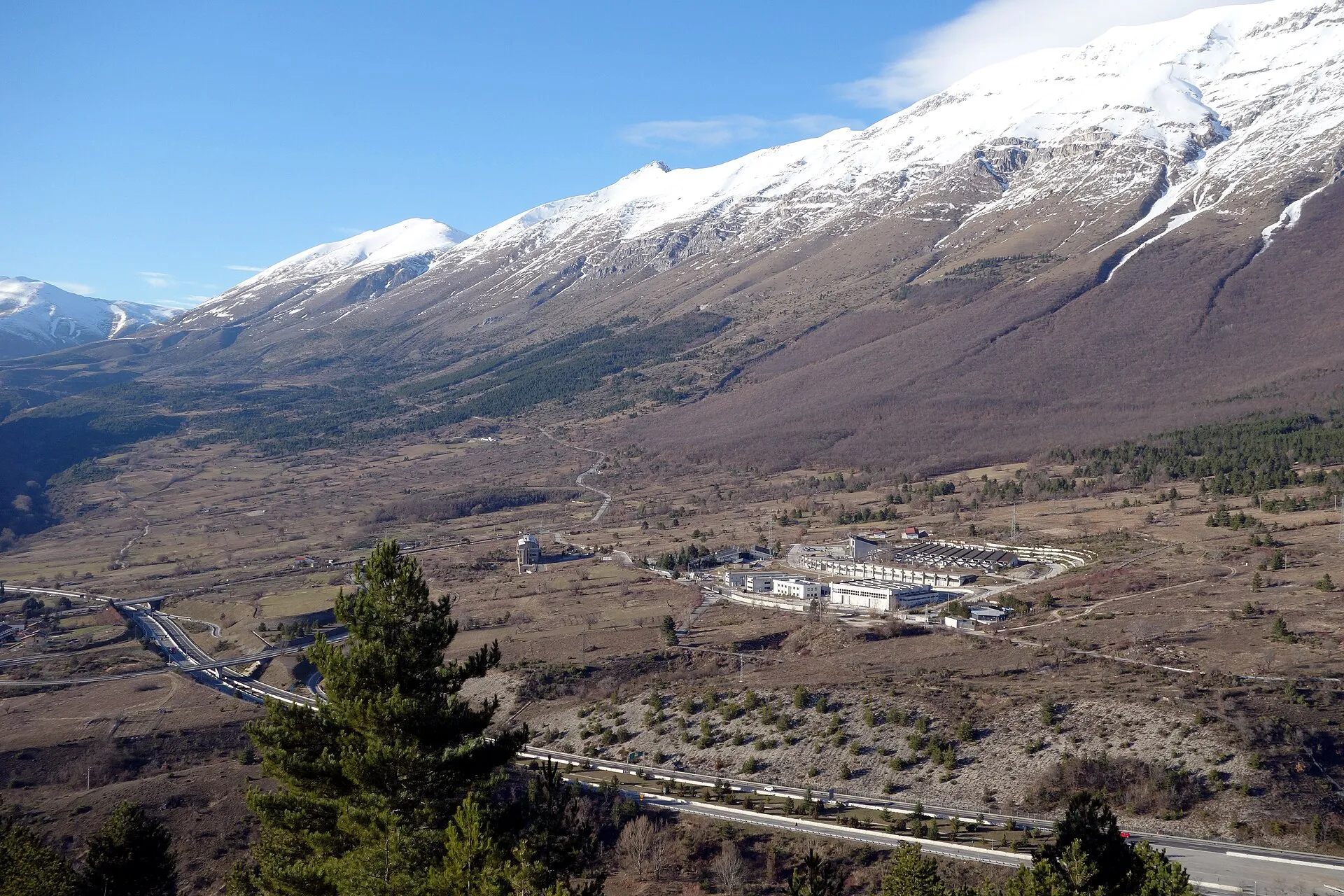
GALLEX, a European experiment led by Till Kirsten with 30 tonnes of gallium in gallium chloride solution at the Gran Sasso laboratory, reported its first results in June 1992. The measured rate was well above what higher-energy neutrinos alone could produce, providing the first observation of pp neutrinos from the primary fusion reaction in the Sun. It confirmed that the Sun is powered by hydrogen fusion, while the rate remained below prediction. Later source calibrations with chromium-51 validated the method.
- Date
- 1992
- Kind of event
- Discovery
- People involved
- Till A. Kirsten, Wolfgang Hampel
The situation before
In 1992 the solar neutrino problem rested on experiments that saw only the higher-energy neutrinos from boron-8 and beryllium-7, which make up a tiny fraction of the solar flux and depend steeply on the core temperature. The fundamental pp chain reaction, p + p → d + e⁺ + νₑ, had never been observed through its neutrinos. The first gallium results from SAGE, published in December 1991, had shown almost no signal, which raised the alarming possibility that even these neutrinos were missing.
What happened
GALLEX was a European collaboration with groups from Germany, France, Italy, Israel and the United States, led by Till Kirsten of the Max Planck Institute for Nuclear Physics in Heidelberg, with Wolfgang Hampel among the key figures. Its detector, in Hall A of the Gran Sasso underground laboratory in Italy, held 30.3 tonnes of gallium in about 100 tonnes of a concentrated gallium chloride solution. Neutrinos converted gallium-71 into germanium-71, which forms volatile germanium tetrachloride. Every three to four weeks this was flushed out with nitrogen, converted into germane gas and filled into miniature proportional counters, where the decays of the roughly dozen germanium atoms were counted – the gallium-germanium method.
Solar runs started in May 1991. In June 1992 the collaboration presented its first result at the Neutrino '92 conference in Granada, and the paper appeared in Physics Letters B in July:
The essential point was not the deficit but its size. Neutrinos from boron-8 and beryllium-7 alone, at the rates allowed by Homestake and Kamiokande, could account for only a fraction of the measured rate. The remainder had to come from pp neutrinos. GALLEX had observed the primary fusion reaction of the Sun.
Reaction
The result was greeted as direct evidence that the Sun shines by hydrogen fusion, a question settled theoretically since Hans Bethe's work in 1938 but never tested in the solar core. It did not end the solar neutrino problem: the rate was still only about 60 percent of the prediction. Physics Today headlined that the GALLEX data could not 'quite lay the solar neutrino problem to rest'. Within a couple of years SAGE, with more data, confirmed a similar rate.
Consequences
- In 1994 and 1995 GALLEX exposed its tank to an artificial chromium-51 neutrino source of more than 60 PBq and recovered the expected signal within about 10 percent, showing that the method worked.
- The experiment ended in 1997, with a final rate of about 78 SNU; its successor GNO ran until 2003, and the combined result was about 69 SNU.
- The gallium rate, compared with chlorine and water results, implied that intermediate-energy beryllium-7 neutrinos were strongly suppressed – a pattern that astrophysics could not easily explain but the MSW effect could.
- The source tests of GALLEX and SAGE, together, later formed part of the gallium anomaly.
- Borexino measured pp neutrinos in real time in 2014.
Frequently asked questions
When were solar pp neutrinos first observed?
GALLEX reported the first evidence in June 1992, from data taken at Gran Sasso since May 1991.
Who led GALLEX?
Till Kirsten of the Max Planck Institute for Nuclear Physics in Heidelberg.
Did GALLEX solve the solar neutrino problem?
No. It showed that the Sun is powered by hydrogen fusion, but its rate was still about 60 percent of the prediction. The deficit was explained only in 2001–2002 by flavour change.
Original papers
- First resultP. Anselmann et al. (GALLEX), Solar neutrinos observed by GALLEX at Gran Sasso, Phys. Lett. B 285, 376 (1992)
- Final resultF. Kaether et al., Reanalysis of the GALLEX solar neutrino flux and source experiments, Phys. Lett. B 685, 47 (2010)arXiv:1001.2731
Concepts
Mentioned in 1 page
Lessons 1
Last updated: · Editorial standard
Cite this page
Text
Neutrino Atlas (2026). “1992: GALLEX observes solar pp neutrinos”. Retrieved 22 November 2026, from https://neutrino-atlas.com/timeline/1992-gallex-pp-neutrinos/BibTeX
@misc{neutrinoatlas2026ine1992gallexppneutrinos,
  title        = {1992: GALLEX observes solar pp neutrinos},
  author       = {{Neutrino Atlas}},
  year         = {2026},
  url          = {https://neutrino-atlas.com/timeline/1992-gallex-pp-neutrinos/},
  note         = {Accessed 2026-11-22},
  language     = {english}
}