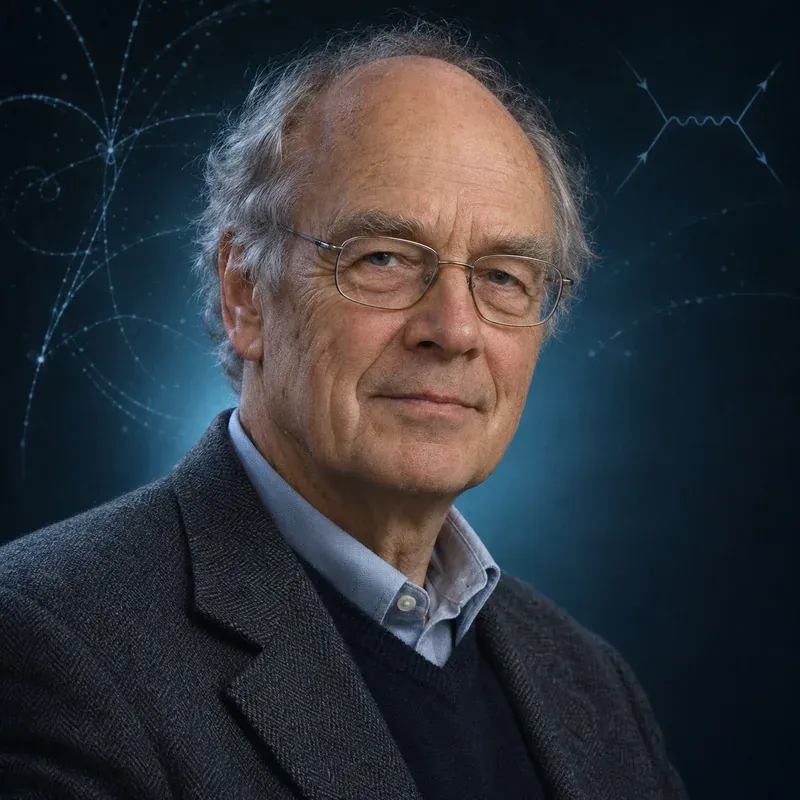
 Illustration
Till A. Kirsten
Kirsten hosted the first GALLEX planning meeting at MPIK Heidelberg on 12 January 1977 and, after Kamiokande's results, led the Max Planck group's 1984 proposal for the gallium experiment. GALLEX at Gran Sasso (data-taking 1991–1997, followed by GNO to 2003) made the first detection of low-energy pp solar neutrinos in 1992 and confirmed a deficit pointing to neutrino properties beyond the Standard Model.
- Nationality
- German
- Field
- Nuclear astrophysics, radiochemistry
- Institutions
- Heidelberg University (PhD 1964), Max-Planck-Institut für Kernphysik, Heidelberg
Background
Till A. Kirsten is a German nuclear chemist and astrophysicist who spent his career at the Max-Planck-Institut für Kernphysik (MPIK) in Heidelberg. He received his doctorate from Heidelberg University in 1964 under Wolfgang Gentner, the founding director of MPIK. His early research belonged to the institute's strong tradition in noble-gas geochemistry and cosmochemistry, in which tiny quantities of rare isotopes extracted from rocks and meteorites are counted to reconstruct their history. This experience with extracting and counting a handful of atoms proved decisive for his later move into solar neutrino physics.
Path to GALLEX
In the 1970s the Homestake chlorine experiment of Raymond Davis Jr. detected only about a third of the predicted flux. Its reaction, however, was sensitive mainly to the rare high-energy boron-8 neutrinos, whose predicted flux depends steeply on the temperature of the solar core. The way to decide whether the solar neutrino problem lay in the Sun or in the neutrinos was to measure the pp neutrinos from the first step of hydrogen fusion. Their flux is fixed by the Sun's luminosity, but their energy is below 420 keV. The only practical reaction was capture on gallium-71, which turns it into germanium-71 with a threshold of 233 keV.
On 12 January 1977 Kirsten hosted the first planning meeting for a gallium experiment in his office at MPIK, with Davis, Wolfgang Hampel, Oliver Schaeffer of Brookhaven and the astrophysicist Donald Clayton. A joint Brookhaven–Heidelberg proposal in 1978 was not funded, and American full-scale proposals also failed. In 1984 Kirsten's Max Planck group put forward its own proposal, which led to the European-led GALLEX collaboration with partners from France, Italy, Israel, Poland and the United States. Kirsten became its principal investigator and spokesperson.
Key contributions
GALLEX was installed at the Gran Sasso laboratory in Italy. Its tank held 101 tonnes of gallium chloride solution containing 30.3 tonnes of gallium. Every few weeks the few atoms of germanium-71 produced by neutrinos were flushed out as a volatile chloride, converted to germane gas and counted in small proportional counters through their decay with an 11.4-day half-life, a textbook example of radiochemical detection.
Data taking began in May 1991, and in 1992 GALLEX published the first observation of solar pp neutrinos. The rate, later expressed as about 70 SNU, was well below the solar-model prediction of about 128 SNU, yet high enough to show that the pp reaction powers the Sun. Since the pp flux is hard to change in any solar model, the remaining deficit pointed to new neutrino properties, later explained by flavour oscillations with large mixing. To exclude chemical or detector artefacts, the collaboration exposed the gallium to intense chromium-51 neutrino sources and added arsenic-71 as a tracer; the chemistry worked as expected. The source tests, together with those of SAGE, later fed the debate on the gallium anomaly.
Later work
GALLEX ended in 1997 and was succeeded by the Gallium Neutrino Observatory (GNO), which ran until 2003. At the 2018 International Solar Neutrino Conference in Dresden he gave an invited talk tracing the path from radiochemical to real-time detection of solar neutrinos, the approach later taken by experiments such as Borexino, also at Gran Sasso. The independent check of GALLEX came from the SAGE experiment led by Vladimir Gavrin, which used metallic gallium at Baksan and found a compatible rate.
Known for
- Principal investigator / leader of GALLEX
- Discovery of solar pp neutrinos (1992)
- Noble-gas geochemistry
Chronology
- 1964PhD under Wolfgang Gentner, Heidelberg
- 1977First GALLEX planning meeting
- 1984MPIK group proposes GALLEX
- 1991GALLEX starts data-taking at LNGS
- 1992First observation of solar pp neutrinos
Original papers
- P. Anselmann et al. (GALLEX), Solar neutrinos observed by GALLEX at Gran Sasso, Phys. Lett. B 285, 376 (1992)DOI 10.1016/0370-2693(92)91521-A
Experiments
Connected people
- Raymond Davis Jr.
- Vladimir N. Gavrin (Vladimir Nikolaevich Gavrin)
- Wolfgang Hampel
- Ettore Fiorini
- Stefan Schönert
- Antonino Zichichi
- Rudolf Ludwig Mössbauer
- Vadim Alekseevich Kuzmin
Frequently asked questions
What did GALLEX discover?
In 1992 GALLEX made the first observation of pp neutrinos, the low-energy neutrinos from the first step of hydrogen fusion in the Sun. It confirmed that the pp chain powers the Sun, while a remaining deficit pointed to neutrino oscillations.
Why was gallium used?
Gallium-71 captures electron neutrinos with a threshold of only 233 keV, low enough for pp neutrinos. The produced germanium-71 can be extracted chemically and counted through its radioactive decay.
On the timeline
Mentioned in 13 pages
Lessons 1
Milestones 2
People 7
Last updated: · Editorial standard
Cite this page
Text
Neutrino Atlas (2026). “Till A. Kirsten”. Retrieved 22 November 2026, from https://neutrino-atlas.com/people/till-kirsten/BibTeX
@misc{neutrinoatlas2026peopletillkirsten,
  title        = {Till A. Kirsten},
  author       = {{Neutrino Atlas}},
  year         = {2026},
  url          = {https://neutrino-atlas.com/people/till-kirsten/},
  note         = {Accessed 2026-11-22},
  language     = {english}
}