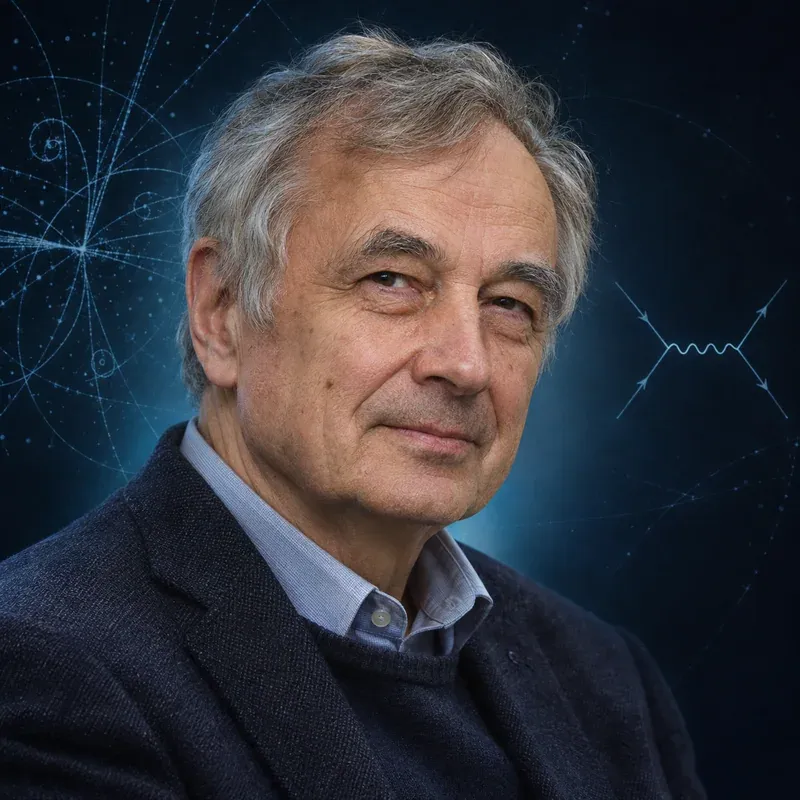
 Illustration
Vladimir N. Gavrin (Vladimir Nikolaevich Gavrin)
Gavrin's INR group began gallium laboratory work around 1975, developing extraction from metallic gallium. As leader of the Soviet–American Gallium Experiment at Baksan, which began solar measurements in December 1989, he oversaw a 1990–2007 result of about 65 SNU, roughly about 50–55 % of solar-model predictions. SAGE's chromium and argon source calibrations gave the 'gallium anomaly', later tested by BEST.
- Nationality
- Russian
- Field
- Solar neutrino physics, radiochemistry
- Institutions
- Institute for Nuclear Research (INR), Russian Academy of Sciences, Moscow, Baksan Neutrino Observatory
Background
Vladimir Nikolaevich Gavrin is a Russian experimental physicist at the Institute for Nuclear Research (INR) of the Russian Academy of Sciences in Moscow, who has also been affiliated with the Lebedev Physical Institute. He has spent most of his career on one problem: measuring the low-energy solar neutrinos with gallium. He is a full member (academician) of the Russian Academy of Sciences.
Path to gallium
In 1965 the Soviet physicist Vadim Kuzmin proposed a radiochemical detector based on the capture of electron neutrinos on gallium-71, which produces germanium-71. The reaction has a threshold of only 233 keV, low enough to catch the pp neutrinos from the first step of hydrogen fusion, which carry most of the Sun's neutrino flux and are firmly tied to its luminosity. Kuzmin also suggested calibrating such a detector with an artificial chromium-51 neutrino source.
Around 1975 Gavrin's group at INR began laboratory work on a gallium detector, in parallel with Raymond Davis's group at Brookhaven. The INR team first tried gallium chloride solution, but Soviet industry could not supply 50 tonnes of it at the required purity. Gavrin's group therefore turned to metallic gallium, which melts at about 30 °C and can be kept liquid. They developed a process for extracting a few atoms of germanium from tens of tonnes of molten metal. This choice distinguished the Soviet experiment from the European GALLEX led by Till Kirsten, which used a chloride solution.
SAGE
The Soviet–American Gallium Experiment, SAGE, was installed in a dedicated hall about 3.5 kilometres inside the main tunnel of the Baksan Neutrino Observatory in the North Caucasus, under rock shielding equivalent to 4,700 metres of water. Its principal investigators included Georgy Zatsepin and Gavrin, with American partners such as Bruce Cleveland and Kenneth Lande. The target was about 50 tonnes of metallic gallium. Each month or so, the germanium produced by neutrinos was extracted chemically and counted in small proportional counters through its decay with an 11.4-day half-life.
Solar measurements began around the turn of 1989–90. The first results, published in 1991, showed a rate well below the solar-model prediction. Over 1990–2007 SAGE measured about 65 SNU, roughly half of the predicted value of about 128 SNU, in agreement with GALLEX and GNO. Because the pp flux is so robustly predicted, the deficit in gallium could not be blamed on the solar model alone. It became, together with Homestake, Kamiokande and later SNO, part of the evidence for flavour change through the MSW effect.
Source experiments and the gallium anomaly
To prove that the detector and chemistry worked, SAGE exposed its gallium to intense artificial neutrino sources: chromium-51 in 1995 and argon-37 in 2004. The measured rates were lower than expected, at 0.95 ± 0.12 and 0.79 (+0.09/−0.10) of the prediction. Combined with two GALLEX chromium sources, the average was 0.88 ± 0.05, more than two standard deviations below one. This deficit became known as the gallium anomaly and was interpreted by some as a hint of a light sterile neutrino.
Gavrin's group then led the Baksan Experiment on Sterile Transitions, BEST. In 2019 a 3.4-megacurie chromium-51 source was placed at the centre of 47 tonnes of gallium divided into an inner and an outer zone. Results published in 2022 gave rates of 0.79 ± 0.05 and 0.77 ± 0.05 of the expected value in the two zones. The anomaly was confirmed but showed no difference with distance, so its origin, whether new physics or an overestimated capture cross-section, remains open.
Known for
- Leader of SAGE
- Metallic gallium radiochemistry
- Gallium anomaly and BEST
- Full member (academician) of the Russian Academy of Sciences
Chronology
- 1975INR gallium laboratory work begins
- 1989SAGE starts solar neutrino measurements
- 1995⁵¹Cr source calibration
- 2006Doctor of physico-mathematical sciences
- 2022BEST results
Original papers
- A. I. Abazov et al. (SAGE), Search for neutrinos from the Sun using the reaction 71Ga(νe,e−)⁷¹Ge, Phys. Rev. Lett. 67, 3332 (1991)DOI 10.1103/PhysRevLett.67.3332
- J. N. Abdurashitov et al. (SAGE), Measurement of the solar neutrino capture rate with gallium metal. III, Phys. Rev. C 80, 015807 (2009)DOI 10.1103/PhysRevC.80.015807
- V. N. Gavrin, The Russian-American gallium experiment SAGE, Phys. Usp. 54, 941 (2011)
Experiments
Connected people
- Alexander Yevgenievich Chudakov
- Bruce T. Cleveland
- Kenneth Lande
- Till A. Kirsten
- Steven R. Elliott
- Vadim Alekseevich Kuzmin
Frequently asked questions
What is SAGE?
The Soviet–American Gallium Experiment at Baksan, which used about 50 tonnes of metallic gallium to measure solar neutrinos, including the low-energy pp neutrinos, from 1990 onward.
On the timeline
Mentioned in 15 pages
People 6
Last updated: · Editorial standard
Cite this page
Text
Neutrino Atlas (2026). “Vladimir N. Gavrin (Vladimir Nikolaevich Gavrin)”. Retrieved 22 November 2026, from https://neutrino-atlas.com/people/vladimir-gavrin/BibTeX
@misc{neutrinoatlas2026peoplevladimirgavrin,
  title        = {Vladimir N. Gavrin (Vladimir Nikolaevich Gavrin)},
  author       = {{Neutrino Atlas}},
  year         = {2026},
  url          = {https://neutrino-atlas.com/people/vladimir-gavrin/},
  note         = {Accessed 2026-11-22},
  language     = {english}
}