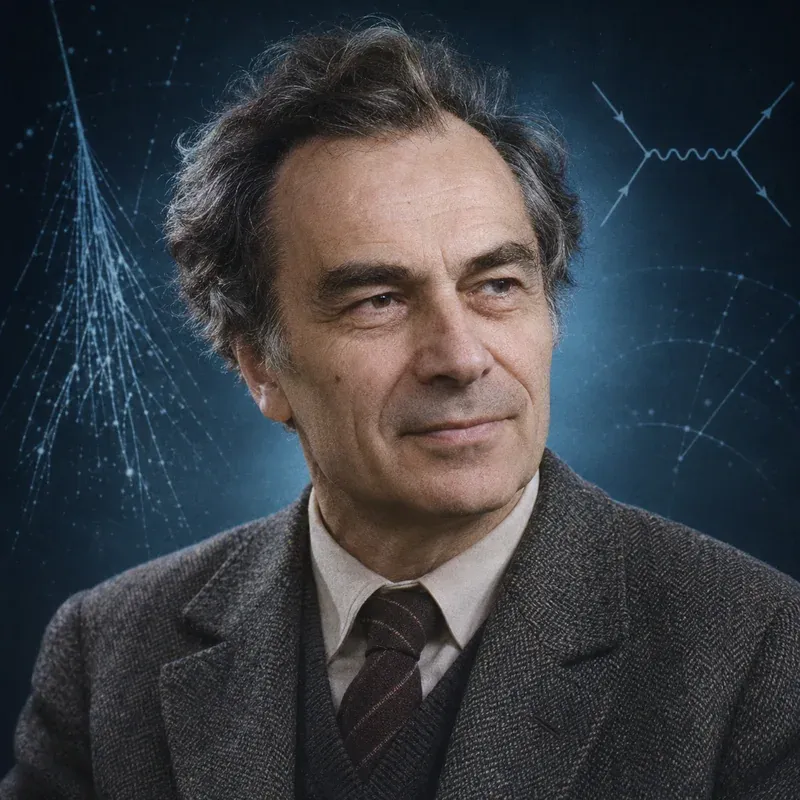
 Illustration
Alexander Yevgenievich Chudakov
Chudakov was involved in creating the Baksan Neutrino Observatory from 1963 and led the design of the Baksan Underground Scintillation Telescope, operating from 1978, which produced results in cosmic-ray physics and neutrino astrophysics. In the early 1980s he proposed Lake Baikal as the site for a Soviet deep-water neutrino telescope. In 1959 he built a 100-ton water Cherenkov detector, an early ancestor of large water detectors.
- Born
- 16 June 1921
Moscow, Russia - Died
- 25 January 2001
Moscow, Russia - Nationality
- Soviet / Russian
- Field
- Cosmic-ray and neutrino physics
- Institutions
- Moscow State University, Lebedev Physical Institute, Institute for Nuclear Research (INR), Moscow, Baksan Neutrino Observatory
Early life and education
Alexander Yevgenievich Chudakov was born in Moscow on 16 June 1921; his father, Evgenii Chudakov, later became a vice-president of the USSR Academy of Sciences. He entered Moscow State University in 1940, began research under the cosmic-ray physicist Sergei Vernov while still a student, and, after the war had delayed his studies, graduated in physics in 1948.
A versatile cosmic-ray physicist
From 1948 to 1971 Chudakov worked at the Lebedev Physical Institute. His early work ranged widely: classified rocket measurements of cosmic rays above the atmosphere, the first observation of transition radiation, and the prediction of reduced ionisation for narrow electron–positron pairs, now called the Chudakov effect. With Vernov he flew instruments on the third Soviet Sputnik that found the Earth's outer radiation belt, and with Georgy Zatsepin he proposed in 1961 the Cherenkov method for ground-based gamma-ray astronomy. In 1959 he built a 100-tonne water Cherenkov detector, an early ancestor of today's giant water detectors.
Baksan and the underground telescope
From 1963 Chudakov was a driving force behind the Baksan Neutrino Observatory in the North Caucasus, overseeing it from the overall concept down to construction details. In 1971 his group moved to the new Institute for Nuclear Research in Moscow, where he headed the laboratory of high-energy leptons. The Baksan Underground Scintillation Telescope, with 330 tonnes of liquid scintillator, started in 1978. It was one of the first large multipurpose underground facilities and produced results on cosmic-ray muons, neutrino astrophysics and searches for exotic particles; in 1987 it was one of the detectors that recorded the neutrino burst from SN 1987A.
Lake Baikal
Chudakov took part in the early international discussions on DUMAND, the deep-ocean neutrino telescope planned off Hawaii. Around 1980 he proposed to use the deep, clear water of Lake Baikal in Siberia as the site of a "Russian DUMAND". The idea was taken up by Grigory Domogatsky and grew into the Baikal neutrino telescope, the forerunner of today's Baikal-GVD.
Legacy
Chudakov was elected a full member of the USSR Academy of Sciences in 1987, headed the Academy's Council on Cosmic Rays from 1983 and chaired the IUPAP Cosmic Ray Commission from 1984 to 1987. He died in Moscow on 25 January 2001.
Known for
- Baksan Underground Scintillation Telescope (1978)
- Creation of Baksan Neutrino Observatory
- Proposed Lake Baikal as a 'Russian DUMAND'
Chronology
- 1959100-ton water Cherenkov detector
- 1963Begins work on Baksan observatory
- 1971Head of high-energy lepton laboratory, INR
- 1978Baksan Underground Scintillation Telescope starts
- 1987Full member, USSR Academy of Sciences
Experiments
- Baksan Underground Scintillation Telescope
- Baikal Neutrino Telescope
Connected people
- Grigory Vladimirovich Domogatsky
- Moisey Alexandrovich Markov
- Vladimir N. Gavrin (Vladimir Nikolaevich Gavrin)
- Gurgen Askaryan
Frequently asked questions
What is the Chudakov effect?
The reduction of ionisation losses by a very narrow electron–positron pair, whose opposite charges partly screen each other. Chudakov predicted it in 1949 and published it in 1955; analogous screening appears in quantum chromodynamics.
What was Chudakov's role in neutrino physics?
He led the creation of the Baksan Neutrino Observatory and its underground scintillation telescope, and he proposed Lake Baikal as the site of a Soviet deep-water neutrino telescope.
Mentioned in 6 pages
Last updated: · Editorial standard
Cite this page
Text
Neutrino Atlas (2026). “Alexander Yevgenievich Chudakov”. Retrieved 22 November 2026, from https://neutrino-atlas.com/people/alexander-chudakov/BibTeX
@misc{neutrinoatlas2026peoplealexanderchudakov,
  title        = {Alexander Yevgenievich Chudakov},
  author       = {{Neutrino Atlas}},
  year         = {2026},
  url          = {https://neutrino-atlas.com/people/alexander-chudakov/},
  note         = {Accessed 2026-11-22},
  language     = {english}
}