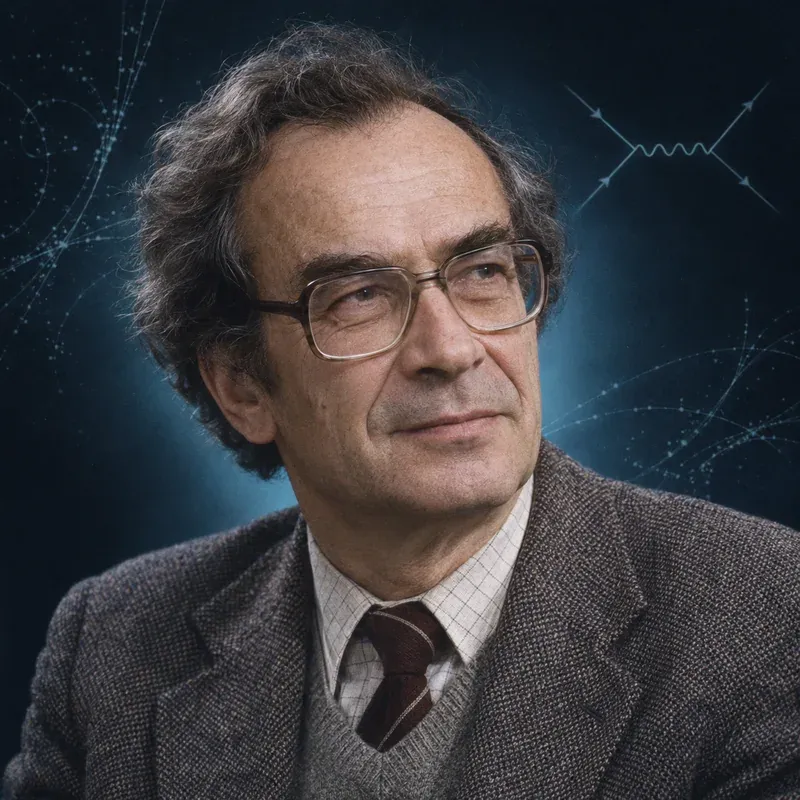
 Illustration
Grigory Vladimirovich Domogatsky
From 1980 Domogatsky led INR's Laboratory of Neutrino Astrophysics at High Energies and was spokesman of the Baikal neutrino telescope for his whole career. Under him the Baikal project deployed the first 3-string array (1993), recorded the first upward neutrino-induced muons (1994–1996) and completed NT-200 in 1998, the first underwater neutrino telescope, followed by the cubic-kilometre Baikal-GVD. As a theorist he showed with Nadyozhin that supernova neutrinos contribute to nucleosynthesis of light elements.
- Born
- 15 January 1941
Moscow, Soviet Union - Died
- 17 December 2024
- Nationality
- Russian
- Field
- Neutrino astrophysics
- Institutions
- Moscow State University, Lebedev Physical Institute, Institute for Nuclear Research (INR), Russian Academy of Sciences
Early life and education
Grigory Vladimirovich Domogatsky was born in Moscow in 1941 into a family of artists: his grandfather was a sculptor and his father a painter, woodcarver and book illustrator. He chose physics instead, earning his PhD at Moscow State University in 1970 and working at the Lebedev Physical Institute before receiving the higher Soviet doctorate (doctor of science) in 1980.
Theoretical work
Domogatsky began as a theorist of low-energy neutrino interactions and of the neutrino emission from collapsing stars. With Dmitry Nadyozhin he showed that the intense neutrino flux from a core-collapse supernova does more than carry away energy: neutrinos scattering on nuclei in the outer shells of the star knock out nucleons and so help produce rare light isotopes such as ⁷Li and ¹¹B. This ‘neutrino process’ is now part of standard models of supernova nucleosynthesis. He also argued for linking underground detectors so that a stellar collapse would not be missed – an idea later realised in the SuperNova Early Warning System.
Building a telescope in Lake Baikal
In 1980 Domogatsky became head of the newly founded Laboratory of Neutrino Astrophysics at High Energies at the Institute for Nuclear Research of the Russian Academy of Sciences, and he served as spokesman of the Baikal project for the rest of his career. The idea, going back to Moisey Markov and to Alexander Chudakov, was to use a large natural body of water as the target and medium of a neutrino telescope: a high-energy muon neutrino that interacts below the detector produces an upward-going muon whose Cherenkov light is recorded by strings of photomultipliers. The Earth filters out all other particles coming from below.
Lake Baikal offered unusual advantages: a depth of more than a kilometre close to the shore, clear fresh water with little bioluminescence and no potassium-40 background from sea salt, and above all a thick winter ice cover. Each February and March the ice serves as a stable platform from which strings can be lowered, repaired and recovered without ships. Site exploration began in 1981. Test configurations gave first physics results in the late 1980s, a three-string array followed in 1993, and in 1996 the collaboration identified the first neutrino-induced upward muons recorded by an underwater detector. The full NT-200 telescope, with about 200 optical modules and built with German partners including Christian Spiering's group at DESY Zeuthen, was completed in April 1998. It was the first underwater neutrino telescope and the proof of concept for AMANDA, ANTARES and IceCube.
Baikal-GVD and legacy
Under Domogatsky's leadership the collaboration then began Baikal-GVD, a cubic-kilometre-scale array built cluster by cluster from the mid-2010s, while NT-200 was retired. Baikal-GVD is the largest neutrino telescope in the Northern Hemisphere and complements IceCube's view of the sky, alongside KM3NeT in the Mediterranean. Domogatsky was a corresponding member of the Russian Academy of Sciences and received the Bruno Pontecorvo Prize and the Pavel Cherenkov Prize, among other awards. He died in December 2024, aged 83.
Known for
- Spokesman of the Baikal Neutrino Telescope
- NT-200 and Baikal-GVD
- Idea of a supernova early-warning network
- NT200 underwater telescope
- Early proposal of a supernova neutrino detector network
Chronology
- 1970PhD, Moscow State University
- 1980Head of INR neutrino astrophysics laboratory
- 1981Site exploration at Lake Baikal begins
- 1993First 3-string Baikal array
- 1993NT36 deployed
- 1996First clear upward neutrino muon (NT-96)
- 1998NT200 completed (April)
- 2024Dies (17 December)
Original papers
- I. A. Belolaptikov et al. (Baikal), The Baikal underwater neutrino telescope: design, performance and first results, Astropart. Phys. 7, 263 (1997)DOI 10.1016/S0927-6505(97)00022-4
Experiments
- Baikal NT-200
- Baikal-GVD
- Baikal NT200
- SNEWS (SuperNova Early Warning System)
Connected people
- Alexander Yevgenievich Chudakov
- Christian Spiering
- Francis Halzen
- Moisey Alexandrovich Markov
- Valery Anatolievich Rubakov
Frequently asked questions
Why was Lake Baikal chosen for a neutrino telescope?
It is deep close to the shore, its fresh water is clear and nearly free of the radioactive and biological light backgrounds of the sea, and its winter ice cover lets the team deploy and maintain detector strings from a solid surface.
What was NT-200?
The first underwater neutrino telescope, completed in 1998 with about 200 photomultipliers in Lake Baikal. It detected upward-going muons from atmospheric neutrinos and set early limits on cosmic neutrino fluxes.
Was Domogatsky an experimentalist or a theorist?
Both. He started with theoretical work on supernova neutrinos and neutrino-induced nucleosynthesis and then spent four decades leading the Baikal experiment.
On the timeline
Mentioned in 8 pages
Last updated: · Editorial standard
Cite this page
Text
Neutrino Atlas (2026). “Grigory Vladimirovich Domogatsky”. Retrieved 22 November 2026, from https://neutrino-atlas.com/people/grigory-domogatsky/BibTeX
@misc{neutrinoatlas2026peoplegrigorydomogatsky,
  title        = {Grigory Vladimirovich Domogatsky},
  author       = {{Neutrino Atlas}},
  year         = {2026},
  url          = {https://neutrino-atlas.com/people/grigory-domogatsky/},
  note         = {Accessed 2026-11-22},
  language     = {english}
}