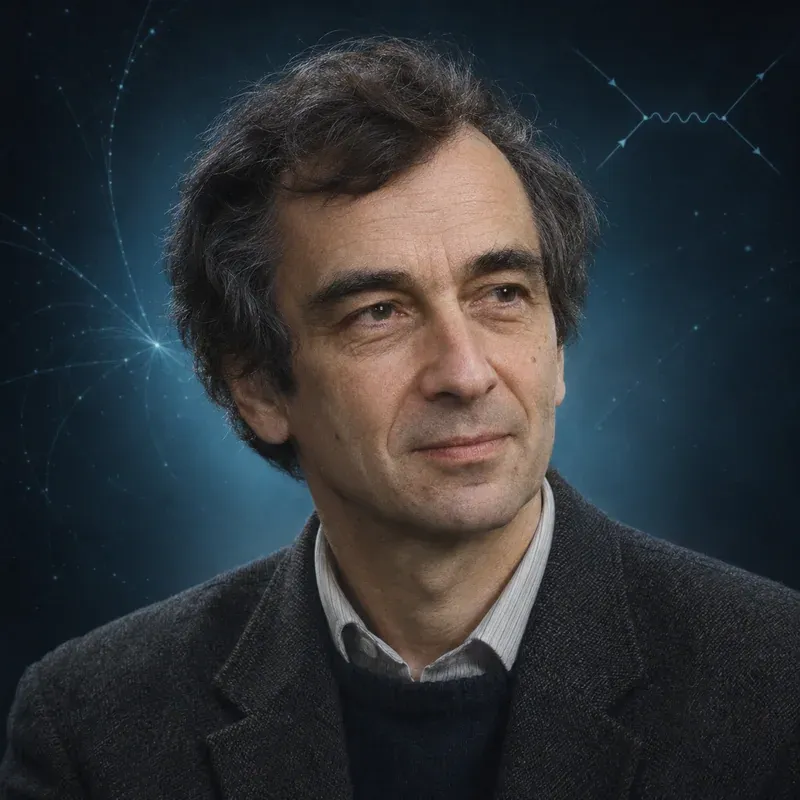
 Illustration
Valery Anatolievich Rubakov
In 1985 Rubakov, Vadim Kuzmin and Mikhail Shaposhnikov showed that the anomalous electroweak processes that violate baryon and lepton number become rapid in the hot early universe. These sphaleron transitions convert a lepton asymmetry into a baryon asymmetry and are therefore the central step of leptogenesis, which links the matter excess of the universe to heavy neutrinos. In 1998, with Evgeny Akhmedov and Alexei Smirnov, he proposed that CP-violating oscillations of light sterile neutrinos could generate the baryon asymmetry. As deputy director of INR in 1987–1994 he oversaw the Baksan Neutrino Observatory and the Baikal neutrino telescope.
- Born
- 16 February 1955
Moscow, USSR - Died
- 19 October 2022
- Nationality
- Russian
- Field
- Theoretical particle physics and cosmology
- Institutions
- Moscow State University (graduated 1978), Institute for Nuclear Research, Russian Academy of Sciences (from 1978; deputy director 1987–1994), Russian Academy of Sciences (full member)
Education and early work
Valery Anatolievich Rubakov was born on 16 February 1955 in Moscow. He studied physics at Moscow State University from 1972 to 1978 and then joined the Institute for Nuclear Research (INR) of the Academy of Sciences, where he defended his PhD in 1981 on the vacuum structure of gauge theories. He remained at INR for his whole career and also headed the department of particle physics and cosmology at Moscow State University.
His early results came from non-perturbative field theory. He showed that magnetic monopoles of grand unified theories can catalyse proton decay, an effect now named after Curtis Callan and Rubakov. In 1983, with Mikhail Shaposhnikov, he proposed that our world might be confined to a wall in a higher-dimensional space, an early form of the brane-world idea.
Electroweak processes and the baryon asymmetry
In 1985 Rubakov, Vadim Kuzmin and Shaposhnikov showed that the electroweak violation of baryon and lepton number, negligible today, proceeds rapidly at the temperatures of the early universe. These sphaleron transitions conserve B − L but wash out or reshuffle B + L. The result changed baryogenesis: an asymmetry created at grand-unification scales could be erased, but a lepton asymmetry could be converted into baryons. This is the mechanism behind leptogenesis, proposed a year later by Fukugita and Yanagida.
In 1998, with Evgeny Akhmedov and Alexei Smirnov, he proposed baryogenesis through CP-violating oscillations of sterile neutrinos with masses far below the grand-unification scale, an idea later developed in the νMSM.
Neutrino experiments and recognition
From 1987 to 1994 Rubakov was INR's deputy director for science, responsible for the Baksan Neutrino Observatory and the Baikal underwater neutrino telescope. He received the Pontecorvo Prize in 2008. In February 2022 he signed an open letter of Russian scientists opposing the invasion of Ukraine. He died on 19 October 2022, aged 67.
Known for
- Electroweak baryon- and lepton-number violation at high temperature (Kuzmin–Rubakov–Shaposhnikov, 1985)
- Monopole catalysis of proton decay (Callan–Rubakov effect)
- Brane-world scenario (with M. Shaposhnikov, 1983)
- Baryogenesis via sterile-neutrino oscillations (with E. Akhmedov and A. Smirnov, 1998)
- Textbooks on gauge fields and the early universe
Chronology
- 1978Graduates from Moscow State University; joins INR
- 1981PhD thesis on vacuum structure in gauge theories
- 1983Brane-world proposal with Shaposhnikov
- 1985Kuzmin–Rubakov–Shaposhnikov paper on electroweak B and L violation
- 1987Deputy director of INR, overseeing Baksan and Baikal
- 1998Baryogenesis via neutrino oscillations (with Akhmedov and Smirnov)
- 2008Bruno Pontecorvo Prize
Original papers
- V. A. Kuzmin, V. A. Rubakov, M. E. Shaposhnikov, On anomalous electroweak baryon-number non-conservation in the early universe, Phys. Lett. B 155, 36 (1985)DOI 10.1016/0370-2693(85)91028-7
- E. Kh. Akhmedov, V. A. Rubakov, A. Yu. Smirnov, Baryogenesis via neutrino oscillations, Phys. Rev. Lett. 81, 1359 (1998)arXiv:hep-ph/9803255
Experiments
- Baksan Neutrino Observatory
- Baikal neutrino telescope
Connected people
Frequently asked questions
Why is Rubakov's 1985 paper important for neutrino physics?
It showed that sphaleron processes in the early universe convert lepton number into baryon number, the step that lets heavy-neutrino decays explain the matter–antimatter asymmetry through leptogenesis.
What is the Callan–Rubakov effect?
The catalysis of proton decay by grand-unified magnetic monopoles, found independently by Rubakov and Curtis Callan in the early 1980s.
Mentioned in 1 page
Last updated: · Editorial standard
Cite this page
Text
Neutrino Atlas (2026). “Valery Anatolievich Rubakov”. Retrieved 22 November 2026, from https://neutrino-atlas.com/people/valery-rubakov/BibTeX
@misc{neutrinoatlas2026peoplevaleryrubakov,
  title        = {Valery Anatolievich Rubakov},
  author       = {{Neutrino Atlas}},
  year         = {2026},
  url          = {https://neutrino-atlas.com/people/valery-rubakov/},
  note         = {Accessed 2026-11-22},
  language     = {english}
}