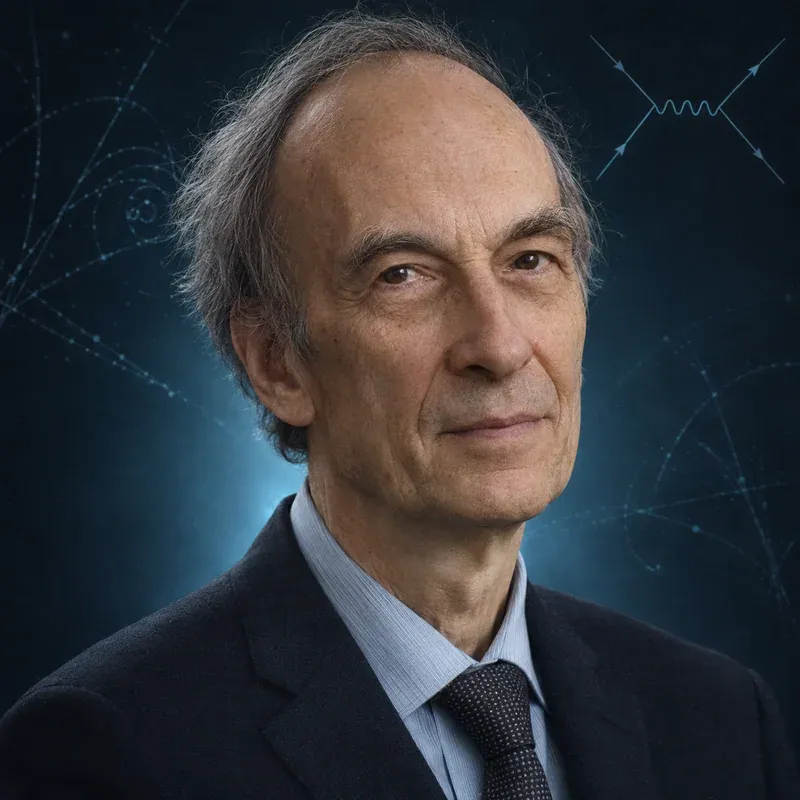
 Illustration
Alexei Yuryevich Smirnov
In 1984–85, with Mikheyev, Smirnov found the resonance enhancement of neutrino oscillations in matter and the adiabatic conversion of neutrinos in media of varying density, which together with Wolfenstein's work form the MSW effect. The effect explains the energy dependence of solar neutrino suppression and is applied to supernova neutrinos and to neutrinos crossing the Earth. With Berezinsky (1975) he linked diffuse high-energy neutrino fluxes to gamma-ray fluxes.
- Born
- 16 October 1951
USSR - Nationality
- Russian
- Field
- Neutrino theory and phenomenology
- Institutions
- Institute for Nuclear Research (INR), Moscow, Moscow State University, ICTP Trieste, Max Planck Institute for Nuclear Physics, Heidelberg
Education and career
Alexei Yuryevich Smirnov was born on 16 October 1951 in the Soviet Union. He graduated from the Faculty of Physics of Moscow State University in 1974 and in 1977 joined the Institute for Nuclear Research (INR) of the USSR Academy of Sciences in Moscow, where he received his Candidate of Sciences degree in 1979 and his Doctor of Sciences degree in 1989. From 1982 to 1990 he also taught at Moscow State University. In 1992 he became a staff associate of the International Centre for Theoretical Physics (ICTP) in Trieste, and from 1997 a staff member and later principal research scientist there. Since 2015 he has been a Max Planck Fellow at the Max-Planck-Institut für Kernphysik in Heidelberg.
Neutrinos and gamma rays from cosmic sources
Smirnov's early work with Veniamin Berezinsky in 1975 concerned ultra-high-energy neutrinos from space. They pointed out that the processes producing such neutrinos, the decay of pions made in collisions of protons, also produce gamma rays, which cascade down to lower energies on their way to Earth. The observed diffuse gamma-ray background therefore limits how large a diffuse neutrino flux can be. This connection is still used to interpret the astrophysical neutrinos detected by IceCube and is a basic idea of multimessenger astronomy.
The MSW effect
In 1978 Lincoln Wolfenstein had shown that neutrinos travelling through matter feel an extra potential, because electron neutrinos, unlike the other flavours, can scatter on electrons through the charged current. In 1984–85 Smirnov and Stanislav Mikheyev, an experimentalist at INR, worked out what this means in a medium whose density changes, such as the Sun. They found two effects. First, at a particular density the matter potential exactly compensates the vacuum mass difference, and mixing becomes maximal even if the vacuum mixing angle is small: the MSW resonance. Second, if the density changes slowly enough, a neutrino follows the changing state of the system adiabatically and can be converted almost completely from one flavour into another.
The result explained why different solar-neutrino experiments saw different suppressions. Low-energy pp neutrinos are below the resonance and oscillate almost as in vacuum, while high-energy boron-8 neutrinos, produced in the dense solar core, pass through the resonance and leave the Sun mainly as the heavier mass state, so that only about a third of them arrive as electron neutrinos. Their main paper appeared in Soviet Journal of Nuclear Physics 42 (1985). Together with Wolfenstein's work, the mechanism became known as the MSW effect.
For a time several MSW solutions to the solar neutrino problem were allowed. Around 2002 the measurements of SNO and KamLAND selected the large-mixing-angle solution, and Borexino later measured the transition between vacuum-like and matter-dominated behaviour across the solar spectrum, as the theory predicts.
Later work
Smirnov has extended the theory of matter effects to many settings. With Amol Dighe he showed in 2000 how the neutrino signal of a core-collapse supernova could reveal the mass ordering and the mixing angle θ₁₃. With Evgeny Akhmedov and Michele Maltoni he studied neutrinos crossing the Earth and introduced oscillograms, maps of oscillation probability against energy and zenith angle that are now standard tools for atmospheric-neutrino experiments. He has also worked on sterile neutrinos, on the theory of neutrino mass and on patterns in the mixing matrix such as quark–lepton complementarity, proposed with Hisakazu Minakata. Among his doctoral students are Francesco Vissani and Cecilia Lunardini. He has served as an editor of the Journal of High Energy Physics and the Journal of Cosmology and Astroparticle Physics.
Recognition
Smirnov shared the 2005 Bruno Pontecorvo Prize of the Joint Institute for Nuclear Research for work on the effect of matter on neutrino oscillations. In 2008 he and Mikheyev received the J. J. Sakurai Prize of the American Physical Society "for pioneering and influential work on the enhancement of neutrino oscillations in matter", and in the same year the Markov Prize of INR. In 2016 the Albert Einstein Society in Bern awarded him the Albert Einstein Medal.
Known for
- MSW effect (with Mikheyev)
- Adiabatic flavour conversion in non-uniform media
- Neutrino–gamma connection in astrophysics (with Berezinsky, 1975)
Chronology
- 1975Berezinsky–Smirnov neutrino–gamma bound
- 1985MSW resonance and adiabatic conversion with Mikheyev
- 2005Bruno Pontecorvo Prize
- 2008Sakurai Prize
- 2016Albert Einstein Medal
Original papers
- S. P. Mikheyev, A. Yu. Smirnov, Resonance enhancement of oscillations in matter and solar neutrino spectroscopy, Sov. J. Nucl. Phys. 42, 913 (1985)
- A. Yu. Smirnov, The MSW effect and matter effects in neutrino oscillations, Phys. Scripta T121, 57 (2005)
Experiments
Connected people
- Lincoln Wolfenstein
- Stanislav Pavlovich Mikheyev
- Veniamin Sergeevich Berezinsky
- Hans Bethe
- Serguey Todorov Petcov
- Evgeny Kh. Akhmedov
- Stephen J. Parke
- Valery Anatolievich Rubakov
Frequently asked questions
What is Alexei Smirnov known for?
Above all for the MSW effect, worked out with Stanislav Mikheyev in 1984–85: the resonant enhancement of neutrino oscillations in matter and the adiabatic conversion of neutrinos in a medium of changing density. It explains the energy dependence of the solar-neutrino deficit.
Why is the effect called MSW?
The letters stand for Mikheyev, Smirnov and Wolfenstein. Wolfenstein introduced the matter potential in 1978; Mikheyev and Smirnov discovered the resonance and adiabatic conversion that make the effect so strong in the Sun.
Has Smirnov received a Nobel Prize?
No. His honours include the Bruno Pontecorvo Prize (2005), the J. J. Sakurai Prize (2008, with Mikheyev) and the Albert Einstein Medal (2016).
On the timeline
Mentioned in 25 pages
Milestones 4
People 10
Last updated: · Editorial standard
Cite this page
Text
Neutrino Atlas (2026). “Alexei Yuryevich Smirnov”. Retrieved 22 November 2026, from https://neutrino-atlas.com/people/alexei-smirnov/BibTeX
@misc{neutrinoatlas2026peoplealexeismirnov,
  title        = {Alexei Yuryevich Smirnov},
  author       = {{Neutrino Atlas}},
  year         = {2026},
  url          = {https://neutrino-atlas.com/people/alexei-smirnov/},
  note         = {Accessed 2026-11-22},
  language     = {english}
}