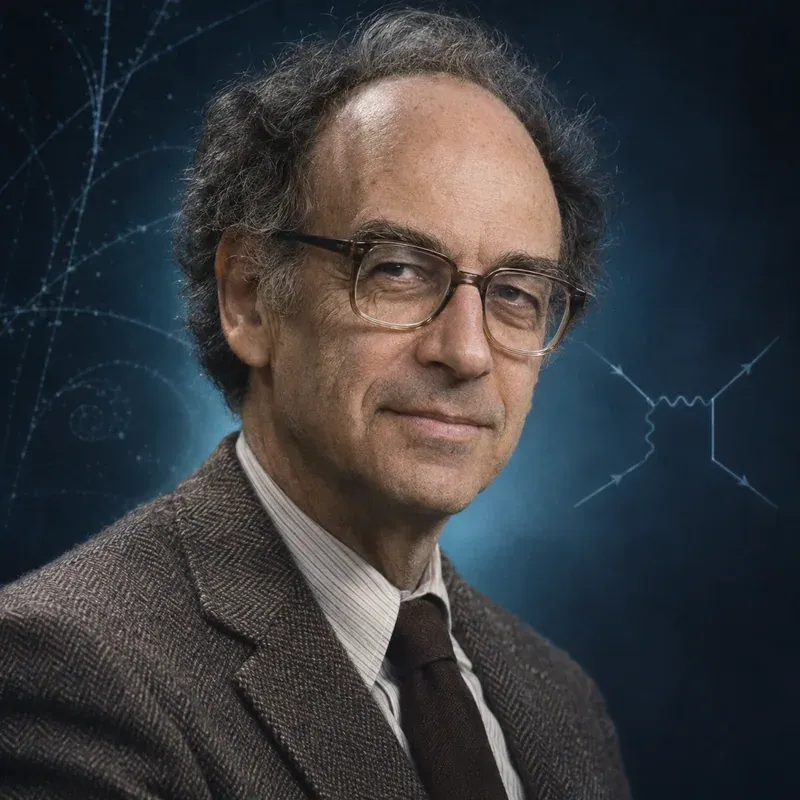
 Illustration
Lincoln Wolfenstein
In 1978 Wolfenstein showed that coherent forward scattering of neutrinos on electrons (and nucleons) in matter changes their oscillations, adding an effective potential for electron neutrinos. Mikheyev and Smirnov later showed this produces resonant flavour conversion, and the combined Mikheyev–Smirnov–Wolfenstein (MSW) effect explains solar neutrino data and drives matter effects in long-baseline and supernova neutrinos.
- Born
- 10 February 1923
Cleveland, Ohio, USA - Died
- 27 March 2015
Oakland, California, USA - Nationality
- American
- Field
- Theoretical particle physics; weak interactions
- Institutions
- Carnegie Mellon University, University of Chicago (PhD 1949)
Early life and education
Lincoln Wolfenstein was born on 10 February 1923 in Cleveland Heights, Ohio. He studied at the University of Chicago, receiving his bachelor's degree in 1943, a master's degree in 1944 and his PhD in 1949. His thesis adviser was Edward Teller, and Enrico Fermi sat on the examining committee. In 1948 he joined the physics department of the Carnegie Institute of Technology in Pittsburgh, later Carnegie Mellon University, where he spent his entire career, retiring in 2000 after 52 years.
Path to neutrino physics
For most of his career Wolfenstein worked on the weak interaction and its symmetries. After CP violation was discovered in the decay of neutral kaons in 1964, he proposed the same year the 'superweak' model, in which CP violation comes from a new, extremely feeble interaction that only mixes neutral kaons with their antiparticles. The model was a standard point of comparison for decades until measurements of direct CP violation at CERN and Fermilab ruled it out around 2000. In 1983 he introduced the Wolfenstein parametrization of the quark-mixing (CKM) matrix, which writes its elements as powers of a small parameter and is still used in nearly every analysis of quark flavour.
Key contributions
In 1978 Wolfenstein turned to neutrinos, which had become interesting through Raymond Davis's deficit of solar neutrinos and Bruno Pontecorvo's idea of oscillations. His paper 'Neutrino oscillations in matter' pointed out something that earlier treatments had ignored: a neutrino crossing matter scatters coherently in the forward direction on the electrons and nucleons it passes, just as light is slowed in glass. These collisions do not deflect the neutrino, but they shift its phase.
All neutrino flavours feel the same shift from the neutral current, which has no effect on oscillations. Electron neutrinos, however, can also scatter on electrons through the charged current, so they acquire an extra potential energy. This matter potential acts like an additional term in the neutrino mass matrix and changes both the effective mixing angle and the oscillation length.
In 1985 Stanislav Mikheyev and Alexei Smirnov showed that when the density changes slowly, as in the Sun, the effective mixing passes through a resonance, and electron neutrinos produced in the solar core can be converted almost completely into another flavour even if the vacuum mixing angle is small. The combined Mikheyev–Smirnov–Wolfenstein (MSW) effect became the accepted explanation of the solar neutrino problem once SNO, Super-Kamiokande and KamLAND established the large-mixing-angle solution around 2002. The energy dependence of the electron-neutrino survival probability measured for boron-8 neutrinos is the clearest signature of the effect.
In 1979 Wolfenstein applied matter effects to the dense core of a collapsing star, an early step towards the study of supernova neutrinos. In 1981 he showed that Majorana neutrinos with opposite CP parities can partly cancel in neutrinoless double beta decay, which is why the measured rate constrains the effective Majorana mass rather than the individual masses.
Later life and legacy
Wolfenstein received the J. J. Sakurai Prize of the American Physical Society in 1992 and the Bruno Pontecorvo Prize of the Joint Institute for Nuclear Research in 2005, shared with Mikheyev and Smirnov. He helped found the Aspen Center for Physics in 1962. Outside physics he campaigned against nuclear weapons proliferation, helped found the Pittsburgh chapter of the Committee for a Sane Nuclear Policy and was a member of the Union of Concerned Scientists. He died in Oakland, California, on 27 March 2015.
Matter effects are now an essential part of oscillation physics beyond the Sun. Neutrinos crossing the Earth undergo Earth matter effects that produce a day–night asymmetry for solar neutrinos, and the opposite sign of the potential for neutrinos and antineutrinos lets long-baseline experiments such as NOvA and DUNE determine the mass ordering.
Known for
- Matter effects on neutrino oscillations (MSW effect)
- Wolfenstein parametrization of the CKM matrix
- Superweak model of CP violation
Chronology
- 1978'Neutrino oscillations in matter'
- 1979Applies matter effects to stellar collapse
- 1992Sakurai Prize
- 2005Bruno Pontecorvo Prize (with Mikheyev and Smirnov)
Original papers
- L. Wolfenstein, Neutrino oscillations in matter, Phys. Rev. D 17, 2369 (1978)DOI 10.1103/PhysRevD.17.2369
- L. Wolfenstein, Neutrino oscillations and stellar collapse, Phys. Rev. D 20, 2634 (1979)DOI 10.1103/PhysRevD.20.2634
Experiments
Connected people
- Alexei Yuryevich Smirnov
- Hans Bethe
- John Norris Bahcall
- Stanislav Pavlovich Mikheyev
- Vernon Duane Barger
- Stephen J. Parke
Frequently asked questions
What is the 'W' in the MSW effect?
It stands for Wolfenstein, who showed in 1978 that matter changes neutrino oscillations. Mikheyev and Smirnov added the resonant conversion in 1985. See MSW effect.
Did Wolfenstein receive a Nobel Prize?
No. His prizes include the 1992 Sakurai Prize and the 2005 Bruno Pontecorvo Prize.
Why do only electron neutrinos feel the extra potential?
Ordinary matter contains electrons but no muons or tau leptons, so only electron neutrinos can scatter on it through the charged current. The neutral-current shift is the same for all flavours and cancels in oscillations.
On the timeline
- 1978Wolfenstein: matter changes neutrino oscillations
- 1985Mikheyev and Smirnov discover resonant conversion
Mentioned in 22 pages
Comparisons 1
Milestones 4
People 5
Last updated: · Editorial standard
Cite this page
Text
Neutrino Atlas (2026). “Lincoln Wolfenstein”. Retrieved 22 November 2026, from https://neutrino-atlas.com/people/lincoln-wolfenstein/BibTeX
@misc{neutrinoatlas2026peoplelincolnwolfenstein,
  title        = {Lincoln Wolfenstein},
  author       = {{Neutrino Atlas}},
  year         = {2026},
  url          = {https://neutrino-atlas.com/people/lincoln-wolfenstein/},
  note         = {Accessed 2026-11-22},
  language     = {english}
}