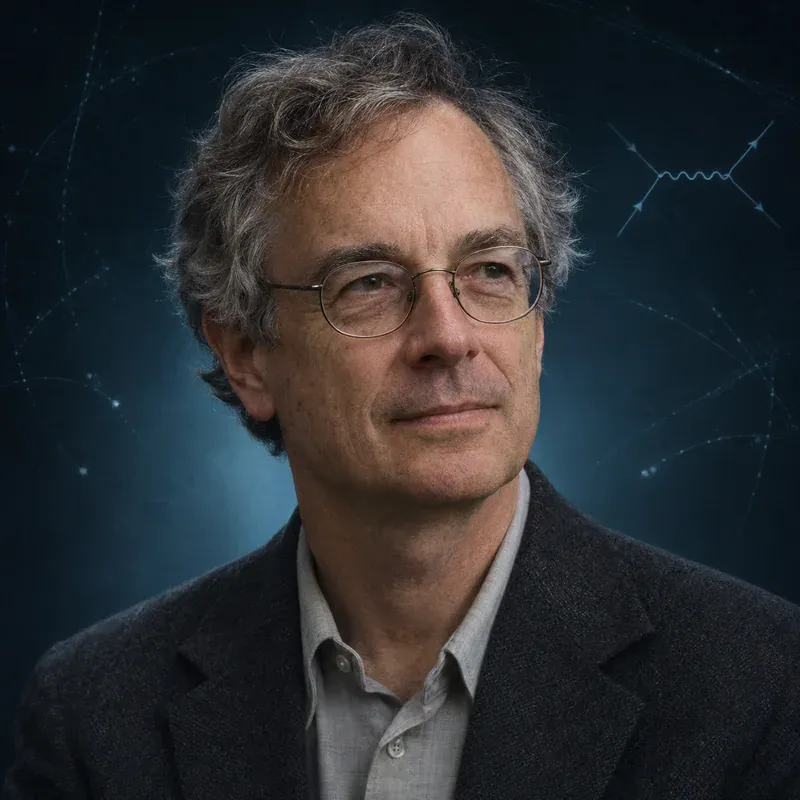
 Illustration
Stephen J. Parke
In 1986, shortly after Mikheyev and Smirnov showed that matter can resonantly enhance solar-neutrino conversion, Parke gave the first analytic treatment of the MSW transition including its non-adiabatic regime. Treating the resonance as a Landau–Zener level crossing, he derived a compact formula for the electron-neutrino survival probability that became the standard tool for mapping the MSW solutions of the solar neutrino problem. Since then he has worked extensively on oscillation phenomenology for long-baseline experiments such as T2K, NOvA, Hyper-Kamiokande and DUNE and for reactor experiments such as Daya Bay, RENO and JUNO, including approximate formulas for oscillation probabilities in matter.
- Nationality
- New Zealand-American
- Field
- Theoretical particle physics
- Institutions
- University of Auckland, Harvard University (PhD 1980), SLAC, Fermilab
Background
Stephen Parke grew up in Gisborne, New Zealand, and studied mathematics and physics at the University of Auckland. He went to Harvard on a Frank Knox Memorial Fellowship and completed his PhD in 1980 under Sidney Coleman. After three years as a postdoc at SLAC, working mainly with Sidney Drell, he joined the Fermilab Theory Group, arriving in early 1984, and has remained at Fermilab since; from 2010 to 2015 he headed its Theoretical Physics Department.
Level crossing in the Sun
In 1985 Stanislav Mikheyev and Alexei Smirnov, building on Lincoln Wolfenstein, showed that electron neutrinos produced in the solar core can be converted almost completely into another flavour as they pass through a density at which the matter potential cancels the vacuum mass splitting. Whether the conversion is complete depends on how slowly the density changes compared with the oscillation length, the adiabaticity of the transition. Parke recognised that the MSW resonance is a two-level crossing of exactly the kind treated by Landau and Zener in atomic physics and derived the survival probability averaged over the production region:
With Pc expressed through the density gradient at the resonance, the formula described the whole plane of mass splitting and mixing angle, from the adiabatic to the strongly non-adiabatic regime. It was used to map the regions allowed by the Homestake, Kamiokande and gallium experiments, including the small-mixing-angle and large-mixing-angle solutions of the solar neutrino problem; the latter was confirmed by SNO and KamLAND.
Amplitudes and top quarks
In the same year Parke and Tomasz Taylor found a remarkably simple expression for a class of tree-level amplitudes with many gluons, now called the Parke–Taylor or maximally helicity-violating amplitudes, which later became a starting point of modern methods for computing scattering amplitudes. With Gregory Mahlon he pioneered the study of spin correlations in top-quark pair production at hadron colliders, work that underlies the recent observation of quantum entanglement in top pairs by ATLAS and CMS.
Oscillation phenomenology
Since the measurement of θ13, much of Parke's work has concerned long-baseline and reactor experiments: approximate but accurate expressions for oscillation probabilities in matter, the effective mass splittings that reactor and accelerator experiments actually measure, and the sensitivity of T2K, NOvA, Hyper-Kamiokande, DUNE, Daya Bay, RENO and JUNO to the mass ordering and δCP. He was elected an APS Fellow in 1996, and the University of Auckland awarded him a DSc in 2018.
Known for
- Analytic non-adiabatic (Landau–Zener) solution of the MSW effect (1986)
- Parke–Taylor formula for multi-gluon scattering amplitudes (1986)
- Top-quark spin correlations at hadron colliders
- Phenomenology of long-baseline and reactor oscillation experiments
- Head of the Fermilab Theoretical Physics Department (2010–2015)
Chronology
- 1980PhD at Harvard under Sidney Coleman; SLAC postdoc (to 1983)
- 1984Moves to the Fermilab Theory Group
- 1986Non-adiabatic MSW formula and Parke–Taylor amplitudes
- 1996Fellow of the American Physical Society
- 2010Head of the Fermilab Theoretical Physics Department (to 2015)
- 2018DSc, University of Auckland
Original papers
- S. J. Parke, Nonadiabatic level crossing in resonant neutrino oscillations, Phys. Rev. Lett. 57, 1275 (1986)DOI 10.1103/PhysRevLett.57.1275
- S. J. Parke, T. R. Taylor, An amplitude for n-gluon scattering, Phys. Rev. Lett. 56, 2459 (1986)DOI 10.1103/PhysRevLett.56.2459
Experiments
Connected people
Frequently asked questions
What is the Parke formula?
A Landau–Zener expression for the solar electron-neutrino survival probability through an MSW resonance, valid in both the adiabatic and non-adiabatic regimes (1986).
Is Stephen Parke also known outside neutrino physics?
Yes, for the Parke–Taylor formula for multi-gluon amplitudes and for top-quark spin correlations.
Mentioned in 1 page
Last updated: · Editorial standard
Cite this page
Text
Neutrino Atlas (2026). “Stephen J. Parke”. Retrieved 22 November 2026, from https://neutrino-atlas.com/people/stephen-parke/BibTeX
@misc{neutrinoatlas2026peoplestephenparke,
  title        = {Stephen J. Parke},
  author       = {{Neutrino Atlas}},
  year         = {2026},
  url          = {https://neutrino-atlas.com/people/stephen-parke/},
  note         = {Accessed 2026-11-22},
  language     = {english}
}