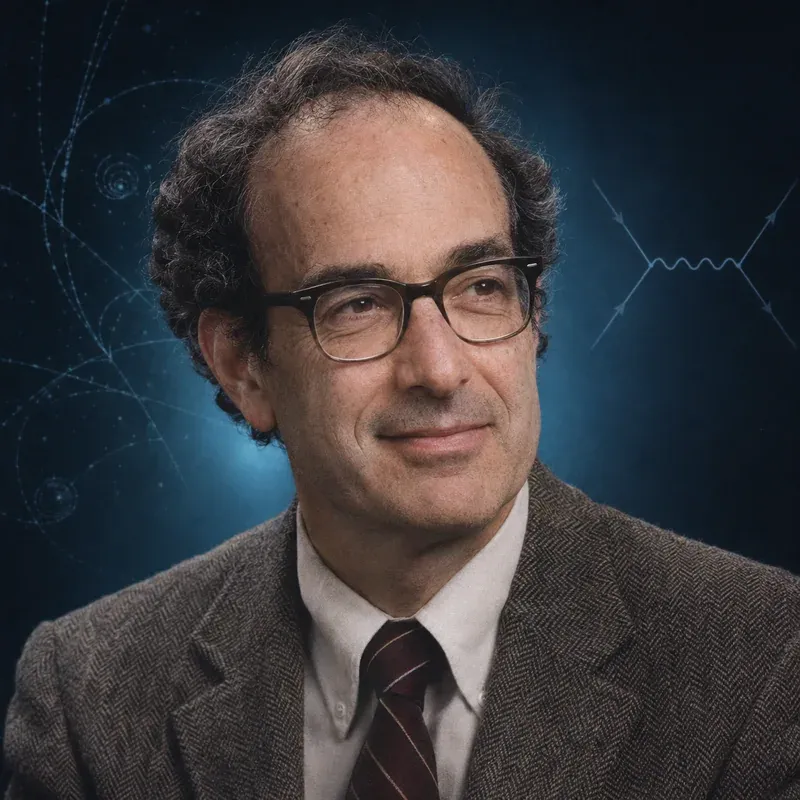
 Illustration
John Norris Bahcall
From 1962 Bahcall computed the solar neutrino fluxes and the capture rate on chlorine; in 1964 he and Raymond Davis proposed the Homestake experiment, and its measured rate of about one-third of his prediction defined the solar neutrino problem. Over four decades, with collaborators such as Roger Ulrich, Marc Pinsonneault and Sarbani Basu, he refined the standard solar model and its uncertainties; helioseismology confirmed the model, pointing to new neutrino physics. SNO's 2001–02 results matched his predicted ⁸B flux, confirming flavour conversion.
- Born
- 30 December 1934
Shreveport, Louisiana, USA - Died
- 17 August 2005
New York City, USA - Nationality
- American
- Field
- Astrophysics; solar neutrinos
- Institutions
- Caltech, Institute for Advanced Study, Princeton
Early life and education
John Norris Bahcall was born on 30 December 1934 in Shreveport, Louisiana. He began university as a philosophy student at Louisiana State University, considered becoming a Reform rabbi, and took his first physics class only to meet a science requirement. He later said of it: 'It was the hardest thing I have ever done in my life, but I fell in love with science.' He received his bachelor's degree from the University of California, Berkeley, in 1956, a master's degree from the University of Chicago in 1957 and his PhD from Harvard University in 1961.
Path to neutrino physics
After his doctorate Bahcall spent a year at Indiana University as a research fellow with Emil Konopinski, an expert on beta decay. There he learned to calculate weak nuclear transition rates, the skill that led directly to his life's work. In 1962 he joined the Kellogg Radiation Laboratory at Caltech, where William Fowler's group was measuring the nuclear reactions that power the Sun. Raymond Davis Jr. of Brookhaven had been developing a chlorine–argon detector and needed to know how many neutrinos it could expect. Bahcall calculated the absorption cross-section of chlorine-37, including a previously overlooked transition to an excited state of argon-37 that increased the predicted rate for high-energy boron-8 neutrinos about twentyfold.
Key contributions
In March 1964 Bahcall and Davis published back-to-back papers in Physical Review Letters: Bahcall's theoretical prediction and Davis's experimental proposal. The argument was that a large tank of cleaning fluid deep underground could test directly whether the Sun shines by nuclear fusion. The experiment was built in the Homestake gold mine and gave its first result in 1968: about one-third of the predicted rate. For the next three decades this mismatch was the solar neutrino problem.
Bahcall's central contribution was to make the prediction trustworthy. With collaborators including Roger Ulrich, Marc Pinsonneault and Sarbani Basu he built successive versions of the standard solar model, computing the Sun's interior from its observed mass, luminosity, age and composition, and gave careful uncertainty estimates for every input. He insisted that the uncertainties be stated openly so that experimenters could judge how serious a disagreement was. He introduced the solar neutrino unit, the SNU, and summarised the field in the monograph 'Neutrino Astrophysics' (1989).
Through the 1980s and 1990s many physicists suspected that the solar model was wrong rather than the neutrinos. Bahcall argued the opposite. New experiments – Kamiokande, the gallium detectors SAGE and GALLEX, and later Super-Kamiokande – all saw deficits, but of different sizes, a pattern that no reasonable change to the Sun could reproduce. Helioseismology, which measures sound waves inside the Sun, confirmed his model's predicted sound speed to about 0.1 per cent. The remaining explanation was new neutrino physics, in particular flavour conversion enhanced by the MSW effect, on which he also worked with Hans Bethe.
The resolution came in 2001–2002, when SNO measured both the electron-neutrino flux and the total flux of all flavours from boron-8. The total agreed with Bahcall's prediction, while only about a third arrived as electron neutrinos. The Sun was right, and neutrinos change flavour.
Later work and legacy
Bahcall joined the Institute for Advanced Study in Princeton in 1968 and was professor of natural sciences there from 1971. Beyond neutrinos he worked on quasar absorption lines and the structure of the Galaxy, and from the 1970s he was one of the main scientific advocates for the Hubble Space Telescope, working with Lyman Spitzer Jr. to win its approval from Congress. He was president of the American Astronomical Society (1990–92) and president-elect of the American Physical Society at the time of his death. His honours include the National Medal of Science (1998), the Hans Bethe Prize (1998), the Dan David Prize (2003), the Enrico Fermi Award (2003, with Davis) and the Gold Medal of the Royal Astronomical Society (2003).
When the Nobel Prize in Physics for 2002 went to Davis and Masatoshi Koshiba, many colleagues regretted that Bahcall was not included. He died in New York on 17 August 2005. Today's solar models, and the measurements of pp, beryllium-7 and CNO neutrinos by Borexino, continue the programme he defined: to use neutrinos to look into the core of a star.
Known for
- Standard solar model and solar neutrino flux predictions
- Theory behind the Homestake chlorine experiment
- Book 'Neutrino Astrophysics' (1989)
- Hubble Space Telescope advocacy
Chronology
- 1964Bahcall and Davis propose the chlorine experiment
- 1968First Homestake result below prediction
- 1988Bahcall–Ulrich standard solar model review
- 1989'Neutrino Astrophysics' published
- 2001BP00 model; SNO confirms total ⁸B flux
- 2003Enrico Fermi Award (with Davis)
Original papers
- J. N. Bahcall, Solar neutrinos. I. Theoretical, Phys. Rev. Lett. 12, 300 (1964)DOI 10.1103/PhysRevLett.12.300
- J. N. Bahcall, R. K. Ulrich, Solar models, neutrino experiments, and helioseismology, Rev. Mod. Phys. 60, 297 (1988)DOI 10.1103/RevModPhys.60.297
- J. N. Bahcall, Neutrino Astrophysics, Cambridge University Press (1989)
- J. N. Bahcall, M. H. Pinsonneault, S. Basu, Solar models: current epoch and time dependences, neutrinos, and helioseismological properties, Astrophys. J. 555, 990 (2001)arXiv:astro-ph/0010346
Experiments
- Sanford Underground Research Facility (SURF)
- Kamiokande
- SAGE (Soviet–American Gallium Experiment)
- GALLEX / GNO
- Super-Kamiokande
- SNO (Sudbury Neutrino Observatory)
Connected people
- Bruno Pontecorvo
- Hans Bethe
- Marc H. Pinsonneault
- Roger K. Ulrich
- Lincoln Wolfenstein
- Wick C. Haxton
- Stephen J. Parke
Frequently asked questions
What was John Bahcall's role in the solar neutrino problem?
He calculated how many solar neutrinos the Homestake chlorine detector should see and proposed the experiment with Raymond Davis in 1964. The measured rate was about one-third of his prediction; his decades of work on the standard solar model showed that the deficit pointed to neutrino physics rather than an error in our understanding of the Sun.
Did John Bahcall win a Nobel Prize?
No. The 2002 Nobel Prize in Physics went to Raymond Davis Jr. and Masatoshi Koshiba (with Riccardo Giacconi for X-ray astronomy). Bahcall received many other honours, including the National Medal of Science and, with Davis, the Enrico Fermi Award.
Was Bahcall's solar model correct?
Yes, in its essentials. In 2002 SNO measured the total boron-8 neutrino flux of all flavours and found it in agreement with his prediction, and helioseismology had already confirmed the model's interior structure.
On the timeline
- 1964Bahcall and Davis propose a solar neutrino test
- 1968Homestake finds too few solar neutrinos
- 2001SNO shows solar neutrinos change flavour
- 2002SNO measures the total solar neutrino flux
Mentioned in 37 pages
FAQ 3
Milestones 8
- 1964 · Bahcall and Davis propose a solar neutrino test
- 1968 · Homestake finds too few solar neutrinos
- 1969 · Oscillations proposed to explain the solar deficit
- 1998 · Homestake publishes its final solar result
- 2001 · SNO shows solar neutrinos change flavour
- 2002 · Nobel Prize for neutrino astrophysics
- 2002 · SNO measures the total solar neutrino flux
- 2015 · Nobel Prize for neutrino oscillations
People 10
Terms 13
Last updated: · Editorial standard
Cite this page
Text
Neutrino Atlas (2026). “John Norris Bahcall”. Retrieved 22 November 2026, from https://neutrino-atlas.com/people/john-bahcall/BibTeX
@misc{neutrinoatlas2026peoplejohnbahcall,
  title        = {John Norris Bahcall},
  author       = {{Neutrino Atlas}},
  year         = {2026},
  url          = {https://neutrino-atlas.com/people/john-bahcall/},
  note         = {Accessed 2026-11-22},
  language     = {english}
}