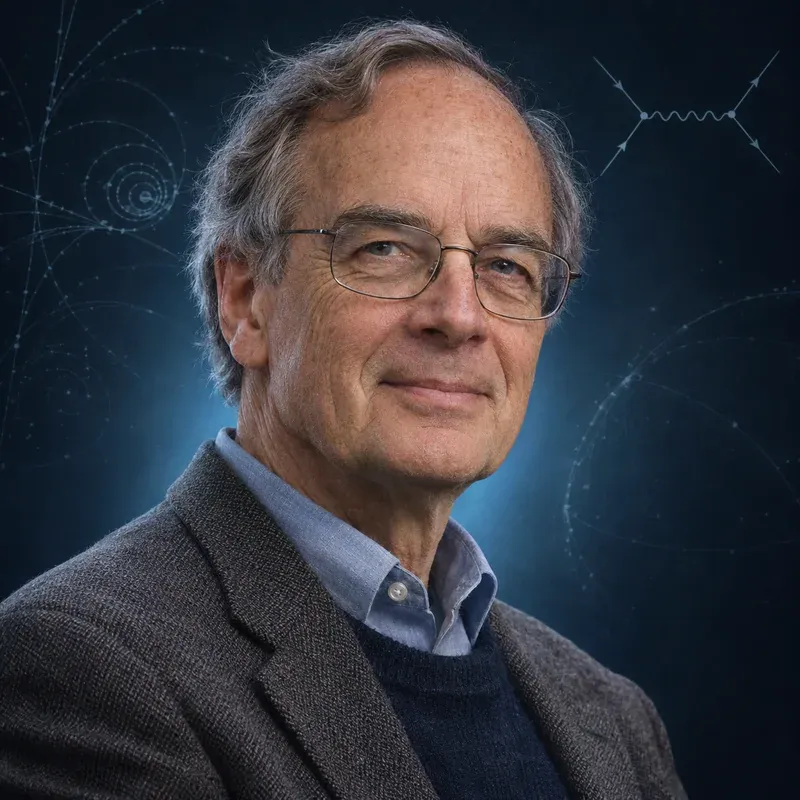
 Illustration
Roger K. Ulrich
Ulrich showed that oscillations seen at the solar surface are acoustic modes trapped in the solar interior, founding helioseismology. With Bahcall he wrote the 1988 Reviews of Modern Physics analysis of standard solar models and their neutrino-flux uncertainties, comparing models with p-mode data. Helioseismic tests of the solar interior showed that the solar neutrino deficit could not be blamed on the solar model.
- Nationality
- American
- Field
- Solar physics; helioseismology
- Institutions
- UCLA, Caltech, Mount Wilson Observatory
Education and career
Roger K. Ulrich studied chemistry as an undergraduate at the University of California, Berkeley, and stayed there for a PhD in astronomy, which he received in 1968. After about eighteen months at the California Institute of Technology from 1969, he joined the University of California, Los Angeles, where he spent the rest of his career. He also worked on instruments at the Mount Wilson Observatory near Pasadena, including improvements to its 60-foot and 150-foot solar tower telescopes.
Key contributions
In the 1960s observers had found that the surface of the Sun moves up and down with periods of about five minutes. In 1970 Ulrich showed that these motions are the visible signature of sound waves trapped inside the Sun, ringing like a bell; John Leibacher and Robert Stein reached a similar conclusion independently. Each mode of oscillation penetrates to a different depth, so precise measurement of their frequencies works like seismology on Earth and reveals the temperature, density and rotation of the solar interior. Ulrich’s predictions of the pattern of modes were later confirmed by ground-based and space-based observations, and the field became known as helioseismology.
This mattered directly for neutrino physics. The solar neutrino problem raised the possibility that the standard solar model overestimated the core temperature, which strongly controls the flux of boron-8 neutrinos. In 1988 Ulrich and John Bahcall published a detailed review in Reviews of Modern Physics that combined solar models, their predicted neutrino fluxes and uncertainties, and the helioseismic data then available. As helioseismic measurements improved through the 1990s, the measured sound speed in the solar interior matched the standard model to a fraction of a percent. The solar model was not the culprit, which strengthened the case that neutrinos themselves change flavour, as SNO later showed.
Recognition
Ulrich received the Arctowski Medal of the US National Academy of Sciences in 2002. In 2022 he shared the Kavli Prize in Astrophysics with Conny Aerts and Jørgen Christensen-Dalsgaard for pioneering work and leadership in the development of helio- and asteroseismology.
Known for
- Founding helioseismology (interpretation of solar 5-minute oscillations)
- Bahcall–Ulrich solar model review (1988)
- Kavli Prize in Astrophysics 2022
Chronology
- 1968PhD in astronomy, UC Berkeley
- 1970Interpretation of the 5-minute oscillations as interior acoustic modes
- 1988Bahcall–Ulrich review of solar models
- 2022Kavli Prize in Astrophysics
Original papers
- R. K. Ulrich, The five-minute oscillations on the solar surface, Astrophys. J. 162, 993 (1970)
- J. N. Bahcall, R. K. Ulrich, Solar models, neutrino experiments, and helioseismology, Rev. Mod. Phys. 60, 297 (1988)DOI 10.1103/RevModPhys.60.297
Experiments
Connected people
Frequently asked questions
What is helioseismology?
The study of the Sun’s interior through its surface oscillations. Sound waves trapped inside the Sun make the surface move with periods of minutes; their frequencies reveal conditions at different depths.
How did helioseismology help solve the solar neutrino problem?
It measured the interior of the Sun independently of neutrinos and found it in close agreement with the standard solar model. The missing neutrinos therefore had to be explained by neutrino physics, namely flavour change.
Mentioned in 4 pages
Last updated: · Editorial standard
Cite this page
Text
Neutrino Atlas (2026). “Roger K. Ulrich”. Retrieved 22 November 2026, from https://neutrino-atlas.com/people/roger-ulrich/BibTeX
@misc{neutrinoatlas2026peoplerogerulrich,
  title        = {Roger K. Ulrich},
  author       = {{Neutrino Atlas}},
  year         = {2026},
  url          = {https://neutrino-atlas.com/people/roger-ulrich/},
  note         = {Accessed 2026-11-22},
  language     = {english}
}