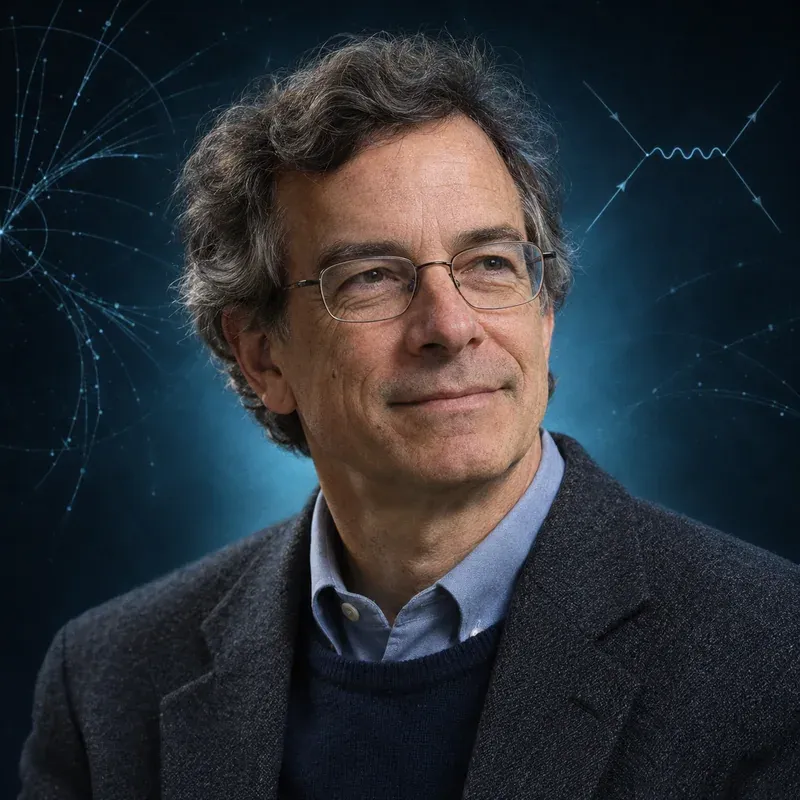
 Illustration
Marc H. Pinsonneault
Pinsonneault was John Bahcall's main collaborator on standard solar models from the early 1990s, adding helium and heavy-element diffusion and updated opacities to the BP92, BP95 and BP00 models. These models gave the reference solar neutrino fluxes that, compared with Homestake, gallium, Super-Kamiokande and SNO data, established that the solar neutrino deficit required neutrino flavour change.
- Field
- Stellar structure and evolution; solar models
- Institutions
- Ohio State University, Yale University (PhD 1988)
Education
Marc H. Pinsonneault studied physics at the University of Texas at Austin (BS 1983) and received his PhD in astronomy from Yale University in 1988, where he worked on models of rotating stars. He is a professor of astronomy at Ohio State University, which named him a University Distinguished Scholar in 2017.
Solar models with John Bahcall
A standard solar model is a computer model of the Sun built from the equations of stellar structure, nuclear reaction rates, opacities and an assumed initial composition. It is evolved for 4.6 billion years and adjusted until it matches today's radius and luminosity. The result predicts the flux of each type of solar neutrino, from the low-energy pp neutrinos to the rare high-energy boron-8 neutrinos.
From the early 1990s Pinsonneault was the main collaborator of John Bahcall on these models. Their 1992 Reviews of Modern Physics paper added the slow settling of helium toward the solar centre. The BP95 model, with Gerald Wasserburg, included the diffusion of heavier elements as well, and the BP98 and BP2000 models, with Sarbani Basu, used improved opacities and equations of state. Helioseismology, the study of the Sun's oscillations, showed that these models reproduced the sound speed inside the Sun to about 0.1 percent.
This mattered for neutrino physics. Because the models were tested independently and their uncertainties carefully estimated, the deficit seen by Homestake, the gallium experiments and Super-Kamiokande could not plausibly be blamed on the Sun. In 2001–2002 SNO measured the total boron-8 flux of all flavours through the neutral current and found it in agreement with the model, while the electron-neutrino part was only about a third. The solar neutrino problem was thus resolved by neutrino flavour change.
Later work
Pinsonneault's later research concerns stellar rotation and angular-momentum evolution, stellar ages and abundances, and asteroseismology, combining Kepler data with spectroscopic surveys such as APOGEE. With Barbara Ryden he wrote the textbook 'Stellar Structure and Evolution' (2023).
Known for
- Bahcall–Pinsonneault standard solar models (BP92, BP95, BP00)
- Element diffusion in solar models
- Stellar rotation and angular-momentum evolution
- Asteroseismology with Kepler/APOGEE
Chronology
- 1988PhD at Yale
- 1992Bahcall–Pinsonneault solar models with diffusion
- 1995BP95 standard solar model
- 2001BP00 model (with Basu)
Original papers
- J. N. Bahcall, M. H. Pinsonneault, Standard solar models, with and without helium diffusion, and the solar neutrino problem, Rev. Mod. Phys. 64, 885 (1992)DOI 10.1103/RevModPhys.64.885
- J. N. Bahcall, M. H. Pinsonneault, S. Basu, Solar models: current epoch and time dependences, neutrinos, and helioseismological properties, Astrophys. J. 555, 990 (2001)arXiv:astro-ph/0010346
Experiments
- Sanford Underground Research Facility (SURF)
- SNO (Sudbury Neutrino Observatory)
- Super-Kamiokande
- Borexino
Connected people
Frequently asked questions
How did SNO test the Bahcall–Pinsonneault models?
SNO's heavy-water detector measured the boron-8 neutrino flux of all flavours together. The result matched the solar-model prediction, showing that the Sun produced the expected neutrinos and that the missing electron neutrinos had changed flavour.
Are solar models still uncertain?
Yes, in one respect. Newer analyses of the solar spectrum give lower abundances of heavy elements, and models using them agree less well with helioseismology. This is the solar metallicity problem, which measurements of CNO neutrinos can help resolve.
Mentioned in 3 pages
Terms 1
Last updated: · Editorial standard
Cite this page
Text
Neutrino Atlas (2026). “Marc H. Pinsonneault”. Retrieved 22 November 2026, from https://neutrino-atlas.com/people/marc-pinsonneault/BibTeX
@misc{neutrinoatlas2026peoplemarcpinsonneault,
  title        = {Marc H. Pinsonneault},
  author       = {{Neutrino Atlas}},
  year         = {2026},
  url          = {https://neutrino-atlas.com/people/marc-pinsonneault/},
  note         = {Accessed 2026-11-22},
  language     = {english}
}