Homestake Chlorine Experiment
Ray Davis's pioneering radiochemical detector that first measured solar neutrinos and found too few.
A 615-tonne tank of tetrachloroethylene (C₂Cl₄) deep in the Homestake gold mine captured solar ν_e via ³⁷Cl → ³⁷Ar. Over about 25 years it measured 2.56 ± 0.23 SNU, roughly one third of the Standard Solar Model prediction. This was the original 'solar neutrino problem'. Davis shared the 2002 Nobel Prize.
Compare all experiments → · World map →
In plain words
Ray Davis's idea was to let solar neutrinos turn a few chlorine atoms into argon and then find those argon atoms. In a tank of cleaning fluid the size of a large swimming pool, the Sun produced only about one argon atom every two days. Extracting and counting such tiny quantities from hundreds of tonnes of liquid was the central achievement of the experiment.
How the detector works
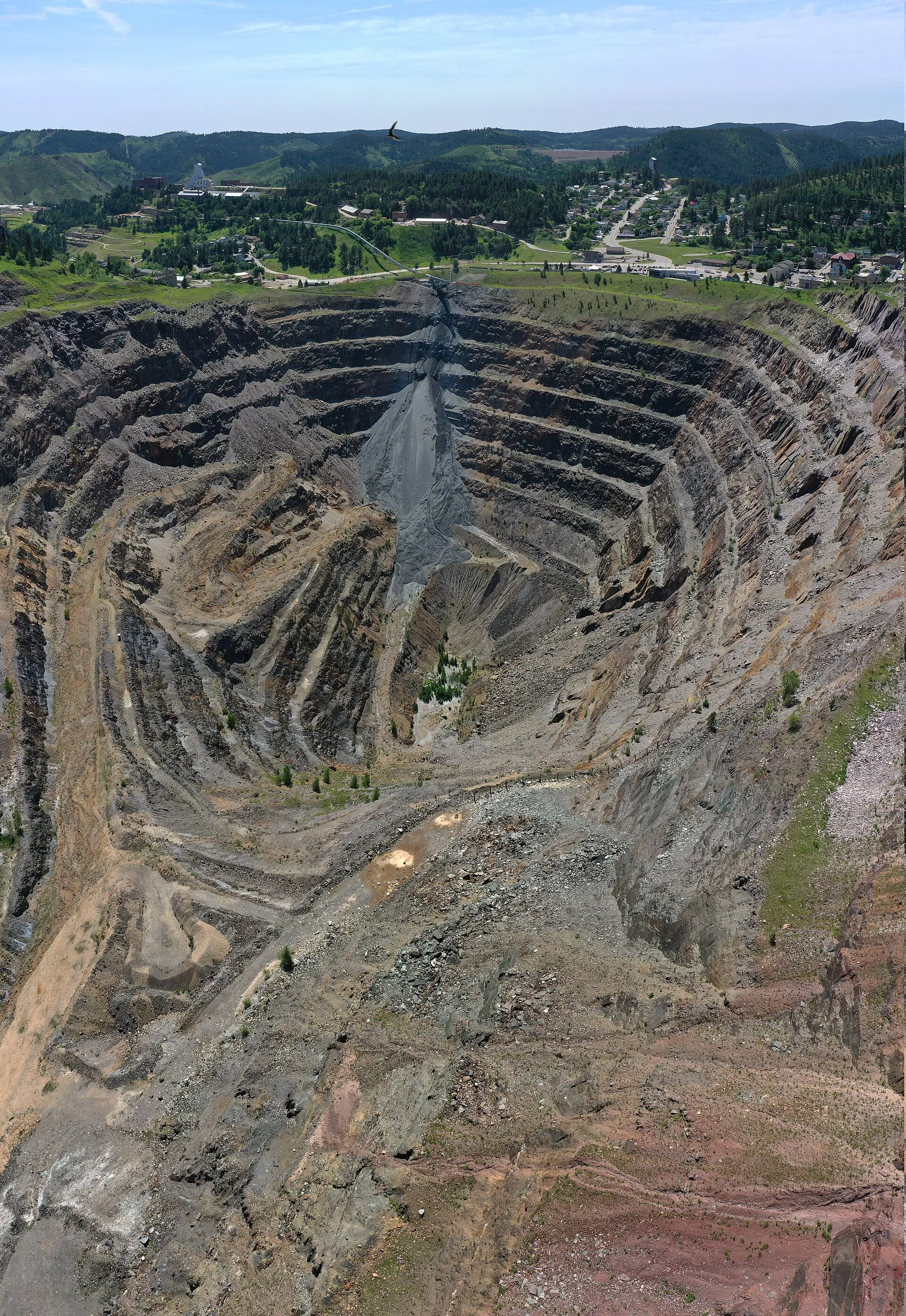
The detector stood 1478 metres underground in the Homestake gold mine in Lead, South Dakota, where the rock shielded it from cosmic rays. The tank held 615 tonnes, about 380,000 litres, of tetrachloroethylene (C₂Cl₄). A solar electron neutrino with more than 814 keV can convert ³⁷Cl into radioactive ³⁷Ar.
Every one to three months, helium was bubbled through the tank to sweep out the argon, which was collected on a charcoal trap, purified and loaded into small proportional counters. The counters recorded the 2.8 keV Auger electrons emitted when ³⁷Ar decays back to chlorine. Known amounts of carrier argon added before each run measured the extraction efficiency, typically above 90 per cent.
Key results
The first result in 1968 by Davis, Don Harmer and Kenneth Hoffman gave only an upper limit, already below John Bahcall's prediction. Regular measurements ran from 1970 to 1994. The final analysis, led by Bruce Cleveland and published in 1998, gave 2.56 ± 0.16 (stat.) ± 0.16 (syst.) SNU, about one third of the standard solar model prediction of roughly 8 SNU. The chlorine reaction is mostly sensitive to ⁸B and ⁷Be neutrinos.
Why it matters for neutrino physics
Homestake defined the solar neutrino problem and kept it alive for decades, despite doubts about the radiochemistry and the solar model. The deficit was later explained by flavour conversion. Raymond Davis Jr. shared the 2002 Nobel Prize in Physics. The mine is now the Sanford Underground Research Facility, home of the far detector of DUNE.
Frequently asked questions
Why did Davis use a dry-cleaning fluid?
Tetrachloroethylene is rich in chlorine, cheap, non-flammable and available in large quantities, and argon can be removed from it efficiently by purging with helium.
How many argon atoms were produced?
On average about 0.5 atoms of ³⁷Ar per day from solar neutrinos, so a typical two-month exposure yielded only a few dozen atoms, of which some decayed before extraction.
Original papers
- First resultR. Davis Jr., D. S. Harmer and K. C. Hoffman, Search for Neutrinos from the Sun, Phys. Rev. Lett. 20, 1205 (1968)DOI 10.1103/PhysRevLett.20.1205
- Final resultB. T. Cleveland et al., Measurement of the Solar Electron Neutrino Flux with the Homestake Chlorine Detector, Astrophys. J. 496, 505 (1998)DOI 10.1086/305343
Related terms
People
- Bruno Pontecorvo
- John Norris Bahcall
- Masatoshi Koshiba
- Raymond Davis Jr.
- Bruce T. Cleveland
- Kenneth Lande
- Luis W. Alvarez
On the timeline
- 1946Pontecorvo proposes the chlorine-argon detector
- 1964Bahcall and Davis propose a solar neutrino test
- 1968Homestake finds too few solar neutrinos
- 1998Homestake publishes its final solar result
- 2002Nobel Prize for neutrino astrophysics
Mentioned in 59 pages
FAQ 4
Comparisons 1
Milestones 9
- 1946 · Pontecorvo proposes the chlorine-argon detector
- 1964 · Bahcall and Davis propose a solar neutrino test
- 1968 · Homestake finds too few solar neutrinos
- 1969 · Oscillations proposed to explain the solar deficit
- 1978 · Wolfenstein: matter changes neutrino oscillations
- 1998 · Homestake publishes its final solar result
- 2002 · Nobel Prize for neutrino astrophysics
- 2002 · SNO measures the total solar neutrino flux
People 21
Terms 22
- Boron-8 neutrinos
- Chlorine–Argon method
- Detection principles & detector technology
- Disappearance measurement
- Discovery of neutrino oscillations
- Electron neutrino
- Energy threshold
- Event rate
14 more
- Mixing angle θ12
- Neutrino astronomy
- Neutrino capture on nuclei
- Neutrino oscillation physics
- Radiochemical detectors
- Radiochemical signal (transmutation)
- Sanford Underground Research Facility (SURF)
- Solar neutrino experiments
- Solar neutrino problem
- Solar neutrino unit (SNU)
- Solar neutrinos
- Standard solar Model
- Underground depth & metres water equivalent
- Underground laboratories
Last updated: · Editorial standard
Cite this page
Text
Neutrino Atlas (2026). “Homestake Chlorine Experiment”. Retrieved 22 November 2026, from https://neutrino-atlas.com/terms/homestake/BibTeX
@misc{neutrinoatlas2026termshomestake,
  title        = {Homestake Chlorine Experiment},
  author       = {{Neutrino Atlas}},
  year         = {2026},
  url          = {https://neutrino-atlas.com/terms/homestake/},
  note         = {Accessed 2026-11-22},
  language     = {english}
}