Underground laboratories
Deep laboratories in mines and road tunnels that shield experiments from cosmic rays.
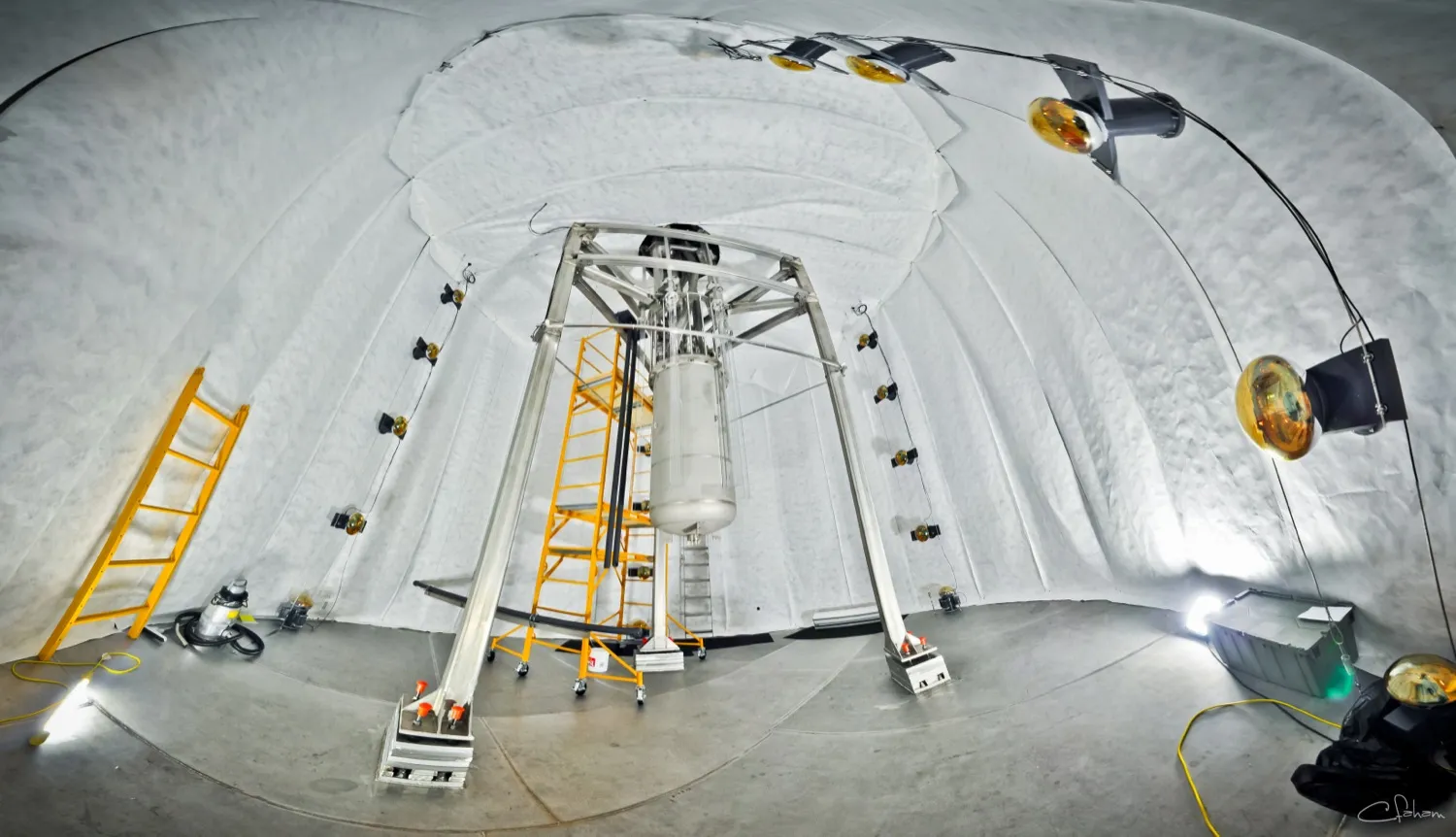
Most low-energy neutrino, double beta decay and dark matter experiments are hosted underground, under 1000–7000 m.w.e. of rock. Laboratories are either in mines (Kamioka, SNOLAB, SURF, Boulby) or beside road tunnels (LNGS, Modane, Canfranc, Jinping), with horizontal access being a major logistic advantage.
- 1Boulby Underground LaboratoryUnderground laboratory
- 2Laboratorio Subterráneo de Canfranc (LSC)Underground laboratory
- 3Laboratoire Souterrain de Modane (LSM)Underground laboratory
- 4Laboratori Nazionali del Gran Sasso (LNGS)Underground laboratory
- 5KM3NeTNeutrino telescope
- 6Neutrino Energy Group, BerlinNeutrinovoltaic research
- 7Baksan Neutrino ObservatoryUnderground laboratory
- 8Baikal-GVDNeutrino telescope
- 9China Jinping Underground Laboratory (CJPL)Underground laboratory
- 10JUNOReactor experiment
- 11Kamioka ObservatoryUnderground laboratory
- 12SNOLABUnderground laboratory
- 13Sanford Underground Research Facility (SURF)Underground laboratory
- 14IceCube Neutrino ObservatoryNeutrino telescope
In plain words
At the Earth's surface, roughly one cosmic-ray muon passes through every square centimetre each minute. For a detector waiting for a handful of neutrino interactions per day, that rain of muons and the radioactivity it creates would drown the signal. The cure is rock. Under a kilometre or more of mountain or mine, the muon flux falls by a factor of about a million, and experiments become quiet enough to hear neutrinos, rare decays or dark matter.
How laboratories are compared
Depth is quoted in metres of water equivalent (m.w.e.), the thickness of water that would give the same shielding; this makes laboratories in granite, limestone and salt comparable (see underground depth). What really matters is the remaining muon flux, which ranges from about one muon per square metre per hour at LNGS to fewer than ten per square metre per month at SNOLAB and CJPL. Other qualities count too: the natural radioactivity and radon level of the rock, the size of the halls, and access. A drive-in road tunnel lets trucks deliver tonnes of equipment at any time, while a mine shaft limits the size of each part and shares the cage with mining operations.
The laboratories in this catalogue
- LNGS in Italy, the largest, beside a motorway tunnel under the Gran Sasso.
- Kamioka in Japan, home of Kamiokande, Super-Kamiokande and KamLAND.
- SNOLAB in Canada, 2 km down in an active nickel mine.
- SURF in the United States, the former Homestake gold mine and future site of DUNE.
- Baksan in Russia, under Mount Andyrchi in the Caucasus.
- CJPL in China, the deepest, under the Jinping mountains.
- Boulby in the UK, in a salt and polyhalite mine.
- Modane in France, beside the Fréjus road tunnel.
- Canfranc in Spain, beside the Somport tunnel in the Pyrenees.
Newer sites include Yemilab in South Korea and the Stawell laboratory in Australia.
History
The first deep experiments used existing mines: in 1965 Frederick Reines's group in a South African gold mine and an Indian–Japanese–British team in the Kolar Gold Fields independently recorded the first atmospheric neutrinos, and Ray Davis built his chlorine detector in the Homestake mine. Searches for proton decay around 1980 led to dedicated laboratories at Kamioka, Modane and Gran Sasso, and the solar neutrino problem drove SNO and the gallium experiments.
Why it matters for neutrino physics
Nearly every low-energy measurement, from solar neutrinos and geoneutrinos to neutrinoless double beta decay, and every supernova watch detector, needs it. It works together with muon vetoes and shielding in the halls.
Frequently asked questions
Why are some laboratories in road tunnels and others in mines?
It depends on what geography offers. Road tunnels under high mountains give great depth with horizontal access, while mines provide depth where no such mountains exist and often have existing infrastructure.
Go deeper
- Laboratori Nazionali del Gran Sasso (LNGS)Italy's INFN laboratory under the Gran Sasso massif, the largest underground research centre in the world.
- Kamioka ObservatoryThe University of Tokyo's ICRR laboratory in the Mozumi mine, home of the Kamiokande family of detectors.
- SNOLABA clean-room laboratory 2 km underground in the Creighton nickel mine near Sudbury, Canada.
- Sanford Underground Research Facility (SURF)The former Homestake gold mine in South Dakota, birthplace of solar neutrino experiments and future home of DUNE.
- Baksan Neutrino ObservatoryA Russian laboratory in a tunnel under Mount Andyrchi in the North Caucasus.
- China Jinping Underground Laboratory (CJPL)The world's deepest underground laboratory, inside a mountain in Sichuan, China.
- Boulby Underground LaboratoryThe UK's deep laboratory in an active potash and salt mine in North Yorkshire.
- Laboratoire Souterrain de Modane (LSM)The French underground laboratory beside the Fréjus road tunnel in the Alps.
- Laboratorio Subterráneo de Canfranc (LSC)The Spanish underground laboratory under Monte Tobazo in the Pyrenees.
- Soudan Underground LaboratoryA laboratory about 710 m deep in a former iron mine in Minnesota that hosted Soudan 2, the MINOS far detector and CDMS.
- Stawell Underground Physics Laboratory (SUPL)Australia's deep underground laboratory, about 1 km down in the Stawell gold mine in Victoria, opened in 2022 and home to SABRE South.
- YemilabSouth Korea's deep underground laboratory, about 1,000 m below Mount Yemi in an operating iron mine, completed in 2022.
Related terms
Mentioned in 13 pages
Lessons 1
FAQ 3
Last updated: · Editorial standard
Cite this page
Text
Neutrino Atlas (2026). “Underground laboratories”. Retrieved 22 November 2026, from https://neutrino-atlas.com/terms/underground-laboratories/BibTeX
@misc{neutrinoatlas2026sundergroundlaboratories,
  title        = {Underground laboratories},
  author       = {{Neutrino Atlas}},
  year         = {2026},
  url          = {https://neutrino-atlas.com/terms/underground-laboratories/},
  note         = {Accessed 2026-11-22},
  language     = {english}
}