Soudan Underground Laboratory
A laboratory about 710 m deep in a former iron mine in Minnesota that hosted Soudan 2, the MINOS far detector and CDMS.
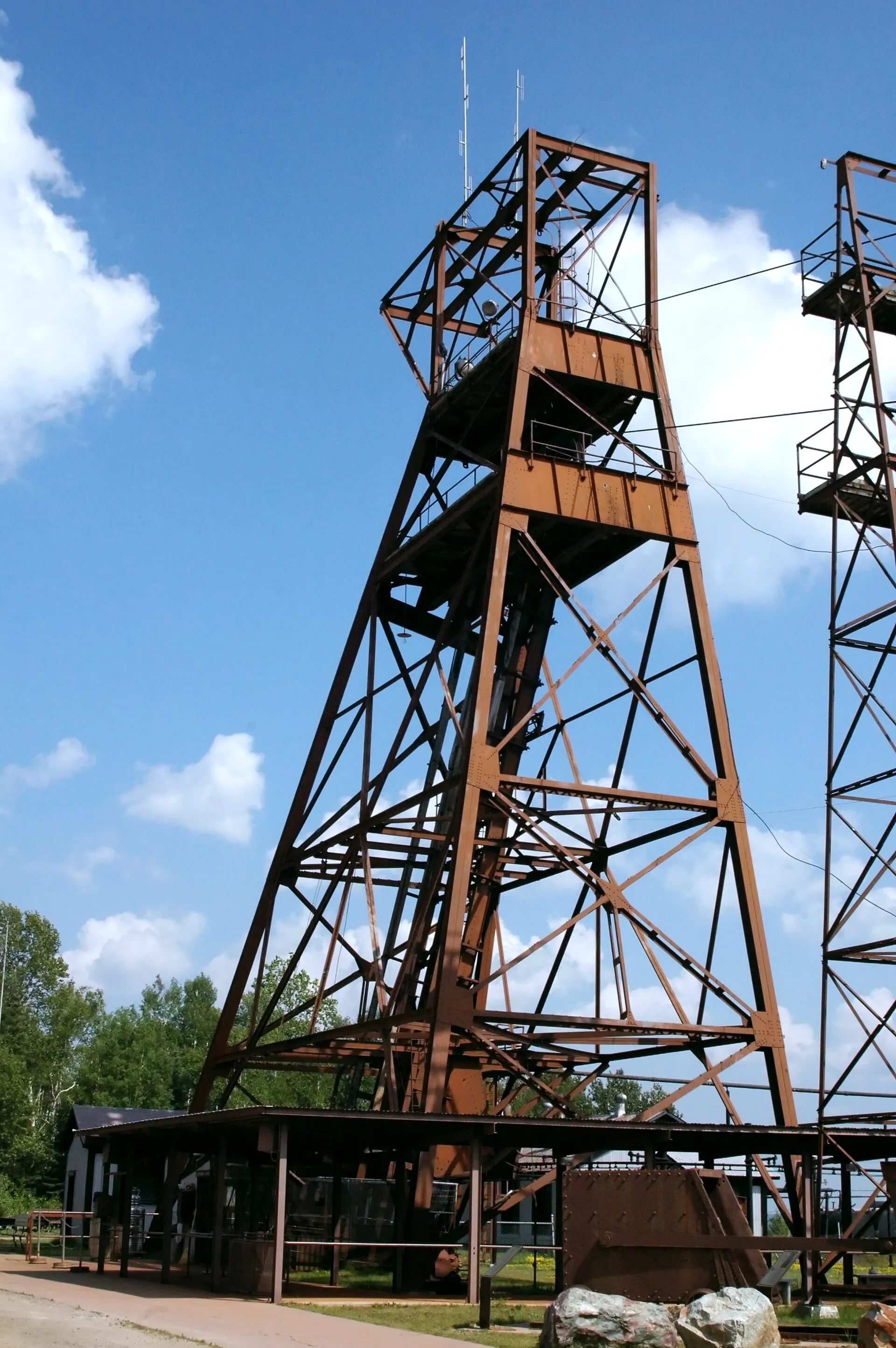
The University of Minnesota laboratory on level 27 of the Soudan iron mine (about 2,100 m water equivalent) began in the early 1980s with proton-decay searches. It hosted the Soudan 2 iron tracking calorimeter, which saw the atmospheric νμ deficit, the 5,400 t MINOS far detector 735 km from Fermilab (2003–2016), and the CDMS dark matter searches. Major experiments ended around 2015–2016.
Compare all experiments → · World map →
In plain words
The Soudan mine in northern Minnesota was the state's first iron mine, worked from 1882 to 1962 and then turned into a state park. Its deep, dry and stable workings, reached by a vertical shaft, made it an attractive home for experiments that need protection from cosmic rays. For about three decades it was one of the main underground sites for particle physics in the United States.
Experiments
University of Minnesota physicist Marvin Marshak founded the laboratory in the early 1980s, on the mine's lowest level about 710 m (2,341 ft) below the surface, roughly 2,100 m water equivalent. Its main experiments were:
- Soudan 1, a small detector of about 30 tonnes that searched for proton decay from the early 1980s.
- Soudan 2, an iron tracking calorimeter of about 960 tonnes that ran from 1989 to 2001. Its 5.9 kiloton-year exposure confirmed the deficit of atmospheric muon neutrinos with a detector technology different from the water Cherenkov detectors that first reported it.
- The MINOS far detector, a 5,400 tonne magnetised steel and scintillator calorimeter, 735 km from Fermilab along the NuMI beam, built in a dedicated cavern and operated from 2003 until 2016.
- The Cryogenic Dark Matter Search (CDMS II, later SuperCDMS Soudan), together with smaller experiments such as CoGeNT and a low-background counting facility.
Notable events
On 17 March 2011 a fire broke out in the access shaft. The power to the laboratory was cut and firefighters pumped water and foam down the shaft, some of which reached the caverns. The MINOS detector was not damaged, although its magnet coil had to be dried, and the experiments resumed after a new power cable was installed.
Status today
CDMS ended at Soudan and moved its programme to SNOLAB, and the MINOS far detector shut down when its beam run ended in 2016. The large experiments were then dismantled. The US deep-underground programme is now centred on the Sanford Underground Research Facility, which will host the far detector of DUNE.
Frequently asked questions
How deep is the Soudan laboratory?
It lies about 710 m (2,341 ft) underground on the mine's 27th level, giving a shielding of roughly 2,100 m water equivalent.
Why was MINOS placed at Soudan?
The mine lies on a straight line from Fermilab at a distance of 735 km, suitable for the oscillation parameters suggested by atmospheric neutrinos, and offered existing deep access.
Related terms
- MINOS / MINOS+
- Soudan 2
- Underground depth & metres water equivalent
- NuMI Beam
- Sanford Underground Research Facility (SURF)
Mentioned in 11 pages
Milestones 2
Last updated: · Editorial standard
Cite this page
Text
Neutrino Atlas (2026). “Soudan Underground Laboratory”. Retrieved 22 November 2026, from https://neutrino-atlas.com/terms/soudan-lab/BibTeX
@misc{neutrinoatlas2026termssoudanlab,
  title        = {Soudan Underground Laboratory},
  author       = {{Neutrino Atlas}},
  year         = {2026},
  url          = {https://neutrino-atlas.com/terms/soudan-lab/},
  note         = {Accessed 2026-11-22},
  language     = {english}
}