2006Experiment
MINOS confirms muon-neutrino disappearance
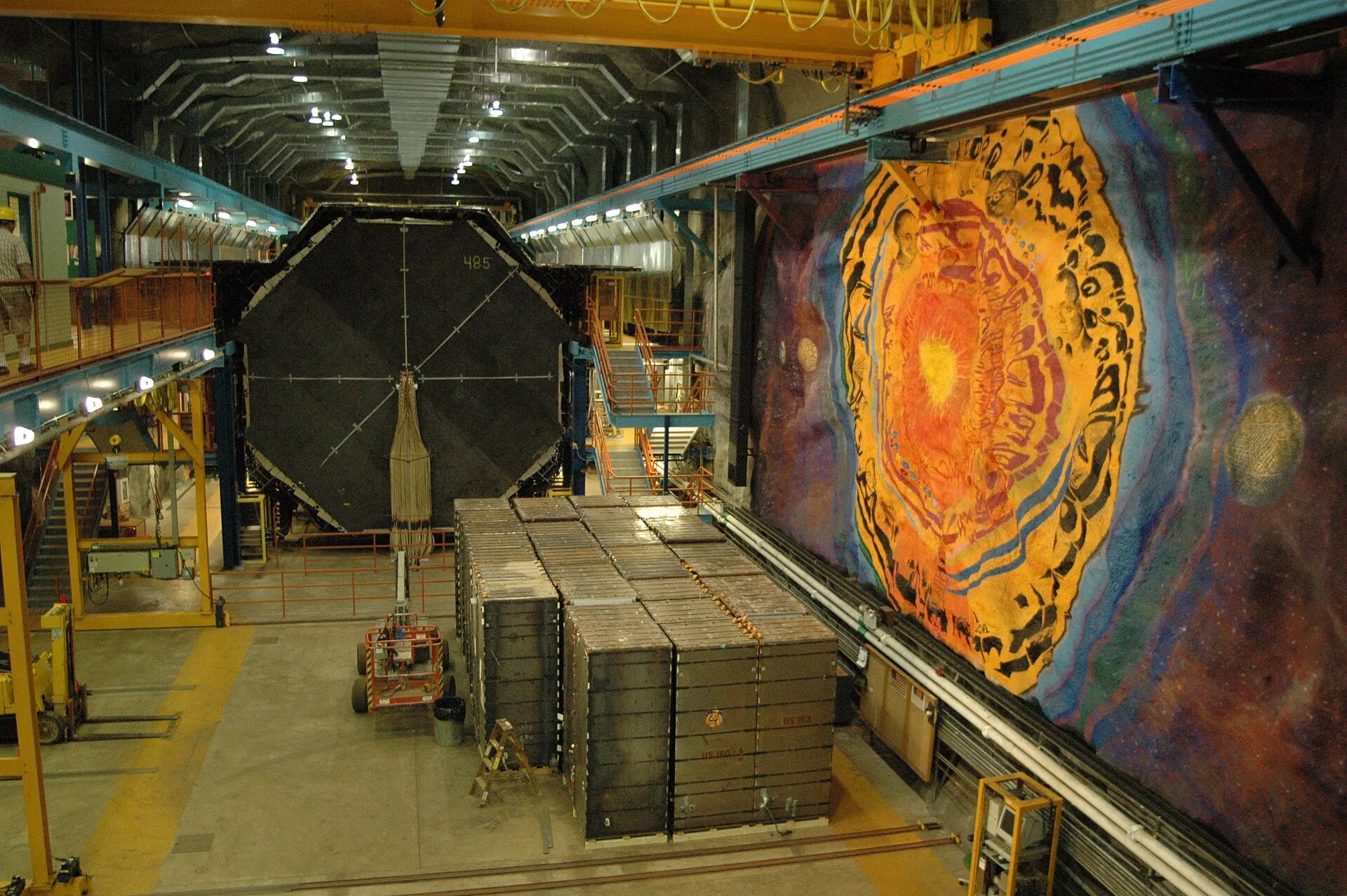
MINOS sent Fermilab's NuMI beam 735 km to a magnetised steel-scintillator detector in the Soudan mine in Minnesota, with a near detector at Fermilab. In 2006 it reported a deficit of muon neutrinos with an energy-dependent distortion consistent with oscillation. Its data provided a precise measurement of the atmospheric mass-squared difference, and later it compared neutrinos and antineutrinos.
- Date
- 2006
- Kind of event
- Experiment
- People involved
- Stanley Wojcicki
- Experiments
- MINOS / MINOS+, NuMI Beam
The situation before
By 2005 the atmospheric oscillation discovered by Super-Kamiokande had been seen in a first accelerator test: K2K sent a beam 250 km across Japan and found fewer muon neutrinos than expected. But K2K's beam was weak and its sample small, and the mass-squared difference was still known only to tens of percent. The next step needed a controlled beam of much higher intensity, a longer baseline and a pair of detectors that would cancel uncertainties in the flux.
Fermilab built the NuMI beamline for this purpose. Protons from the Main Injector at 120 GeV struck a graphite target, and magnetic horns focused the pions that decayed into muon neutrinos aimed at northern Minnesota. MINOS, proposed and led for many years by Stanley Wojcicki of Stanford, placed a 1-kilotonne near detector at Fermilab and a 5.4-kilotonne far detector 735 km away, deep in the Soudan iron mine. Both were magnetised steel-and-scintillator tracking calorimeters of the same design, so that most detector effects cancel in the comparison.
What happened
The NuMI beam began regular operation in 2005. On 30 March 2006 MINOS presented its first oscillation result at Fermilab, based on 1.27 × 10²⁰ protons on target collected up to February 2006.
- Muon-neutrino charged-current events at the far detector below 30 GeV: 215 observed, 336 ± 14 expected without oscillation.
- The deficit was concentrated at low energies, as oscillation predicts for a 735 km baseline, rather than spread evenly.
- Best fit: |Δm²₃₂| = 2.74 (+0.44 −0.26) × 10⁻³ eV² and sin²2θ₂₃ > 0.87 at 68 percent confidence.
The result was published as „Observation of muon neutrino disappearance with the MINOS detectors and the NuMI neutrino beam“ in Physical Review Letters 97, 191801 (2006). It was achieved in the year the experiment lost one of its leaders: co-spokesperson Douglas Michael of Caltech had died in December 2005.
Why it matters
MINOS confirmed atmospheric-type oscillation with a man-made beam and showed that the near–far method could deliver precise disappearance measurements. With more data the mass splitting was narrowed to a few percent. MINOS went on to study antineutrinos by reversing the horn current, set early limits on θ13 and on sterile neutrinos, and handed the NuMI beam to NOvA and MINERvA after 2012. Its measurement of Δm²₃₁, as the splitting is now usually written, remained a pillar of global fits for a decade.
Frequently asked questions
What did MINOS find in 2006?
A deficit of muon neutrinos at its far detector 735 km from Fermilab, 215 events instead of 336, with the energy dependence expected from oscillation.
Why does MINOS have two detectors?
Comparing a near detector at Fermilab with an identical far detector in Minnesota cancels most uncertainties in the beam flux and in neutrino interactions, leaving the oscillation effect.
Original papers
- First resultD. G. Michael et al. (MINOS), Observation of muon neutrino disappearance with the MINOS detectors and the NuMI neutrino beam, Phys. Rev. Lett. 97, 191801 (2006)DOI 10.1103/PhysRevLett.97.191801arXiv:hep-ex/0607088
Concepts
Last updated: · Editorial standard
Cite this page
Text
Neutrino Atlas (2026). “2006: MINOS confirms muon-neutrino disappearance”. Retrieved 22 November 2026, from https://neutrino-atlas.com/timeline/2006-minos-first-result/BibTeX
@misc{neutrinoatlas2026line2006minosfirstresult,
  title        = {2006: MINOS confirms muon-neutrino disappearance},
  author       = {{Neutrino Atlas}},
  year         = {2026},
  url          = {https://neutrino-atlas.com/timeline/2006-minos-first-result/},
  note         = {Accessed 2026-11-22},
  language     = {english}
}