2004Experiment
KamLAND observes the oscillation spectrum
With more data, KamLAND reported a distortion of the reactor antineutrino energy spectrum that matched the oscillation pattern predicted for the solar parameters. The result, published in early 2005, gave the most precise value of the solar mass-squared difference, about 8 × 10⁻⁵ eV². Later data showed nearly a full oscillation cycle in L/E.
- Date
- 2004
- Kind of event
- Experiment
- People involved
- Atsuto Suzuki
- Experiments
- KamLAND
The situation before
KamLAND's first result in December 2002 had shown that about 40 percent of reactor antineutrinos go missing over roughly 180 km. A rate deficit, however, pins down the oscillation parameters only loosely, and it could in principle be mimicked by other mechanisms such as neutrino decay. Oscillation makes a further prediction: because the probability depends on L/E, low-energy and high-energy antineutrinos should be suppressed by different amounts, so the measured energy spectrum should be distorted in a characteristic way. Testing the shape, not just the rate, needed more data.
What happened
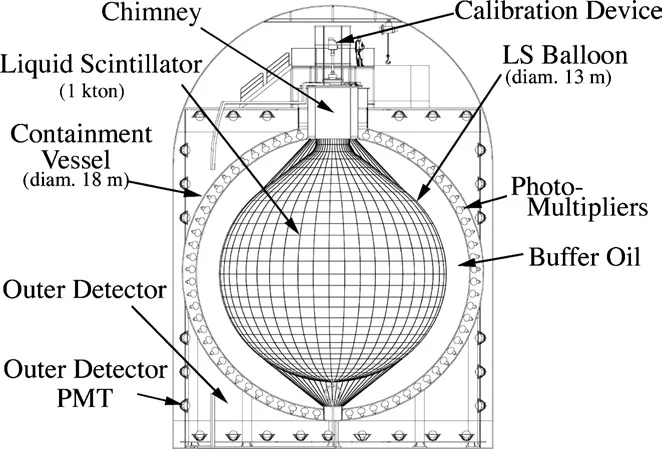
In June 2004 the collaboration led by Atsuto Suzuki presented an analysis of data taken from March 2002 to January 2004, with an enlarged fiducial volume and an exposure of 766 tonne-years, almost five times the first result. Above a prompt-energy threshold of 2.6 MeV it counted 258 events, where 365 ± 24 were expected without oscillation.
- The spectral shape disagreed with the no-oscillation expectation at 99.6 percent confidence.
- Neutrino decay and decoherence, which predict different spectral shapes, were disfavoured.
- A two-flavour fit gave Δm² = 7.9 (+0.6 −0.5) × 10⁻⁵ eV² when combined with solar data, with tan²θ ≈ 0.40.
The paper, „Measurement of neutrino oscillation with KamLAND: evidence of spectral distortion“, was published in Physical Review Letters 94, 081801 in February 2005. From then on, reactor data fixed Δm²₂₁ more precisely than any solar experiment, while solar data remained stronger on the mixing angle θ12.
Consequences
KamLAND kept running and improved the result. Its 2008 analysis, with nearly four times more exposure, rejected an undistorted spectrum at more than 5σ and gave Δm²₂₁ = 7.58 × 10⁻⁵ eV² from KamLAND alone. Plotted against L/E, using a flux-weighted average baseline, the data traced the periodic oscillation pattern directly, a rare sight in a single experiment. The combination of KamLAND's mass splitting with the solar mixing angle is still the basis of the solar sector in global fits. The Chinese experiment JUNO aims to measure the same parameters to better than one percent at a single baseline of about 53 km.
Frequently asked questions
What did KamLAND observe in 2004?
A distortion of the reactor antineutrino energy spectrum that matched the pattern predicted by oscillation with the solar parameters, excluding an undistorted spectrum at 99.6 percent confidence.
Which parameter did KamLAND measure best?
The solar mass-squared difference Δm²₂₁, about 8 × 10⁻⁵ eV² in 2004 and 7.58 × 10⁻⁵ eV² in 2008.
Original papers
- DiscoveryT. Araki et al. (KamLAND), Measurement of neutrino oscillation with KamLAND: Evidence of spectral distortion, Phys. Rev. Lett. 94, 081801 (2005)DOI 10.1103/PhysRevLett.94.081801arXiv:hep-ex/0406035
- MeasurementS. Abe et al. (KamLAND), Precision Measurement of Neutrino Oscillation Parameters with KamLAND, Phys. Rev. Lett. 100, 221803 (2008)DOI 10.1103/PhysRevLett.100.221803
Concepts
Last updated: · Editorial standard
Cite this page
Text
Neutrino Atlas (2026). “2004: KamLAND observes the oscillation spectrum”. Retrieved 22 November 2026, from https://neutrino-atlas.com/timeline/2004-kamland-spectral-distortion/BibTeX
@misc{neutrinoatlas2026amlandspectraldistortion,
  title        = {2004: KamLAND observes the oscillation spectrum},
  author       = {{Neutrino Atlas}},
  year         = {2026},
  url          = {https://neutrino-atlas.com/timeline/2004-kamland-spectral-distortion/},
  note         = {Accessed 2026-11-22},
  language     = {english}
}