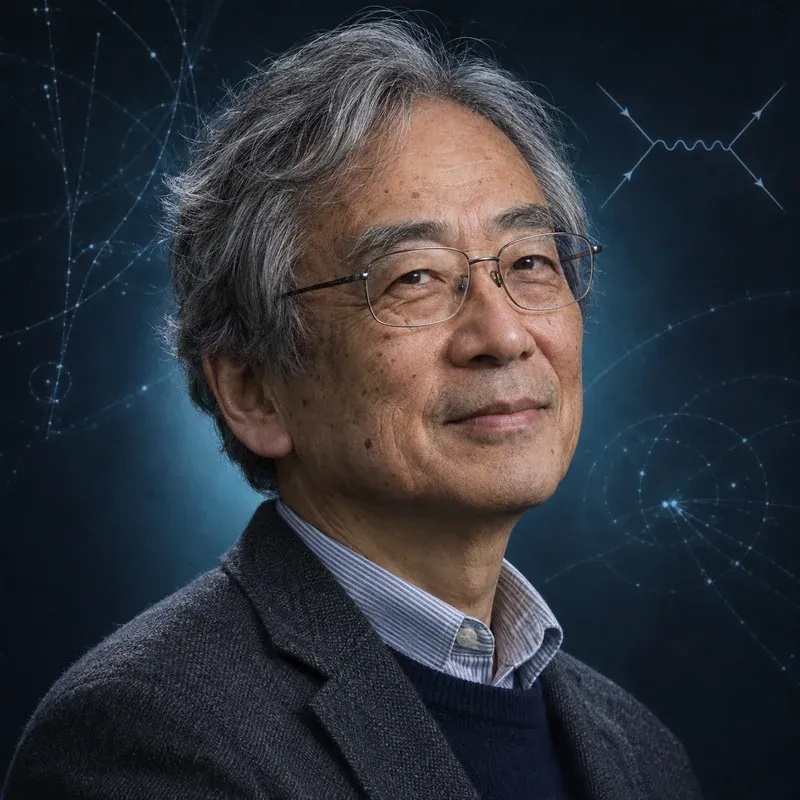
 Illustration
Atsuto Suzuki
Suzuki led the KamLAND experiment, a 1,000-tonne liquid-scintillator detector in the Kamioka mine that measured antineutrinos from Japanese nuclear reactors at an average distance of about 180 km. KamLAND's 2002 result showed reactor antineutrino disappearance, confirming the large-mixing-angle solution to the solar neutrino problem with a terrestrial source. He became director of Tohoku's Research Center for Neutrino Science in 1998.
- Born
- 3 October 1946
Niigata Prefecture, Japan - Nationality
- Japanese
- Field
- Experimental particle physics
- Institutions
- Tohoku University, University of Tokyo, KEK
Education and early career
Atsuto Suzuki was born in 1946 in Niigata prefecture. He studied at Tohoku University in Sendai and received his doctorate there in 1974 under Masatoshi Koshiba, who would later found neutrino astronomy with the Kamiokande detector. In 1982 Suzuki joined the faculty of the University of Tokyo, and in 1993 he took up concurrent professorships at Tohoku University’s Laboratory of Nuclear Science for high-energy physics and at the University of Tokyo’s Institute for Cosmic Ray Research.
Path to neutrino physics
Suzuki was a member of the Kamiokande collaboration during the years in which the water Cherenkov detector turned from a proton-decay search into a neutrino observatory. The Kamiokande-II detector recorded the neutrino burst from SN 1987A in February 1987 and measured solar neutrinos in real time from 1989. The team’s achievements were recognised with the Asahi Prize in 1987 and the Bruno Rossi Prize in 1989. Suzuki also took part in Super-Kamiokande, whose evidence for oscillations of atmospheric neutrinos received a further Asahi Prize in 1998.
Key contributions
When Kamiokande was replaced by Super-Kamiokande in 1996, the old cavern in the Kamioka mine became free. Suzuki, who became director of Tohoku University’s Research Center for Neutrino Science in 1998, led the conversion of that space into KamLAND, the Kamioka Liquid-scintillator Antineutrino Detector. Instead of water it used about 1,000 tonnes of ultra-pure liquid scintillator in a large transparent balloon, viewed by nearly two thousand photomultipliers. Scintillator produces far more light than Cherenkov radiation, allowing KamLAND to detect reactor antineutrinos of a few MeV by inverse beta decay, with the same delayed-coincidence signature that Cowan and Reines had used in 1956. A US collaboration including Giorgio Gratta joined the project; Kunio Inoue was among its leading Japanese members.
The idea was to use the whole of Japan’s nuclear power industry as a single neutrino source. Dozens of reactors lay at distances of roughly 140 to 210 kilometres from Kamioka, with an average baseline of about 180 kilometres. If the solution to the solar neutrino problem was the so-called large-mixing-angle solution, antineutrinos travelling this distance should oscillate and partly disappear. This was a test with a terrestrial, well-understood source of a result derived from the Sun.
KamLAND started taking data in January 2002. Its first result, published at the beginning of 2003, found only about 61 percent of the antineutrinos expected without oscillations, the first observation of reactor antineutrino disappearance. Later data showed the energy spectrum distorted in the oscillatory pattern expected as a function of L/E. Together with SNO, this fixed the solar mass-squared difference Δm²₂₁ and the mixing angle θ₁₂ with high precision, and it showed that the neutrinos and antineutrinos involved obey the same oscillation physics.
In 2005 KamLAND reported the first detection of geoneutrinos: antineutrinos from the decay of uranium and thorium inside the Earth. This opened a new way of measuring the radiogenic heat that helps drive plate tectonics, a field continued today by KamLAND, Borexino and JUNO.
Leadership of KEK and international roles
From 2006 to 2015 Suzuki was Director General of KEK, Japan’s High Energy Accelerator Research Organization in Tsukuba. During his tenure KEK operated the B-factory KEKB, worked with JAEA on the J-PARC complex that supplies the neutrino beam for T2K, and began the upgrade towards SuperKEKB. From 2009 to 2011 he chaired the International Committee for Future Accelerators (ICFA), the body that coordinates planning for large accelerator projects worldwide.
Recognition
Suzuki received the Bruno Pontecorvo Prize of the Joint Institute for Nuclear Research in 2006, the Medal with Purple Ribbon in 2005, and in 2016, together with the KamLAND collaboration and four other neutrino experiments, the Breakthrough Prize in Fundamental Physics. He became a foreign member of the Russian Academy of Sciences in 2011, was named a Person of Cultural Merit in 2021 and was elected to the Japan Academy in 2022.
Known for
- Leader of KamLAND
- First observation of reactor antineutrino disappearance (2002)
- KEK Director General (2006-2015)
- Breakthrough Prize 2016
Chronology
- 1974Doctorate, Tohoku University (advisor Masatoshi Koshiba)
- 1998Director, Research Center for Neutrino Science, Tohoku
- 2002KamLAND reports reactor antineutrino disappearance
- 2006Bruno Pontecorvo Prize; becomes KEK Director General
- 2016Breakthrough Prize in Fundamental Physics (with KamLAND team)
Original papers
- KamLAND Collaboration (K. Eguchi et al.), First results from KamLAND: Evidence for reactor antineutrino disappearance, Phys. Rev. Lett. 90, 021802 (2003)DOI 10.1103/PhysRevLett.90.021802
Experiments
Connected people
Frequently asked questions
What did KamLAND discover under Atsuto Suzuki’s leadership?
It observed the disappearance of reactor antineutrinos over about 180 kilometres (2002–03), confirming neutrino oscillations with a man-made source, and it detected geoneutrinos from inside the Earth for the first time (2005).
How is KamLAND related to Kamiokande?
KamLAND was built in the cavern of the original Kamiokande detector after Kamiokande was retired, replacing water with liquid scintillator to detect low-energy antineutrinos.
What was Suzuki’s role at KEK?
He was Director General of KEK, Japan’s national accelerator laboratory, from 2006 to 2015.
On the timeline
- 2002KamLAND sees reactor antineutrinos disappear
- 2004KamLAND observes the oscillation spectrum
- 2005KamLAND detects geoneutrinos
- 2015Breakthrough Prize honours five oscillation experiments
Mentioned in 10 pages
Milestones 4
Terms 1
Last updated: · Editorial standard
Cite this page
Text
Neutrino Atlas (2026). “Atsuto Suzuki”. Retrieved 22 November 2026, from https://neutrino-atlas.com/people/atsuto-suzuki/BibTeX
@misc{neutrinoatlas2026peopleatsutosuzuki,
  title        = {Atsuto Suzuki},
  author       = {{Neutrino Atlas}},
  year         = {2026},
  url          = {https://neutrino-atlas.com/people/atsuto-suzuki/},
  note         = {Accessed 2026-11-22},
  language     = {english}
}