2015Award
Breakthrough Prize honours five oscillation experiments
The 2016 Breakthrough Prize in Fundamental Physics, announced on 8 November 2015, was awarded to about 1,370 members of five experiments: Daya Bay, K2K and T2K, KamLAND, SNO and Super-Kamiokande. The prize recognised the collective effort behind the discovery and exploration of neutrino oscillations. Leaders such as Wang Yifang, Kam-Biu Luk, Koichiro Nishikawa, Atsuto Suzuki, Arthur McDonald, Yoichiro Suzuki and Takaaki Kajita accepted on behalf of their teams.
- Date
- 8 November 2015
- Kind of event
- Award
- People involved
- Wang Yifang, Kam-Biu Luk, Kōichirō Nishikawa, Atsuto Suzuki, Arthur B. McDonald, Yōichirō Suzuki, Takaaki Kajita
- Experiments
- Daya Bay, K2K, T2K, KamLAND, SNO (Sudbury Neutrino Observatory), Super-Kamiokande
Background
The Breakthrough Prize in Fundamental Physics was founded in 2012 by a group of technology investors around Yuri Milner. With 3 million US dollars per prize it is one of the most valuable awards in science. Unlike the Nobel Prize, which is limited to at most three people per field, it can be given to whole collaborations. The 2015 prize had already gone to the two teams behind the discovery of the accelerating expansion of the universe. A month before the 2016 award was announced, the Nobel Prize in Physics had recognised two individual leaders of oscillation research, Takaaki Kajita and Arthur B. McDonald.
What happened
On 8 November 2015, at a televised ceremony at NASA's Ames Research Center in Mountain View, California, the 2016 Breakthrough Prize in Fundamental Physics was awarded "for the fundamental discovery and exploration of neutrino oscillations, revealing a new frontier beyond, and possibly far beyond, the Standard Model of particle physics". The 3 million dollars were divided among five experiments, and the prize named 1,377 scientists from their collaborations as laureates. The five experiments and the leaders who accepted on their behalf were:
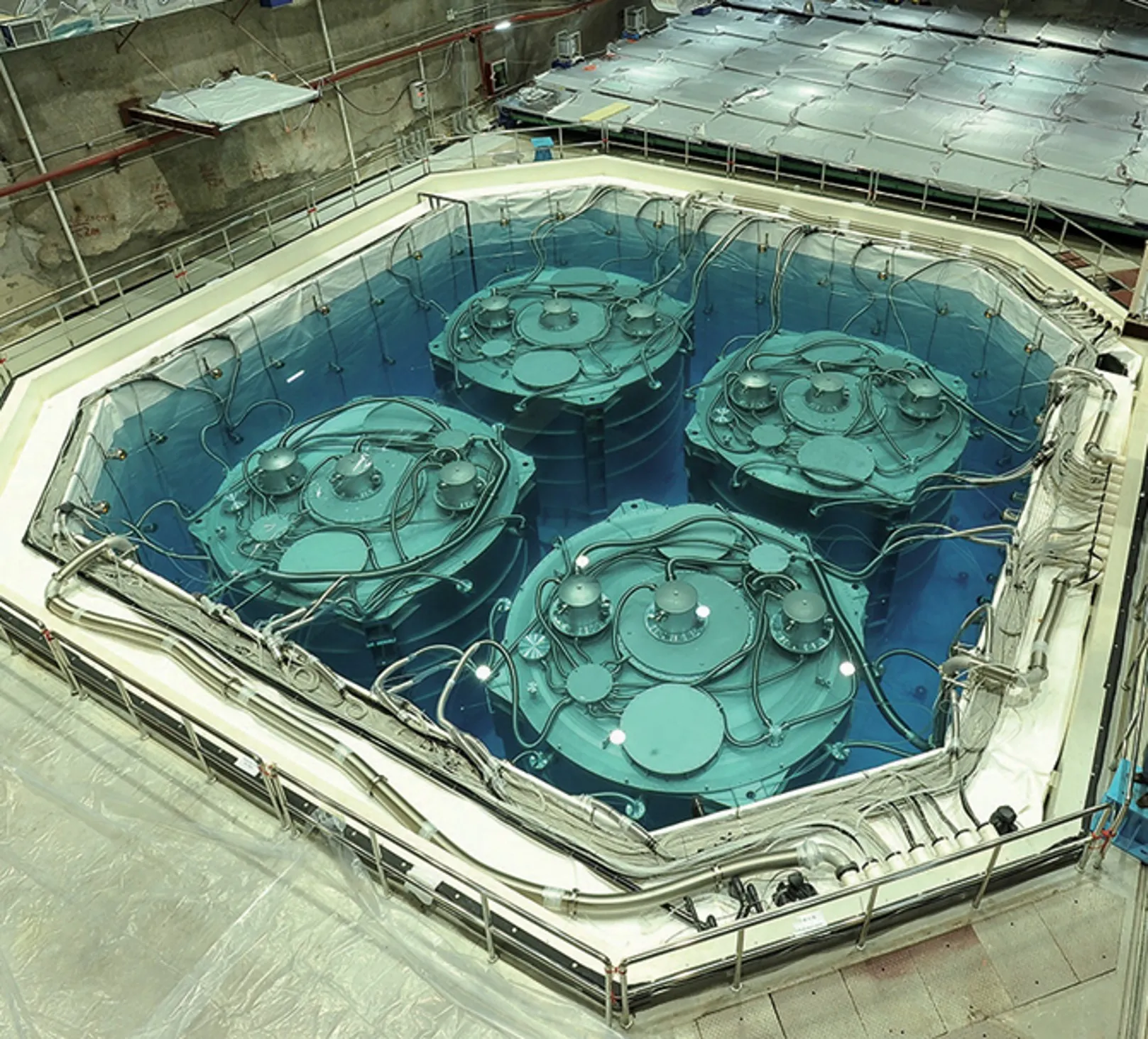
- Daya Bay in China, represented by Wang Yifang and Kam-Biu Luk. In March 2012 it made the first 5σ measurement of the mixing angle θ13 with reactor antineutrinos.
- K2K and T2K in Japan, represented by Koichiro Nishikawa. K2K confirmed the atmospheric oscillation with an accelerator beam from 1999 to 2004; T2K observed electron-neutrino appearance in 2013.
- KamLAND in Japan, represented by Atsuto Suzuki. In 2002 it saw reactor antineutrinos disappear over about 180 km, confirming the solution of the solar neutrino problem in a terrestrial experiment.
- SNO in Canada, represented by Arthur B. McDonald. Its 2001–2002 results showed that solar electron neutrinos change flavour.
- Super-Kamiokande in Japan, represented by Takaaki Kajita and Yoichiro Suzuki. Its 1998 atmospheric result was the first convincing evidence for oscillation, and it later contributed precise solar measurements.
The other 2016 laureates in physics were announced at the same event. The ceremony was hosted by the comedian Seth MacFarlane and broadcast on the National Geographic Channel, part of the founders' aim to give scientists some of the public attention usually reserved for film and sports stars.
Reaction
Laboratories and universities around the world reported the award, often listing their own team members among the laureates. Many commentators saw it as a complement to the Nobel decision: where the Nobel committee had to choose two people, the Breakthrough Prize honoured the engineers, students and physicists who had built and run the detectors over two decades. The experiments were mostly in Asia and North America, but the collaborations included members from Europe and many other regions.
Why it matters
The prize marked how much the field had changed since 1998. Oscillation had moved from a disputed hypothesis to a measured phenomenon described by three mixing angles and two mass splittings, all determined by the honoured experiments. The open questions, such as CP violation and the mass ordering, passed to the next generation: NOvA, JUNO, DUNE and Hyper-Kamiokande. The award also reinforced the practice of recognising large collaborations; in 2016 a special Breakthrough Prize went to the founders and more than a thousand members of LIGO for the detection of gravitational waves.
Frequently asked questions
Who received the 2016 Breakthrough Prize in Fundamental Physics?
1,377 members of five neutrino experiments: Daya Bay, K2K/T2K, KamLAND, SNO and Super-Kamiokande. The prize was announced on 8 November 2015.
How much was the prize worth?
3 million US dollars, divided among the five experiments.
How does it relate to the 2015 Nobel Prize?
The Nobel Prize, announced a month earlier, honoured two individuals, Kajita and McDonald. The Breakthrough Prize honoured the full collaborations behind the discovery and exploration of oscillations.
Original papers
- DiscoveryK. Eguchi et al. (KamLAND Collaboration), First Results from KamLAND: Evidence for Reactor Antineutrino Disappearance, Phys. Rev. Lett. 90, 021802 (2003)DOI 10.1103/PhysRevLett.90.021802
- First resultM. H. Ahn et al. (K2K Collaboration), Indications of Neutrino Oscillation in a 250 km Long-Baseline Experiment, Phys. Rev. Lett. 90, 041801 (2003)DOI 10.1103/PhysRevLett.90.041801arXiv:hep-ex/0212007
- First resultK. Abe et al. (T2K Collaboration), Indication of Electron Neutrino Appearance from an Accelerator-Produced Off-Axis Muon Neutrino Beam, Phys. Rev. Lett. 107, 041801 (2011)DOI 10.1103/PhysRevLett.107.041801arXiv:1106.2822
Concepts
Last updated: · Editorial standard
Cite this page
Text
Neutrino Atlas (2026). “2015: Breakthrough Prize honours five oscillation experiments”. Retrieved 22 November 2026, from https://neutrino-atlas.com/timeline/2015-breakthrough-prize-oscillation/BibTeX
@misc{neutrinoatlas2026kthroughprizeoscillation,
  title        = {2015: Breakthrough Prize honours five oscillation experiments},
  author       = {{Neutrino Atlas}},
  year         = {2026},
  url          = {https://neutrino-atlas.com/timeline/2015-breakthrough-prize-oscillation/},
  note         = {Accessed 2026-11-22},
  language     = {english}
}