2012Application
First message sent with neutrinos
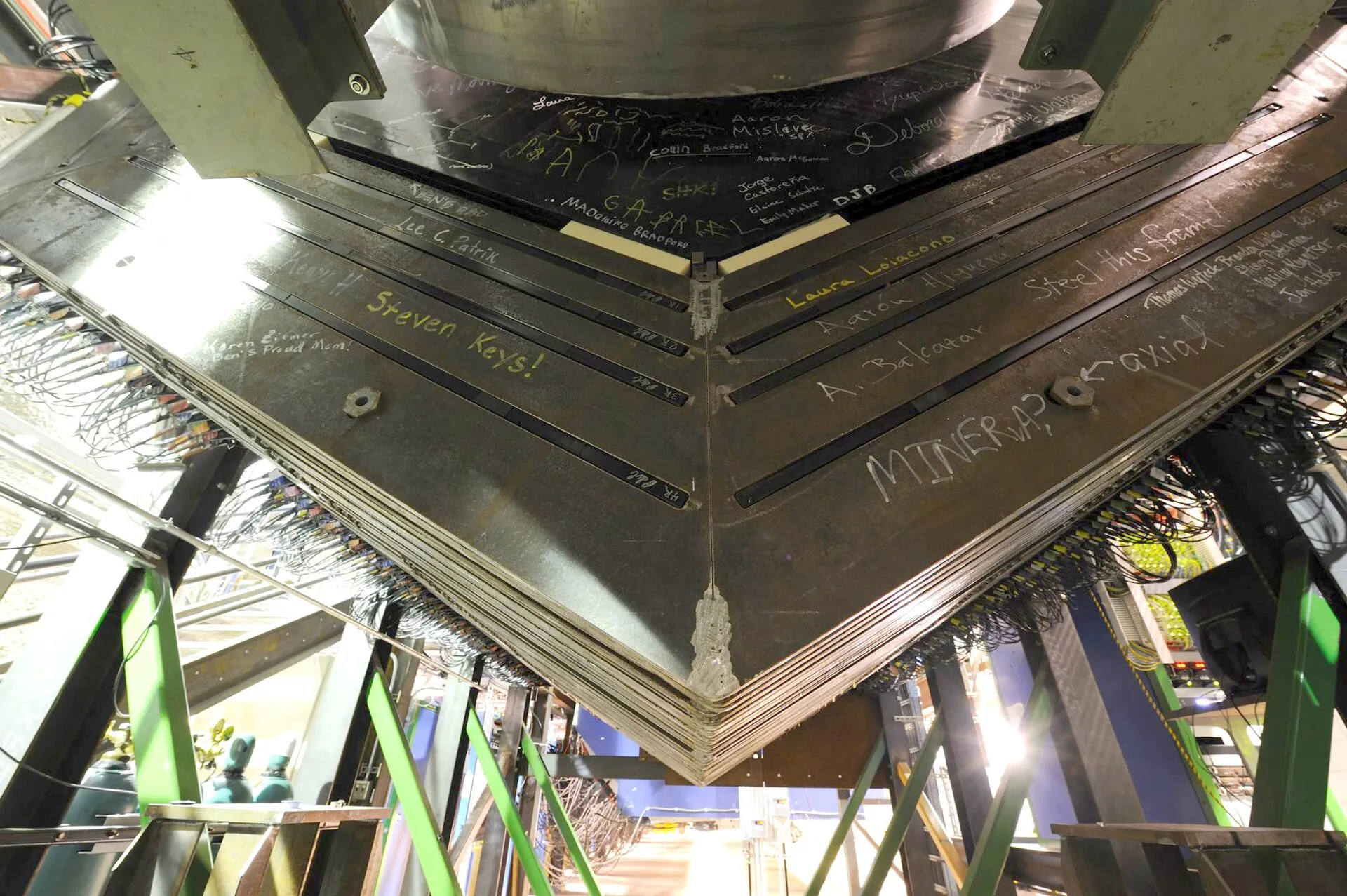
A team led by Daniel Stancil used Fermilab's NuMI beam and the MINERvA detector to transmit the word 'neutrino' through about 1 km of distance, including 240 m of rock. Bits were encoded by switching beam pulses on and off and decoded from the interaction pattern in the detector. The rate was only about 0.1 bit per second with a 1 percent error rate. Announced on 14 March 2012, it demonstrated that neutrinos can carry information through matter that blocks all other signals.
- Date
- 14 March 2012
- Kind of event
- Application
- People involved
- Daniel D. Stancil
Background
Every communication technology in use, from radio to optical fibre, relies on electromagnetic waves, which are absorbed by rock and sea water. Neutrinos pass through almost anything. Physicists had suggested since the 1970s that a modulated neutrino beam could carry messages through the Earth, for example to submarines or between continents, and in 2009 John Learned and colleagues discussed neutrinos as a medium for communication across the galaxy. No one had actually sent a message this way. The idea is described under neutrino communication.
What happened
In 2012 Daniel Stancil of North Carolina State University, working with physicists of the MINERvA collaboration including Kevin McFarland of the University of Rochester, used existing Fermilab equipment for the test. The NuMI beam delivers neutrinos in short pulses about every two seconds, and MINERvA is a fine-grained detector about 1 km downstream. Between them lies about 240 m of rock.
- Encoding: the word „neutrino“ was converted into a binary code; a one was sent as a beam pulse, a zero as a missing pulse.
- Detection: for each pulse MINERvA counted the neutrino-induced events it recorded; a threshold decided between one and zero.
- Distance: 1.035 km in total, including 240 m of earth.
- Performance: about 0.1 bit per second with a bit error rate of about 1 percent after decoding.
The message was decoded correctly. The demonstration was announced on 14 March 2012, and the paper „Demonstration of communication using neutrinos“ was published in Modern Physics Letters A later that year.
Reaction
The test attracted wide media attention as the first message sent with neutrinos. The authors were explicit about its limits: it needed one of the world's most intense neutrino beams and a massive particle detector, and the data rate was far below that of a 1980s modem. The interest was in the principle, a signal that no shielding can block.
Why it matters
The experiment showed that neutrino communication works in practice and gave the first measured figures for rate and error. It also made clear what a useful system would require: much more intense beams and much larger detectors, or detectors in sea water like those of neutrino telescopes. Proposals for submarine communication and for links through the Earth have been revisited since, but neutrino communication remains a physics demonstration rather than a technology in use.
Frequently asked questions
When was the first message sent with neutrinos?
The demonstration with Fermilab's NuMI beam and the MINERvA detector was announced on 14 March 2012. The word „neutrino“ was transmitted through 240 m of rock.
How fast was neutrino communication?
About 0.1 bit per second with a 1 percent bit error rate, limited by the small number of neutrinos detected per beam pulse.
Original papers
- First resultD. D. Stancil et al., Demonstration of Communication Using Neutrinos, Mod. Phys. Lett. A 27, 1250077 (2012)DOI 10.1142/S0217732312500770
Concepts
Mentioned in 1 page
Lessons 1
Last updated: · Editorial standard
Cite this page
Text
Neutrino Atlas (2026). “2012: First message sent with neutrinos”. Retrieved 22 November 2026, from https://neutrino-atlas.com/timeline/2012-neutrino-communication/BibTeX
@misc{neutrinoatlas2026012neutrinocommunication,
  title        = {2012: First message sent with neutrinos},
  author       = {{Neutrino Atlas}},
  year         = {2026},
  url          = {https://neutrino-atlas.com/timeline/2012-neutrino-communication/},
  note         = {Accessed 2026-11-22},
  language     = {english}
}