2011Discovery
EXO-200 observes 2νββ decay of xenon-136
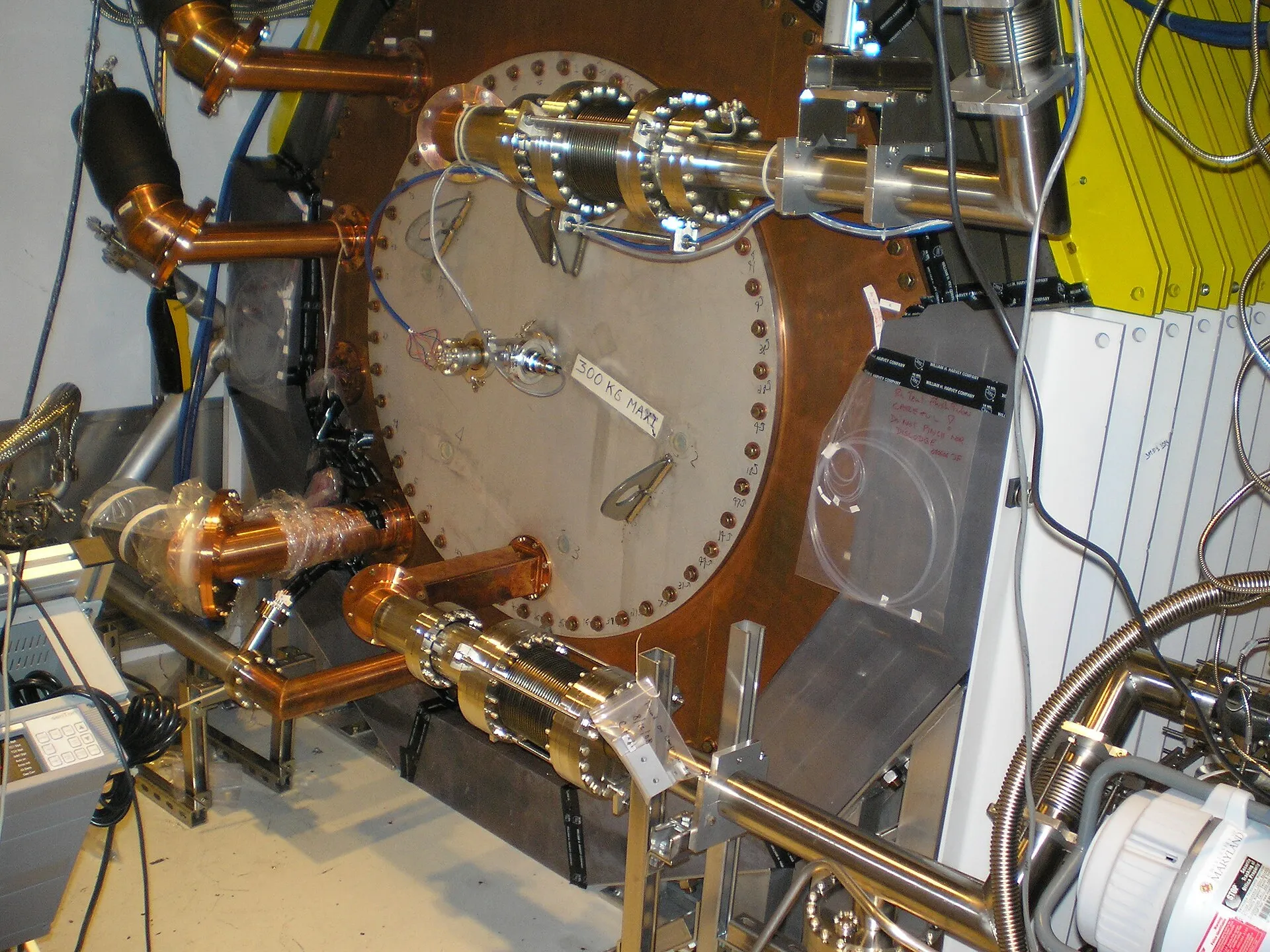
EXO-200, a liquid-xenon time projection chamber holding about 175 kg of liquid xenon enriched in xenon-136 at the WIPP site in New Mexico, began data taking in 2011. It made the first observation of two-neutrino double beta decay of xenon-136, with a half-life of about 2 × 10²¹ years, shorter than some earlier limits. It went on to search for the neutrinoless mode and was succeeded by plans for nEXO.
- Date
- 2011
- Kind of event
- Discovery
- People involved
- Giorgio Gratta
Background
Double beta decay is the rarest radioactive process ever measured. In the standard two-neutrino mode, two neutrons in a nucleus turn into two protons at once, emitting two electrons and two antineutrinos. It had been observed in about ten isotopes, beginning with Michael Moe's direct detection in selenium-82 in 1987. One important candidate was missing: xenon-136. It is attractive for the search for the neutrinoless mode because it can be enriched relatively cheaply, purified continuously and used as both source and detector. But all earlier experiments had only set lower limits on its two-neutrino half-life, the strongest above 10²² years.
The experiment
EXO-200 was the first stage of the Enriched Xenon Observatory, a collaboration in which Giorgio Gratta of Stanford was one of the scientific leaders. It was installed 655 m underground at the Waste Isolation Pilot Plant (WIPP), a salt mine near Carlsbad, New Mexico. The detector was a cylindrical liquid-xenon time projection chamber about 40 cm across, filled with about 175 kg of xenon enriched to about 80 percent in xenon-136. Each event produced both scintillation light and ionisation charge, so that energy, position and the number of separate energy deposits could be reconstructed. All materials near the xenon had been screened for radioactivity at the level needed for a neutrinoless search.
What happened
The enriched xenon was filled in early 2011, and physics data taking began in May 2011. Within a few months the two-neutrino signal stood out clearly above backgrounds as a broad continuum in the energy spectrum of single-site events. The collaboration submitted its result in August 2011.
- The value was about five times shorter than lower limits reported by earlier experiments, which were therefore in tension with it.
- The paper „Observation of two-neutrino double-beta decay in ¹³⁶Xe with the EXO-200 detector“ appeared in Physical Review Letters 107, 212501 (2011).
Reaction
The result was confirmed quickly. In 2012 KamLAND-Zen, which dissolved enriched xenon in liquid scintillator, measured a consistent half-life of about 2.4 × 10²¹ years. The disagreement with older limits was attributed to their background modelling and assumptions. For nuclear theorists the measurement provided a new benchmark: the nuclear matrix element for the two-neutrino mode of xenon-136 turned out to be the smallest of any measured isotope, an input for calculations of the neutrinoless mode.
Consequences
- In 2012 EXO-200 published its first limit on neutrinoless double beta decay of xenon-136, above 10²⁵ years, and with KamLAND-Zen it strongly disfavoured the earlier Heidelberg–Moscow claim of a signal in germanium-76.
- Operations were interrupted in 2014 by a radiological incident and a fire at WIPP unrelated to the experiment, and resumed in 2016.
- The final EXO-200 result of 2019 set a limit of 3.5 × 10²⁵ years.
The collaboration then turned to nEXO, a planned five-tonne detector based on the same liquid-xenon technique, aiming at sensitivities near 10²⁸ years. The 2011 measurement thus both filled a notable gap in the list of observed double beta emitters and marked the start of the xenon-based programme in the search for Majorana neutrinos.
Frequently asked questions
What did EXO-200 discover in 2011?
It made the first observation of two-neutrino double beta decay of xenon-136 and measured a half-life of about 2.1 × 10²¹ years.
Why is xenon-136 important?
It can be enriched and purified at large scale and serve as both source and detector, which makes it one of the main isotopes in the search for neutrinoless double beta decay.
Where was EXO-200 located?
At the Waste Isolation Pilot Plant near Carlsbad, New Mexico, about 655 m underground in a salt formation.
Original papers
- DiscoveryN. Ackerman et al. (EXO-200), Observation of Two-Neutrino Double-Beta Decay in 136Xe with EXO-200, Phys. Rev. Lett. 107, 212501 (2011)DOI 10.1103/PhysRevLett.107.212501
Concepts
Last updated: · Editorial standard
Cite this page
Text
Neutrino Atlas (2026). “2011: EXO-200 observes 2νββ decay of xenon-136”. Retrieved 22 November 2026, from https://neutrino-atlas.com/timeline/2011-exo-200-xenon-2nbb/BibTeX
@misc{neutrinoatlas2026eline2011exo200xenon2nbb,
  title        = {2011: EXO-200 observes 2νββ decay of xenon-136},
  author       = {{Neutrino Atlas}},
  year         = {2026},
  url          = {https://neutrino-atlas.com/timeline/2011-exo-200-xenon-2nbb/},
  note         = {Accessed 2026-11-22},
  language     = {english}
}