nEXO
A proposed 5-tonne enriched liquid-xenon TPC, successor to EXO-200.
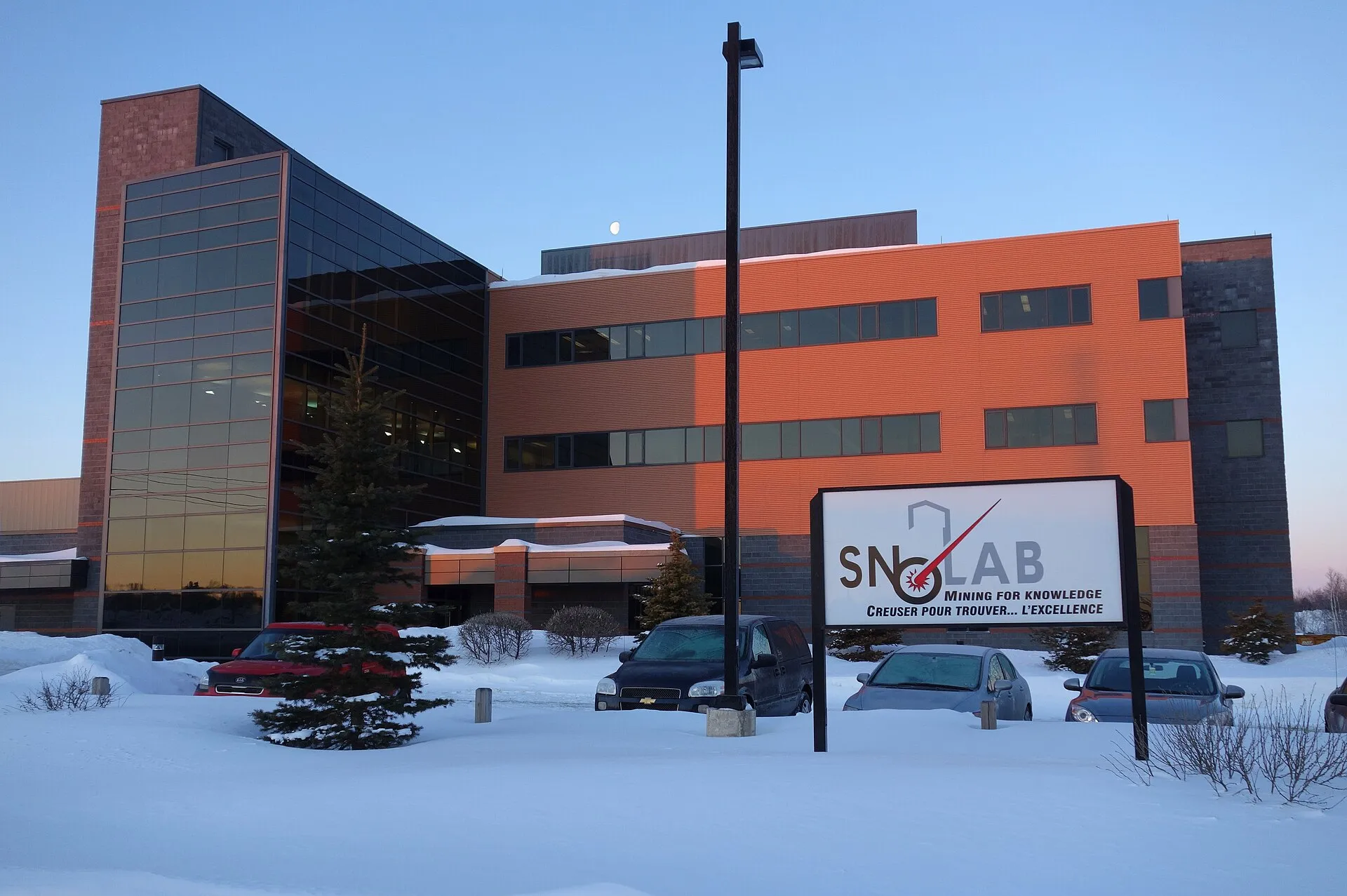
A monolithic single-phase TPC with SiPM light readout would exploit xenon self-shielding. It targets a ¹³⁶Xe half-life sensitivity of about 10²⁸ yr. SNOLAB is the proposed site.
Compare all experiments → · World map →
In plain words
nEXO is the proposed scale-up of EXO-200 by a factor of about 25 in xenon mass. Its central idea is that a large enough block of liquid xenon shields itself: gamma rays from the vessel walls are absorbed in the outer layers, so the innermost tonnes are extraordinarily quiet. The detector would therefore be built as one single, uninterrupted volume rather than many small modules.
How the detector would work
The design is a single-phase xenon TPC about 1.3 m in diameter and height, holding about 5,000 kg of xenon enriched to 90% in ¹³⁶Xe. Compared with EXO-200 it changes the readout:
- Vacuum-ultraviolet sensitive silicon photomultipliers on the barrel replace avalanche photodiodes and collect more scintillation light.
- Charge is collected on segmented tiles instead of wire planes, with low-noise electronics mounted inside the cold xenon.
- A large water tank around the cryostat serves as shield and Cherenkov muon veto.
The analysis would not rely on a hard fiducial cut alone. Instead it uses the measured depth of each event, its energy and whether it is single- or multi-site, so that the cleanest inner region carries the most weight while the outer xenon still helps to constrain backgrounds.
In numbers
- Projected median half-life sensitivity: 1.35 × 10²⁸ years at 90% CL after 10 years of data.
- Median 3σ discovery potential: about 0.74 × 10²⁸ years.
- Corresponding effective Majorana mass reach: about 4.7–20.3 meV, covering the inverted-ordering band and part of the normal-ordering region.
Status today
nEXO is proposed for the Cryopit at SNOLAB in Canada, about 2 km underground. Research and development continues, including work on extracting and identifying the barium daughter ion of a ββ decay, which in principle would remove all backgrounds that do not produce barium. Construction depends on funding decisions.
Frequently asked questions
What is xenon self-shielding?
Liquid xenon is dense and absorbs gamma rays well. In a large monolithic volume, external gammas rarely reach the centre, so the inner part sees far less background than the edges.
How much more sensitive would nEXO be than EXO-200?
Its projected half-life sensitivity of about 10²⁸ years is roughly 400 times beyond EXO-200's final limit of 3.5 × 10²⁵ years.
Original papers
- ProposalG. Adhikari et al. (nEXO Collaboration), nEXO: neutrinoless double beta decay search beyond 10²⁸ year half-life sensitivity, J. Phys. G 49, 015104 (2022)arXiv:2106.16243
Related terms
People
Latest research on this topic
- Estimating cosmogenic backgrounds in nEXO at SNOLAB using Geant4 and FLUKARoss, R., Kharusi, S. Al, Brunner, T. et al. · 31 October 2026
- nEXO radioassay programMacLellan, R., Acharya, P., Aharmim, B. et al. · 16 April 2026
- Characterization of CRYO ASIC for charge readout in the nEXO experimentLi, Z., Yu, M., Angelico, E. et al. · 11 December 2025
On the timeline
Mentioned in 21 pages
Comparisons 1
Milestones 3
People 2
Last updated: · Editorial standard
Cite this page
Text
Neutrino Atlas (2026). “nEXO”. Retrieved 22 November 2026, from https://neutrino-atlas.com/terms/nexo/BibTeX
@misc{neutrinoatlas2026termsnexo,
  title        = {nEXO},
  author       = {{Neutrino Atlas}},
  year         = {2026},
  url          = {https://neutrino-atlas.com/terms/nexo/},
  note         = {Accessed 2026-11-22},
  language     = {english}
}