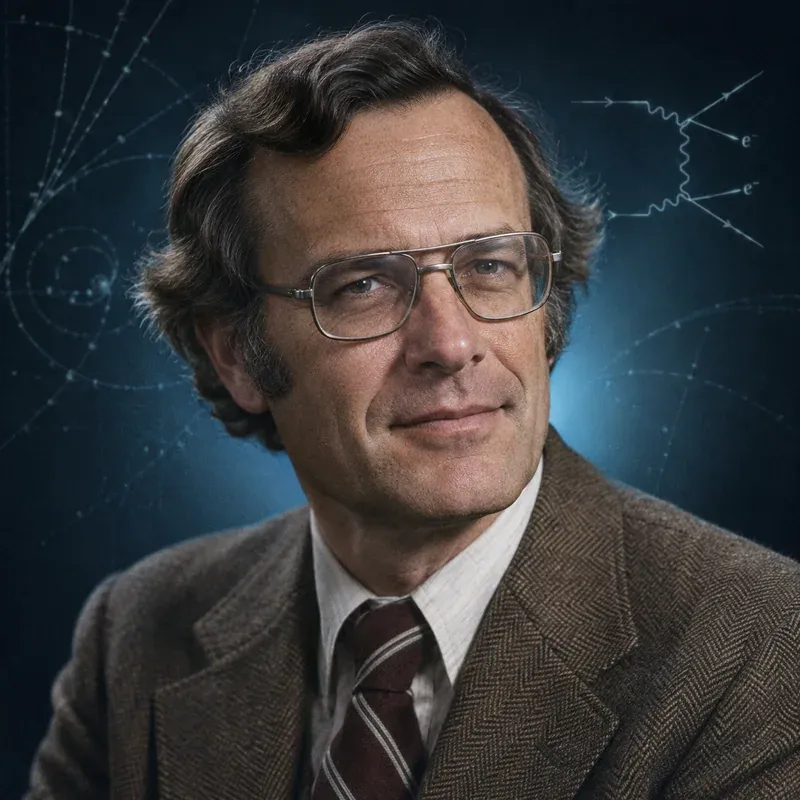
 Illustration
Michael K. Moe
Moe designed the time projection chamber with which he, Steven Elliott and Alan Hahn at UC Irvine made the first direct laboratory observation of two-neutrino double beta decay in 1987, in selenium-82 with a half-life of about 1.1 × 10²⁰ years. Previously the process had been inferred only from daughter-isotope abundances in geological samples.
- Born
- 17 November 1937
Milwaukee, Wisconsin, USA - Nationality
- American
- Field
- Experimental particle and nuclear physics
- Institutions
- Stanford University, Case Western Reserve University (PhD 1965, under Reines), Caltech, University of California, Irvine
Early life and education
Michael K. Moe was born on 17 November 1937 in Milwaukee, Wisconsin. He graduated from Stanford University in 1959 and earned his PhD in 1965 at Case Western Reserve University under Frederick Reines, who had co-discovered the neutrino a decade earlier. After a postdoctoral year at Caltech he followed Reines to the new University of California, Irvine in 1966, where he spent the rest of his career until retiring in 1997.
Path to double beta decay
In 1966 a preprint from Chien-Shiung Wu drew Moe's attention to double beta decay, a process in which a nucleus turns two neutrons into two protons at once. It occurs only in a few even–even nuclei for which ordinary beta decay is energetically forbidden. The variant with two emitted antineutrinos, two-neutrino double beta decay, is allowed in the Standard Model but extremely slow, with half-lives some ten billion times the age of the universe.
Before the 1980s the process had been seen only indirectly. Geochemists measured excess daughter isotopes, such as xenon in ancient tellurium ores or krypton in selenium minerals, and inferred half-lives from the age of the rock. No experiment had caught the two electrons in the act, because natural radioactivity in any detector produces vastly more events in the same energy range.
Key contributions
Moe's solution was a time projection chamber built around a thin foil of enriched selenium-82. Electrons leaving the foil ionise the gas, and a magnetic field bends their paths into helices whose curvature gives the energy. Because the chamber records full three-dimensional tracks, the team could demand two electrons starting from the same point on the foil, use the sense of curvature to tell electrons from positrons, and reject most background topologies such as single electrons and alpha particles.
In 1987 Steven Elliott, Alan Hahn and Moe reported in Physical Review Letters direct evidence for two-neutrino double beta decay in selenium-82, with a half-life of 1.1 (+0.8/−0.3) × 10²⁰ years. It was the first laboratory observation of the process and by far the longest half-life measured directly at the time. The result agreed with the geochemical value and tested the nuclear matrix elements on which every search for the neutrinoless mode depends. His group later measured the same decay in calcium-48, molybdenum-100 and neodymium-150.
Later work and legacy
Moe saw the two-neutrino measurement as a step toward the real prize, neutrinoless double beta decay, which would show that neutrinos are Majorana particles and that lepton number is not conserved. In 1991 he published a proposal for detecting the neutrinoless decay of xenon-136 by identifying the barium daughter ion, an idea later pursued by the EXO-200 and nEXO collaborations, in which he took part. His co-author Steven Elliott later became a leading figure in germanium-based searches such as the Majorana Demonstrator. The tracking approach he pioneered survives in experiments such as NEMO-3. In 2013 the American Physical Society awarded Moe the Tom W. Bonner Prize in Nuclear Physics.
Known for
- First laboratory observation of two-neutrino double beta decay (⁸²Se, 1987)
- Time projection chamber for double beta decay
- Bonner Prize 2013
Chronology
- 1965PhD under Frederick Reines
- 1966Joins UC Irvine
- 1987Observation of 2νββ in 82Se
- 2013Tom W. Bonner Prize
Original papers
- S. R. Elliott, A. A. Hahn, M. K. Moe, Direct evidence for two-neutrino double-beta decay in ⁸²Se, Phys. Rev. Lett. 59, 2020 (1987)DOI 10.1103/PhysRevLett.59.2020
Experiments
- UC Irvine ⁸²Se TPC
Connected people
Frequently asked questions
What did Michael Moe discover?
With Steven Elliott and Alan Hahn he made the first direct laboratory observation of two-neutrino double beta decay, in selenium-82, in 1987.
Why was observing two-neutrino double beta decay important?
It proved that experiments could isolate this rare process from background and provided a test of the nuclear calculations needed to interpret searches for the neutrinoless mode.
Who was Moe's doctoral advisor?
Frederick Reines, co-discoverer of the neutrino with Clyde Cowan and winner of the 1995 Nobel Prize in Physics.
On the timeline
Mentioned in 12 pages
Lessons 1
Milestones 3
People 5
Last updated: · Editorial standard
Cite this page
Text
Neutrino Atlas (2026). “Michael K. Moe”. Retrieved 22 November 2026, from https://neutrino-atlas.com/people/michael-moe/BibTeX
@misc{neutrinoatlas2026peoplemichaelmoe,
  title        = {Michael K. Moe},
  author       = {{Neutrino Atlas}},
  year         = {2026},
  url          = {https://neutrino-atlas.com/people/michael-moe/},
  note         = {Accessed 2026-11-22},
  language     = {english}
}