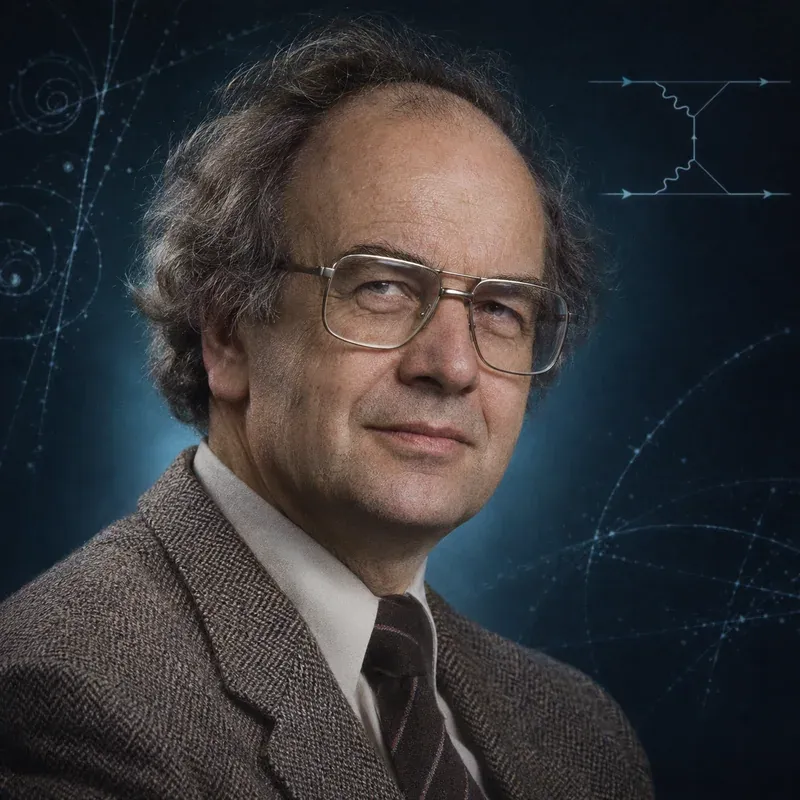
 Illustration
Hans Volker Klapdor-Kleingrothaus
Klapdor-Kleingrothaus proposed and was spokesperson of the Heidelberg–Moscow experiment, which ran enriched germanium-76 detectors at Gran Sasso from 1990 to 2003 and set leading limits on neutrinoless double beta decay. A sub-group led by him claimed evidence for the decay (published 2001; later quoted at 6.4σ with a half-life of about 2.2 × 10²⁵ years), which would imply Majorana neutrinos; the claim was disputed and is not widely accepted, and GERDA later did not confirm it.
- Born
- 25 January 1942
Reinbek, Germany - Nationality
- German
- Field
- Nuclear and astroparticle physics
- Institutions
- University of Hamburg, Max Planck Institute for Nuclear Physics, Heidelberg, Heidelberg University
Education and early career
Hans Volker Klapdor-Kleingrothaus was born in 1942 in Reinbek near Hamburg. He studied physics at the University of Hamburg and received his doctorate in 1969 with a thesis on gamma-ray spectroscopy at an accelerator, followed by habilitations in Hamburg (1971) and Heidelberg (1973). From 1969 to 2007 he worked at the Max Planck Institute for Nuclear Physics in Heidelberg, at first on heavy-ion reactions, and from 1980 he was also professor at Heidelberg University. In 1982 he shared the Physics Prize of the German Physical Society with Wolfgang Hillebrandt for work at the interface of nuclear physics and astrophysics, a field that also covers the nuclear data needed for processes such as the r-process.
Path to double beta decay
Klapdor-Kleingrothaus became one of the most active organisers of the field that links nuclear physics, neutrinos and dark matter. He founded the WEIN conference series in 1986 and later the DARK and Beyond the Desert meetings, and he wrote or edited about 30 books. His central experimental goal was the search for neutrinoless double beta decay, a decay in which a nucleus emits two electrons and no neutrinos. It is only possible if the neutrino is a Majorana particle and lepton number is not conserved.
The Heidelberg–Moscow experiment
Building on the germanium technique of Ettore Fiorini, Klapdor-Kleingrothaus proposed and led the Heidelberg–Moscow experiment, a collaboration with the Kurchatov Institute. It operated five high-purity germanium detectors enriched to about 86 percent in ⁷⁶Ge, with a total of about 11 kg of enriched material, at the Gran Sasso laboratory from 1990 to 2003. Shielded by lead and copper and running for many years, it reached one of the lowest background levels of its time and measured the allowed two-neutrino mode of ⁷⁶Ge precisely. For most of the 1990s it gave the strongest limit on the half-life of the neutrinoless mode and therefore on the effective Majorana mass.
The disputed claim
In 2001 Klapdor-Kleingrothaus, A. Dietz, H. L. Harney and I. V. Krivosheina published ‘Evidence for neutrinoless double beta decay’ in Modern Physics Letters A, based on a small excess of events near the Q-value of 2039 keV. Later analyses by a sub-group led by him of the full 1990–2003 data quoted significances rising to 6.4σ, with a half-life of about 2.2 × 10²⁵ years, which would correspond to an effective Majorana mass of a few tenths of an eV. Many physicists, including members of the original collaboration, did not accept the claim. Critics such as Aalseth and colleagues (2002) argued that the significance depended strongly on the choice of the analysis window and on how nearby gamma lines from ²¹⁴Bi and other background sources were treated.
The question was settled experimentally. In 2013 the first phase of GERDA, using bare enriched germanium detectors in liquid argon at Gran Sasso, saw no signal at the expected rate and disfavoured the claim strongly; combined with results from KamLAND-Zen and EXO-200 on ¹³⁶Xe, it was considered refuted. GERDA's final limit of 1.8 × 10²⁶ years (2020) lies almost an order of magnitude beyond the claimed value.
Legacy
The episode is often cited as an example of the difficulty of claiming a rare signal over a complex background; later experiments such as GERDA fixed their analysis procedures in advance through blind analyses. At the same time, the Heidelberg–Moscow detectors set the standard for low-background enriched germanium operation on which GERDA, the Majorana Demonstrator and LEGEND build.
Known for
- Proposer and spokesperson of the Heidelberg–Moscow ⁷⁶Ge double beta decay experiment
- Contested 2001 claim of evidence for neutrinoless double beta decay
Chronology
- 1969PhD, University of Hamburg; joins MPIK Heidelberg (to 2007)
- 1980Professor at Heidelberg University
- 1982Physics Prize of the German Physical Society (with W. Hillebrandt)
- 1990Heidelberg–Moscow experiment starts at Gran Sasso
- 2001Claim of evidence for 0νββ published
- 2003Heidelberg–Moscow ends
Original papers
- H. V. Klapdor-Kleingrothaus, A. Dietz, H. L. Harney, I. V. Krivosheina, Evidence for neutrinoless double beta decay, Mod. Phys. Lett. A 16, 2409 (2001)DOI 10.1142/S0217732301005825
Experiments
Connected people
Frequently asked questions
Did Klapdor-Kleingrothaus discover neutrinoless double beta decay?
No. He claimed evidence for it in 2001 and later, but the claim was disputed from the start and was ruled out by GERDA and xenon experiments from 2013 onward.
What was the Heidelberg–Moscow experiment?
A ⁷⁶Ge double beta decay experiment at Gran Sasso (1990–2003) with about 11 kg of enriched germanium detectors. Apart from the disputed claim, it produced leading limits and a precise measurement of the two-neutrino decay.
On the timeline
Mentioned in 6 pages
Last updated: · Editorial standard
Cite this page
Text
Neutrino Atlas (2026). “Hans Volker Klapdor-Kleingrothaus”. Retrieved 22 November 2026, from https://neutrino-atlas.com/people/hans-klapdor-kleingrothaus/BibTeX
@misc{neutrinoatlas2026hansklapdorkleingrothaus,
  title        = {Hans Volker Klapdor-Kleingrothaus},
  author       = {{Neutrino Atlas}},
  year         = {2026},
  url          = {https://neutrino-atlas.com/people/hans-klapdor-kleingrothaus/},
  note         = {Accessed 2026-11-22},
  language     = {english}
}