KamLAND-Zen
Xenon-loaded liquid scintillator inside KamLAND, giving the most stringent 0νββ limit to date.
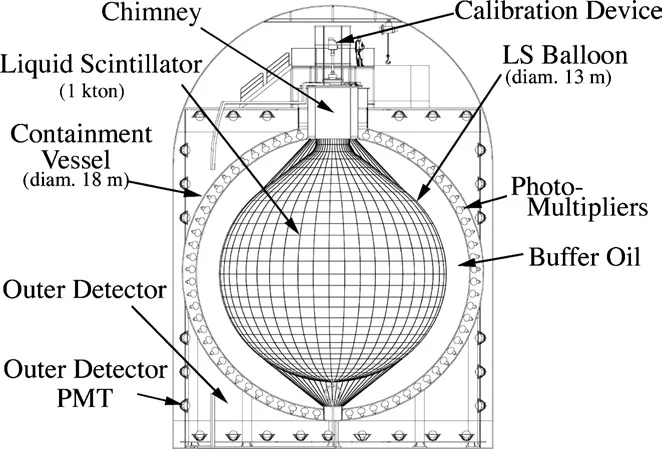
A nylon inner balloon containing about 750 kg of enriched ¹³⁶Xe dissolved in scintillator (KamLAND-Zen 800) sits at the centre of KamLAND. Its 2024 result, T½(¹³⁶Xe) > 3.8 × 10²⁶ yr (90% CL), means mββ < 28–122 meV, beginning to probe the inverted-ordering region.
Compare all experiments → · World map →
In plain words
KamLAND-Zen reused an existing giant: the KamLAND detector, a thousand tonnes of liquid scintillator built to study reactor antineutrinos. At its centre the team hung a thin transparent balloon filled with scintillator in which enriched xenon is dissolved. The surrounding kilotonne of clean liquid acts as an enormous, self-monitoring shield, so a comparatively simple insertion gave access to hundreds of kilograms of ¹³⁶Xe.
How the detector works
About 3% of the inner liquid by weight is xenon enriched to roughly 90% in ¹³⁶Xe. When a nucleus decays, the two electrons share up to Qββ = 2458 keV and make the scintillator glow; about 1,800 photomultipliers record the light. The energy resolution of a scintillator is much worse than that of germanium or bolometers, so KamLAND-Zen compensates with sheer isotope mass, a very clean inner volume, and analysis tools that tag cosmogenic backgrounds such as ¹⁰C after muons and recognise the delayed coincidences of the bismuth–polonium decays.
Key results
- KamLAND-Zen 400 (from October 2011, about 320–380 kg of xenon) reached T½ > 1.07 × 10²⁶ years in 2016. Its early data were limited by ¹¹⁰ᵐAg contamination, attributed to fallout from the 2011 Fukushima accident, which required purification and later a new balloon.
- KamLAND-Zen 800 (data from January 2019, 745 kg of enriched xenon) accumulated 2.1 tonne-years of ¹³⁶Xe exposure. The combined result is T½ > 3.8 × 10²⁶ years at 90% CL, the strongest limit on neutrinoless double beta decay of any isotope.
- The same data give a precise measurement of the two-neutrino mode, whose tail is now one of the main backgrounds.
Why it matters for neutrino physics
The corresponding effective Majorana mass limit of 28–122 meV reaches into the band predicted for the inverted mass ordering. The range reflects the spread of nuclear matrix element calculations, which is why limits are always quoted as an interval.
Status today
The collaboration plans KamLAND2-Zen, with improved light collection and better energy resolution, to separate the 0νββ peak more cleanly from the 2νββ tail.
Frequently asked questions
Why can KamLAND-Zen beat germanium experiments despite worse energy resolution?
It holds far more of its isotope, several hundred kilograms of ¹³⁶Xe, inside a very large and clean shield. For a given background, more decaying nuclei mean a longer half-life can be probed.
Is KamLAND-Zen the same detector as KamLAND?
It uses the KamLAND detector, but adds an inner balloon with xenon-loaded scintillator. The outer KamLAND volume serves as shield and veto.
Original papers
- First resultA. Gando et al. (KamLAND-Zen Collaboration), Measurement of the double-β decay half-life of ¹³⁶Xe with the KamLAND-Zen experiment, Phys. Rev. C 85, 045504 (2012)DOI 10.1103/PhysRevC.85.045504arXiv:1201.4664
- MeasurementS. Abe et al. (KamLAND-Zen Collaboration), Search for the Majorana Nature of Neutrinos in the Inverted Mass Ordering Region with KamLAND-Zen, Phys. Rev. Lett. 130, 051801 (2023)DOI 10.1103/PhysRevLett.130.051801
- Final resultS. Abe et al. (KamLAND-Zen Collaboration), Search for Majorana Neutrinos with the Complete KamLAND-Zen Dataset, Phys. Rev. Lett. (2025)DOI 10.1103/jkf6-48j8
Related terms
People
Latest research on this topic
On the timeline
- 2016KamLAND-Zen pushes 0νββ limits beyond 10²⁶ years
- 2023KamLAND-Zen 800 reaches 2.3 × 10²⁶ years
- 2024KamLAND-Zen's complete data set tightens the Majorana bound
Mentioned in 47 pages
Comparisons 2
Milestones 9
- 1939 · Furry proposes neutrinoless double beta decay
- 1987 · First laboratory observation of 2νββ decay
- 2002 · KamLAND sees reactor antineutrinos disappear
- 2011 · EXO-200 observes 2νββ decay of xenon-136
- 2013 · GERDA Phase I disfavours the Klapdor claim
- 2016 · KamLAND-Zen pushes 0νββ limits beyond 10²⁶ years
- 2023 · KamLAND-Zen 800 reaches 2.3 × 10²⁶ years
- 2024 · KamLAND-Zen's complete data set tightens the Majorana bound
People 6
Terms 24
- Absolute neutrino mass scale
- CUPID-Mo
- Dirac vs Majorana nature
- Double beta decay
- Double beta decay experiments
- Double-beta isotopes and Q-value
- Effective Majorana mass
- EXO-200
16 more
- Experiments & detectors
- Half-life limit & effective Majorana mass
- Heidelberg–Moscow Experiment
- Inverted ordering
- Kamioka Observatory
- KamLAND
- Lepton number
- Lepton number violation
- Liquid scintillator detector
- Majoron
- NEMO-3 / SuperNEMO
- Neutrinoless double beta decay
- Nuclear matrix element
- Quasi-degenerate neutrino masses
- Symmetries and their violation
- Upper limit / exclusion
Last updated: · Editorial standard
Cite this page
Text
Neutrino Atlas (2026). “KamLAND-Zen”. Retrieved 22 November 2026, from https://neutrino-atlas.com/terms/kamland-zen/BibTeX
@misc{neutrinoatlas2026termskamlandzen,
  title        = {KamLAND-Zen},
  author       = {{Neutrino Atlas}},
  year         = {2026},
  url          = {https://neutrino-atlas.com/terms/kamland-zen/},
  note         = {Accessed 2026-11-22},
  language     = {english}
}