EXO-200
A liquid-xenon TPC that made the first observation of two-neutrino double beta decay of ¹³⁶Xe.
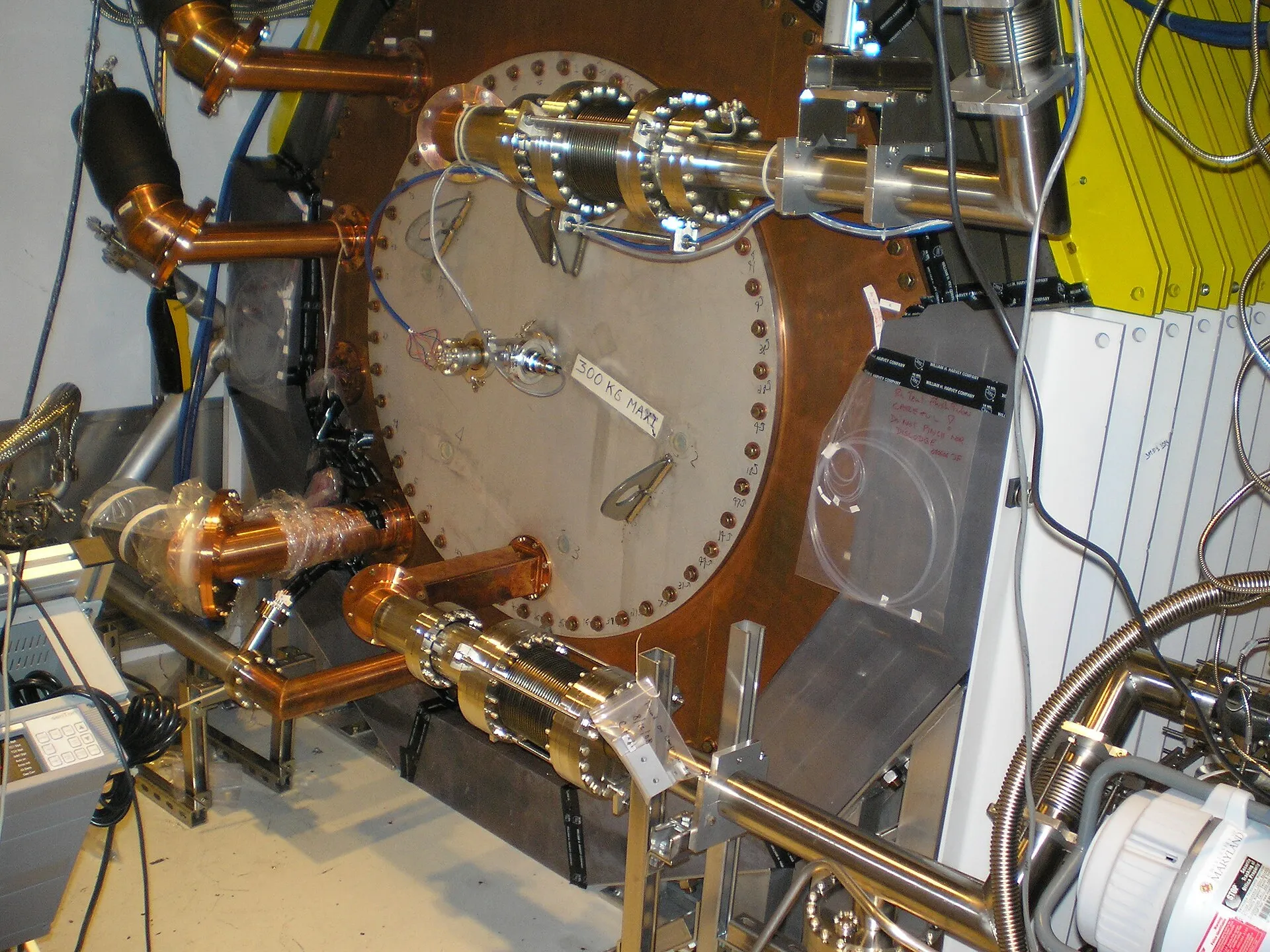
About 200 kg of xenon enriched to 80% in ¹³⁶Xe operated in a TPC at the WIPP salt mine. It measured 2νββ of ¹³⁶Xe (2011) and set a final 0νββ limit of T½ > 3.5 × 10²⁵ yr (2019).
Compare all experiments → · World map →
In plain words
EXO-200 filled a copper cylinder with liquid xenon and turned the whole volume into a camera for particle tracks. Xenon is unusual among 0νββ isotopes because it is a noble element: it can be purified continuously while the detector runs, and the same liquid serves as source, detector medium and inner shield.
How the detector works
EXO-200 was a single-phase xenon time projection chamber with a central cathode and two drift regions. A particle interaction produces two signals at once: scintillation light, recorded by large-area avalanche photodiodes, and ionisation charge, drifted to wire grids at both ends. Combining them is the key trick. Fluctuations in how much energy goes into light versus charge are anticorrelated, so adding both signals with the right weights gives a much sharper energy measurement than either alone. The TPC also distinguishes single-site events, as expected from ββ decay, from multi-site gamma interactions, and locates every event in three dimensions so that a clean inner volume can be selected.
The detector sat at the Waste Isolation Pilot Plant, a salt mine near Carlsbad, New Mexico, under about 1,600 metres water equivalent of rock. Salt contains little uranium and thorium, which keeps the rock background low.
Key results
- 2011: first observation of two-neutrino double beta decay of ¹³⁶Xe, with T½ ≈ 2.1 × 10²¹ years.
- Phase I (2011–2014) and, after an upgrade of the electronics and a radon-suppression system, Phase II (2016–2018), which improved the energy resolution to 1.15% (σ/E) at Qββ = 2458 keV.
- Final 0νββ result (2019): T½ > 3.5 × 10²⁵ years from 234.1 kg·yr of ¹³⁶Xe exposure, giving an effective Majorana mass below 93–286 meV.
Operations paused between 2014 and 2016 after two unrelated incidents at WIPP, an underground truck fire and a radiological release, closed the mine for underground access.
Why it matters for neutrino physics
EXO-200 demonstrated that liquid xenon TPCs can combine good energy resolution, event topology and low background. Together with KamLAND-Zen it independently excluded the Heidelberg–Moscow claim using a different isotope. Its design directly informs the planned tonne-scale successor nEXO; the collaboration was long led by Giorgio Gratta.
Frequently asked questions
Why does EXO-200 read both light and charge?
Energy shared between light and charge fluctuates in opposite directions from event to event. Summing the two signals cancels much of that fluctuation and sharpens the energy peak.
Did EXO-200 find neutrinoless double beta decay?
No. It measured the ordinary two-neutrino decay of ¹³⁶Xe for the first time and set a lower limit on the neutrinoless half-life.
Original papers
- First resultN. Ackerman et al. (EXO-200 Collaboration), Observation of Two-Neutrino Double-Beta Decay in ¹³⁶Xe with the EXO-200 Detector, Phys. Rev. Lett. 107, 212501 (2011)DOI 10.1103/PhysRevLett.107.212501
- Final resultG. Anton et al. (EXO-200 Collaboration), Search for Neutrinoless Double-β Decay with the Complete EXO-200 Dataset, Phys. Rev. Lett. 123, 161802 (2019)DOI 10.1103/PhysRevLett.123.161802arXiv:1906.02723
Related terms
People
Latest research on this topic
- EXO-200 Public Data Release for AI/ML ApplicationsEXO-200 Collaboration · 28 September 2026
- Search for Double Beta Decays of <math display="inline"><mrow><mmultiscripts><mrow><mi>Xe</mi></mrow><mprescripts/><none/><mrow><mn>134</mn></mrow></mmultiscripts></mrow></math> with EXO-200 Phase IIEXO-200 Collaboration · 17 November 2025
On the timeline
Mentioned in 17 pages
Lessons 1
Milestones 3
Last updated: · Editorial standard
Cite this page
Text
Neutrino Atlas (2026). “EXO-200”. Retrieved 22 November 2026, from https://neutrino-atlas.com/terms/exo-200/BibTeX
@misc{neutrinoatlas2026termsexo200,
  title        = {EXO-200},
  author       = {{Neutrino Atlas}},
  year         = {2026},
  url          = {https://neutrino-atlas.com/terms/exo-200/},
  note         = {Accessed 2026-11-22},
  language     = {english}
}