Heidelberg–Moscow Experiment
A ⁷⁶Ge experiment at Gran Sasso, part of whose collaboration claimed evidence for 0νββ, a claim later refuted.
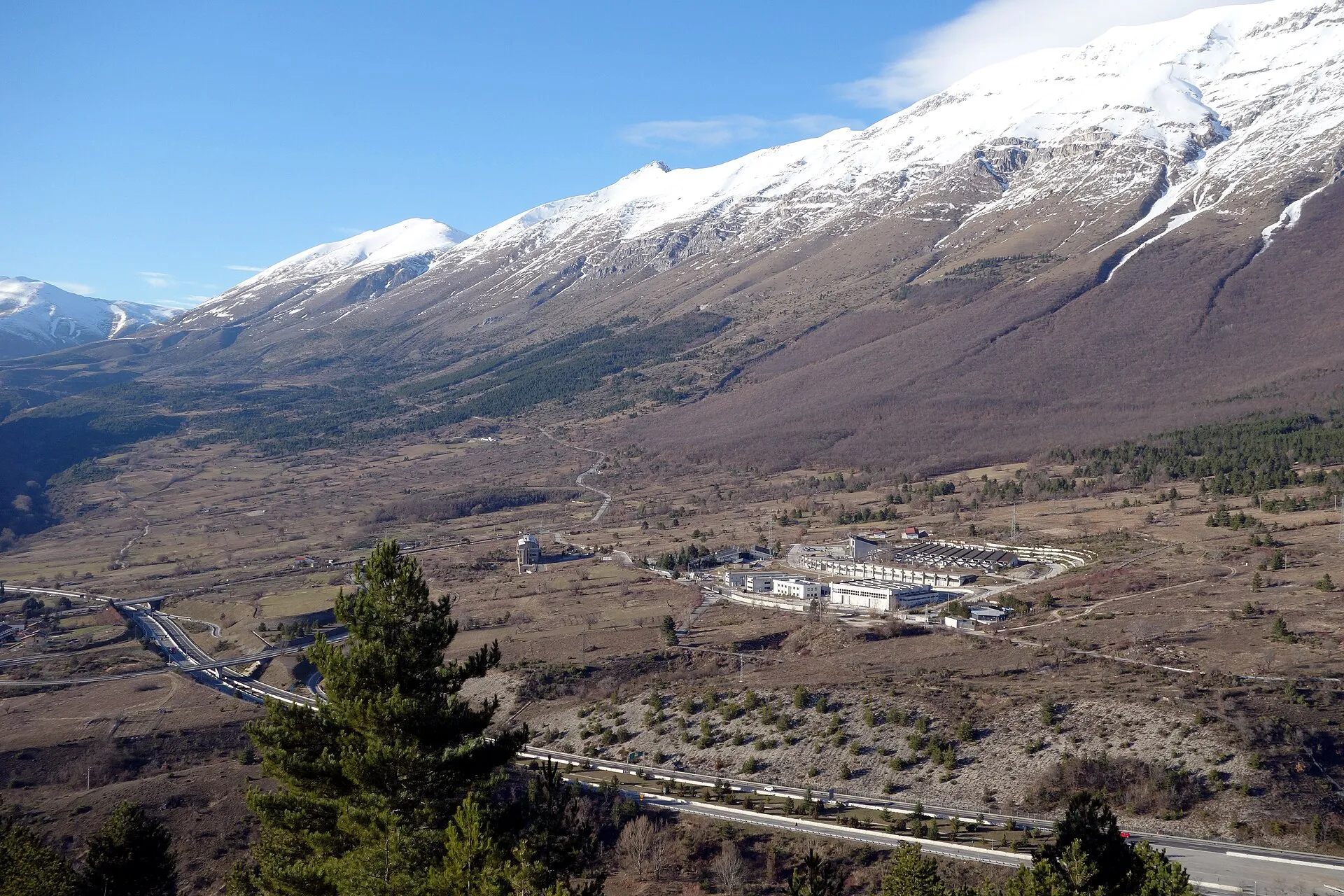
It used five enriched germanium detectors (about 11 kg of ⁷⁶Ge) and set the best limits of its time. In 2001–2004 a subgroup (Klapdor-Kleingrothaus et al.) claimed a signal with T½ ~ 1.2 × 10²⁵ yr, which GERDA excluded in 2013.
Compare all experiments → · World map →
In plain words
The Heidelberg–Moscow experiment was a long, patient wait for an extremely rare event. Its germanium crystals were both the source and the detector: if a ⁷⁶Ge nucleus inside one of them underwent neutrinoless double beta decay, the two emitted electrons would deposit a sharply defined energy of 2039 keV in the same crystal. The experiment therefore searched for a tiny peak at exactly that energy on top of a nearly flat background.
How the detector works
The collaboration of the Max Planck Institute for Nuclear Physics in Heidelberg and the Kurchatov Institute in Moscow operated five high-purity germanium detectors made from germanium enriched to about 86% in ⁷⁶Ge, compared with under 8% in natural germanium. The detectors sat deep inside the Gran Sasso laboratory, surrounded by lead and copper shielding. Germanium diodes give excellent energy resolution, a few keV at 2 MeV, which narrows the window in which background can imitate a signal.
Key results
Data were taken from 1990 to 2003. In 2001 the full collaboration published a lower limit on the 0νββ half-life of about 1.9 × 10²⁵ years, for years the most sensitive result of its kind.
The disputed claim
Also in 2001, a subgroup led by Hans Volker Klapdor-Kleingrothaus reported evidence for a peak at Qββ, at first at about 3σ. Later reanalyses raised the quoted significance to 4.2σ and finally above 6σ, with a half-life near 2.2 × 10²⁵ years. Most of the community remained sceptical: the result depended on how background lines nearby were modelled, and other members of the original collaboration did not sign it. Because the claim was made with the same isotope, it could be tested directly. In 2013 GERDA Phase I found no excess and excluded the claimed signal at more than 99% confidence, later supported by xenon results from KamLAND-Zen and EXO-200.
Why it matters for neutrino physics
Heidelberg–Moscow showed that enriched germanium is a near-ideal tool for 0νββ searches, and its techniques shaped GERDA, the MAJORANA Demonstrator and LEGEND. The controversy also left a lasting methodological lesson: today's experiments define their analysis before looking at the signal region, a practice known as blind analysis.
Frequently asked questions
Did the Heidelberg–Moscow experiment discover neutrinoless double beta decay?
No. A subgroup claimed a signal, but the claim was never confirmed and was excluded by GERDA in 2013. The accepted result of the experiment is a lower limit on the half-life.
Why was germanium-76 chosen?
Germanium can be grown into extremely pure crystals that work as detectors themselves, so the decaying isotope sits inside the sensor. Germanium detectors also have one of the best energy resolutions of any radiation detector.
Original papers
- Final resultH. V. Klapdor-Kleingrothaus et al., Latest results from the HEIDELBERG-MOSCOW double beta decay experiment, Eur. Phys. J. A 12, 147 (2001)DOI 10.1007/s100500170022arXiv:hep-ph/0103062
- MeasurementH. V. Klapdor-Kleingrothaus, A. Dietz, H. L. Harney and I. V. Krivosheina, Evidence for Neutrinoless Double Beta Decay, Mod. Phys. Lett. A 16, 2409 (2001)arXiv:hep-ph/0201231
Related terms
People
On the timeline
Mentioned in 14 pages
Lessons 1
Milestones 2
Last updated: · Editorial standard
Cite this page
Text
Neutrino Atlas (2026). “Heidelberg–Moscow Experiment”. Retrieved 22 November 2026, from https://neutrino-atlas.com/terms/heidelberg-moscow/BibTeX
@misc{neutrinoatlas2026termsheidelbergmoscow,
  title        = {Heidelberg–Moscow Experiment},
  author       = {{Neutrino Atlas}},
  year         = {2026},
  url          = {https://neutrino-atlas.com/terms/heidelberg-moscow/},
  note         = {Accessed 2026-11-22},
  language     = {english}
}