NEMO-3 / SuperNEMO
A tracker-calorimeter experiment that separately measured both electrons from double beta decay in several isotopes.
Thin source foils (about 7 kg of ¹⁰⁰Mo plus ⁸²Se, ¹³⁰Te, ¹¹⁶Cd and others) were surrounded by drift-cell trackers and plastic scintillator calorimeters, giving full kinematics. NEMO-3 made precision 2νββ measurements for seven isotopes. The SuperNEMO demonstrator continues the technique.
Compare all experiments → · World map →
In plain words
Most double beta decay experiments see an event as a single energy deposit. NEMO-3 separated the source from the detector so that it could watch both electrons fly apart, measure each one's energy and the angle between them. This makes it slower to accumulate exposure but gives a uniquely detailed picture of each decay.
How the detector works
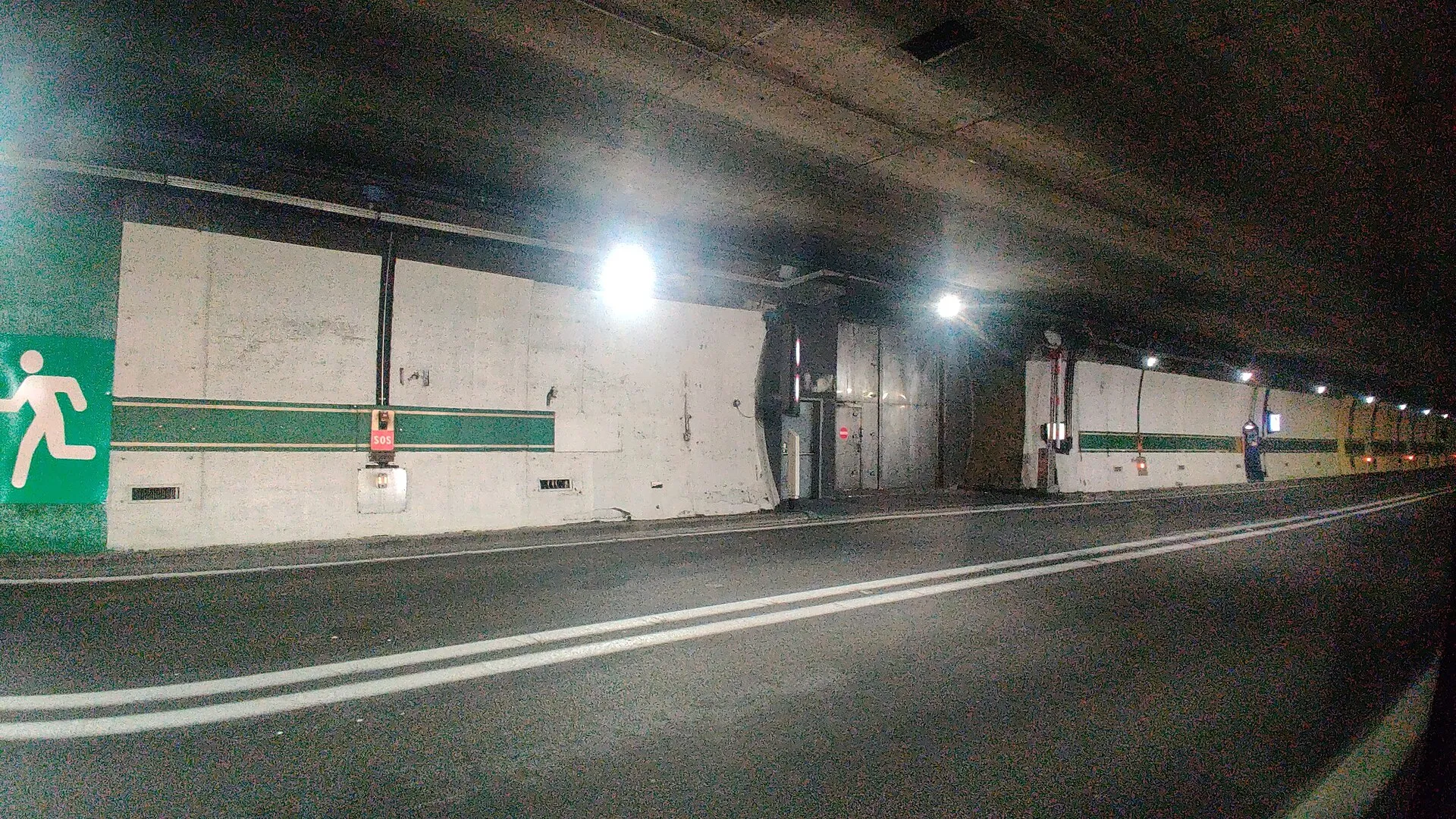
The NEMO-3 detector, installed in the Modane underground laboratory in the Fréjus road tunnel, was a cylinder divided into 20 sectors. Thin foils carrying about 10 kg of double beta isotopes formed its central wall. On both sides, wire drift cells operated in Geiger mode reconstructed the electron tracks, and blocks of plastic scintillator read by photomultipliers measured their energies and arrival times. A magnetic field of about 25 gauss curved the tracks, distinguishing electrons from positrons. The timing between the two calorimeter hits identifies particles crossing the detector from outside, which mimic two electrons emitted from the foil.
Key results
- Seven isotopes studied in one detector: ¹⁰⁰Mo (about 6.9 kg), ⁸²Se, ¹¹⁶Cd, ¹³⁰Te, ¹⁵⁰Nd, ⁹⁶Zr and ⁴⁸Ca.
- Precision measurements of two-neutrino double beta decay half-lives, including the full single-electron energy spectra, which test nuclear models.
- A 0νββ limit for ¹⁰⁰Mo of T½ > 1.1 × 10²⁴ years (2015).
Strengths and limits
The tracker–calorimeter method can tell different mechanisms apart if a signal is ever seen. A light Majorana neutrino exchange, right-handed weak currents or the emission of a hypothetical Majoron would produce different angular and energy distributions of the two electrons. The drawback is that thin foils limit the isotope mass and plastic scintillators have modest energy resolution, so the reach in half-life is lower than that of calorimetric experiments such as CUORE or KamLAND-Zen.
Status today
The SuperNEMO demonstrator, built in the same laboratory with about 6.1 kg of enriched ⁸²Se, improved radiopurity and calorimeter resolution and began physics data taking in April 2025.
Frequently asked questions
What makes NEMO-3 different from other double beta experiments?
It reconstructs both electrons individually, measuring their energies, tracks and opening angle, instead of only the total energy.
Did NEMO-3 observe neutrinoless double beta decay?
No. It produced precise two-neutrino measurements for seven isotopes and lower limits on the neutrinoless half-lives.
Original papers
- Final resultR. Arnold et al. (NEMO-3 Collaboration), Results of the search for neutrinoless double-β decay in ¹⁰⁰Mo with the NEMO-3 experiment, Phys. Rev. D 92, 072011 (2015)DOI 10.1103/PhysRevD.92.072011arXiv:1506.05825
- ProposalR. Arnold et al. (SuperNEMO Collaboration), Probing new physics models of neutrinoless double beta decay with SuperNEMO, Eur. Phys. J. C 70, 927 (2010)arXiv:1005.1241
Related terms
Mentioned in 10 pages
Last updated: · Editorial standard
Cite this page
Text
Neutrino Atlas (2026). “NEMO-3 / SuperNEMO”. Retrieved 22 November 2026, from https://neutrino-atlas.com/terms/nemo-3/BibTeX
@misc{neutrinoatlas2026termsnemo3,
  title        = {NEMO-3 / SuperNEMO},
  author       = {{Neutrino Atlas}},
  year         = {2026},
  url          = {https://neutrino-atlas.com/terms/nemo-3/},
  note         = {Accessed 2026-11-22},
  language     = {english}
}