NEMO (Neutrino Mediterranean Observatory)
An INFN deep-sea research project off Sicily that developed tower prototypes and qualified the Capo Passero site later used by KM3NeT-ARCA.
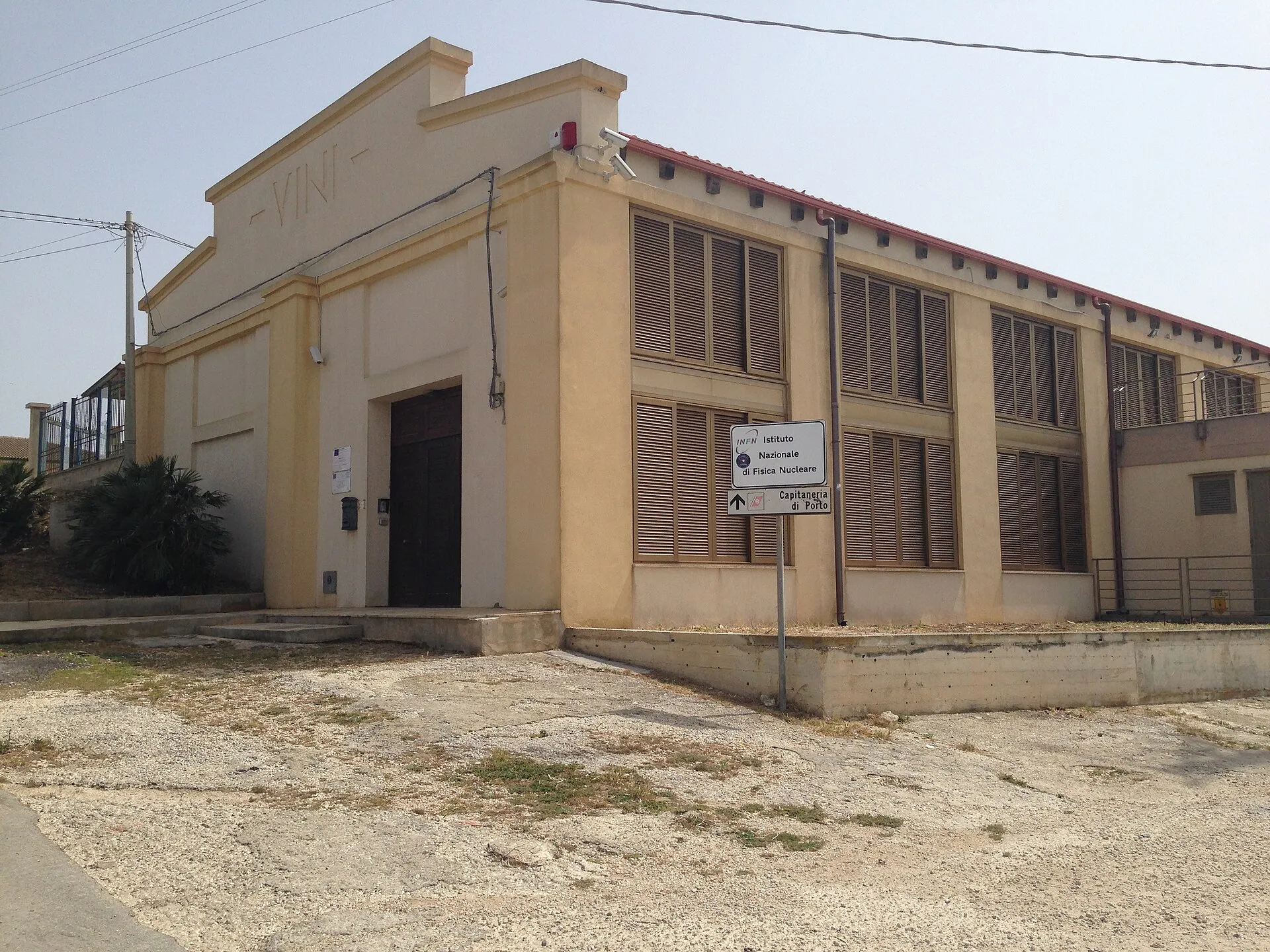
The Neutrino Mediterranean Observatory, led by INFN from the late 1990s, explored a 3,500 m deep site about 80 km off Capo Passero. After a mini-tower test at 2,000 m off Catania, its Phase-2 tower, 380 m tall, was deployed at Capo Passero in March 2013 and monitored the optical background for more than a year, finding low, stable rates dominated by ⁴⁰K decays.
Compare all experiments → · World map →
In plain words
Before building a cubic-kilometre neutrino telescope on the sea floor, one has to know the water: how clear it is, how much light it produces on its own, how strong the currents are and how much sediment settles on the sensors. NEMO was the Italian programme that answered these questions for a site off south-eastern Sicily and built the prototype structures to test deployment at great depth. It is not related to the NEMO-3 double beta decay experiment, which shares only the acronym.
Site and technology
After surveys of several locations, the collaboration selected a site about 80 km off Capo Passero at a depth of about 3,500 m, with good optical transparency and low bioluminescence. Its main structural idea was a flexible tower: horizontal arms carrying pairs of optical modules and linked by ropes, deployed folded as a compact package and unfurled on the sea bed. A shallower test site at 2,000 m depth off Catania was connected to the shore by an electro-optical cable for prototype tests.
Key results
- In a first phase, a mini-tower with a junction box was deployed at the Catania test site in the mid-2000s, demonstrating the deployment and data-transmission technology and recording atmospheric muons.
- The Phase-2 tower, 380 m high, was installed at Capo Passero in March 2013 and connected to a new shore station at Portopalo di Capo Passero.
- Over more than a year it monitored the optical background. The baseline rates were low and stable, consistent with light from the decay of ⁴⁰K dissolved in sea water, with only a small fraction of time affected by bursts of bioluminescence (Eur. Phys. J. C, 2016).
Legacy
NEMO joined ANTARES and NESTOR in the European design study for KM3NeT. Its Capo Passero site and shore infrastructure became the home of KM3NeT-ARCA, the high-energy part of KM3NeT, while its tower experience fed into the KM3NeT detection-unit design.
Frequently asked questions
Is NEMO the same as NEMO-3?
No. The Neutrino Mediterranean Observatory was a deep-sea neutrino telescope project, while NEMO-3 was a double beta decay experiment in the Modane underground laboratory.
Why measure the optical background?
Every photomultiplier in sea water sees a steady rate of light from radioactive ⁴⁰K and occasional bioluminescence. These rates set the noise level the detector must cope with and influence trigger design.
Original papers
- MeasurementS. Adrián-Martínez et al., Long term monitoring of the optical background in the Capo Passero deep-sea site with the NEMO tower prototype, Eur. Phys. J. C 76, 68 (2016)arXiv:1507.05024
Related terms
Latest research on this topic
- Estimation of the <math display="inline"><mrow><msub><mrow><mi>M</mi></mrow><mrow><mi>TOV</mi></mrow></msub></mrow></math> precision for ET, CE, and NEMO from the postmerger of BNS coalescencesConde-Saavedra, Gabriela, Aguiar, Odylio Denys, de Oliveira, Henrique P. et al. · 26 November 2025
Mentioned in 4 pages
Last updated: · Editorial standard
Cite this page
Text
Neutrino Atlas (2026). “NEMO (Neutrino Mediterranean Observatory)”. Retrieved 22 November 2026, from https://neutrino-atlas.com/terms/nemo-telescope/BibTeX
@misc{neutrinoatlas2026termsnemotelescope,
  title        = {NEMO (Neutrino Mediterranean Observatory)},
  author       = {{Neutrino Atlas}},
  year         = {2026},
  url          = {https://neutrino-atlas.com/terms/nemo-telescope/},
  note         = {Accessed 2026-11-22},
  language     = {english}
}