IceCube-Gen2
A proposed expansion of IceCube to about 8 km³ of optical sensors plus a large radio array.
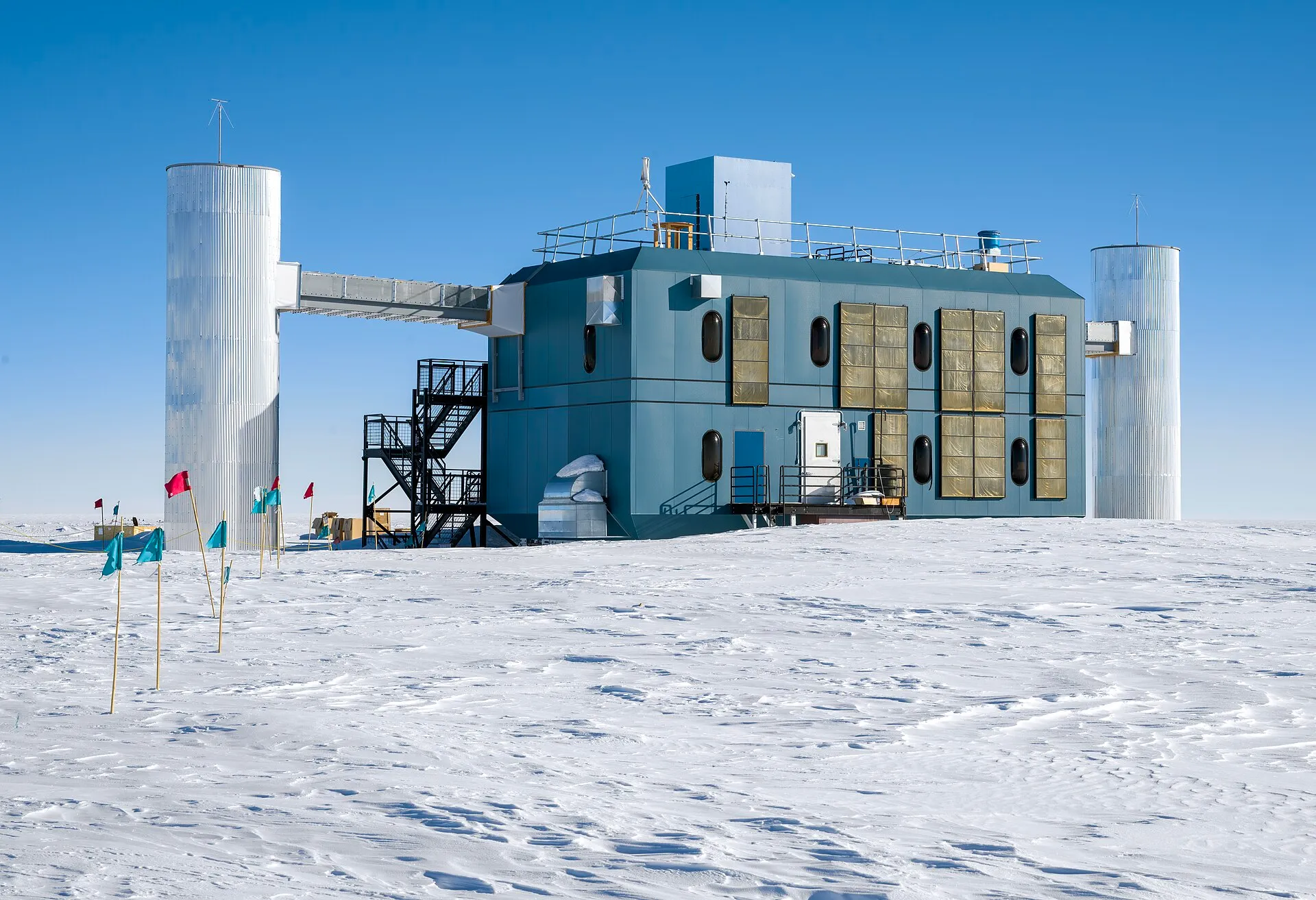
Gen2 would add about 120 new strings with wider spacing for TeV–PeV neutrinos and a surface-and-shallow radio array covering hundreds of km² for EeV neutrinos. It aims for about five times better point-source sensitivity than IceCube.
Compare all experiments → · World map →
In plain words
IceCube showed that cosmic neutrinos exist, but it sees only a few dozen of them each year – too few to map the sky in detail or to catch the rarest, most energetic ones. IceCube-Gen2 is the plan to make the observatory about eight times larger by drilling many more holes, spaced further apart, around the existing detector, and to add a vast field of radio antennas near the ice surface that listens for the radio crackle of ultra-high-energy neutrinos.
Planned design
- An optical array of about 120 new strings with roughly 240 m spacing, surrounding IceCube and enclosing about 8 km³ of ice; wider spacing is possible because the deep ice is very clear.
- New multi-PMT optical modules with more sensitive area per module than IceCube's single-PMT sensors.
- A radio array of antenna stations spread over hundreds of square kilometres, buried at shallow depth, to detect Askaryan pulses from neutrinos above about 10¹⁷ eV (radio detection).
- An extended surface array for cosmic-ray air showers, serving as a veto and for cosmic-ray composition studies.
The IceCube Upgrade, completed in the 2025/26 season, is a first step: it tests new sensor types and calibration methods that Gen2 would use.
Science goals
Gen2 aims for about five times better point-source sensitivity than IceCube, enough to identify populations of sources such as active galaxies or tidal disruption events and to measure their spectra. It would measure the flavour ratio of astrophysical neutrinos precisely, test exotic physics at energies far beyond accelerators, and with its radio array reach the cosmogenic neutrinos expected from ultra-high-energy cosmic rays interacting with the cosmic microwave background.
Status today
IceCube-Gen2 is a proposal of the international IceCube-Gen2 collaboration. It has not been approved for construction, and its timeline depends on funding agencies, notably the US National Science Foundation, and on South Pole logistics.
Frequently asked questions
How much bigger would IceCube-Gen2 be?
Its optical array would cover about 8 km³, around eight times IceCube's volume, plus a radio array covering hundreds of square kilometres.
When will IceCube-Gen2 be built?
No construction date has been set; the project still needs funding approval. The IceCube Upgrade, a smaller first step, has already been installed.
Original papers
- ProposalM. G. Aartsen et al. (IceCube-Gen2 Collaboration), IceCube-Gen2: the window to the extreme Universe, J. Phys. G 48, 060501 (2021)DOI 10.1088/1361-6471/abbd48arXiv:2008.04323
Related terms
People
Latest research on this topic
- Hidden Neutrino Active Galaxy Candidates: Prospects for Catalog and Stacking Searches with IceCube, IceCube-Gen2, and KM3NeTMukhopadhyay, Mainak, Carpio, Jose Alonso, Patel, Heer et al. · 30 October 2026
- Radio measurements of air showers with the IceCube-Gen2 surface prototype station at the Pierre Auger ObservatoryIceCube-Gen2 Collaboration · 31 August 2026
- Development of the New Optical Sensor for IceCube-Gen2Butterfield, Delaney, Wendt, Chris · 9 April 2026
- Expanding the neutrino facility at the South Pole: IceCube-Upgrade and IceCube-Gen2IceCube Collaboration · 12 March 2026
- Improving Supernova Neutrino Detection in IceCube-Gen2 : Detection Prospects of Neutrino Fast-time Features and Novel Neutrino Energy Reconstruction FrameworkBeise, Jakob · 2026
On the timeline
Mentioned in 36 pages
Comparisons 1
Milestones 9
- 1969 · Cosmogenic neutrinos predicted
- 2010 · IceCube is completed at the South Pole
- 2013 · IceCube finds high-energy astrophysical neutrinos
- 2018 · Blazar TXS 0506+056 linked to a neutrino
- 2021 · IceCube detects a Glashow resonance candidate
- 2022 · IceCube sees neutrinos from galaxy NGC 1068
- 2025 · KM3NeT detects a 220 PeV neutrino
- 2026 · IceCube Upgrade strings deployed
Terms 18
Last updated: · Editorial standard
Cite this page
Text
Neutrino Atlas (2026). “IceCube-Gen2”. Retrieved 22 November 2026, from https://neutrino-atlas.com/terms/icecube-gen2/BibTeX
@misc{neutrinoatlas2026termsicecubegen2,
  title        = {IceCube-Gen2},
  author       = {{Neutrino Atlas}},
  year         = {2026},
  url          = {https://neutrino-atlas.com/terms/icecube-gen2/},
  note         = {Accessed 2026-11-22},
  language     = {english}
}