P-ONE (Pacific Ocean Neutrino Experiment)
A planned cubic-kilometre-scale neutrino telescope in the deep north-east Pacific, built on Ocean Networks Canada's cabled seafloor observatory.
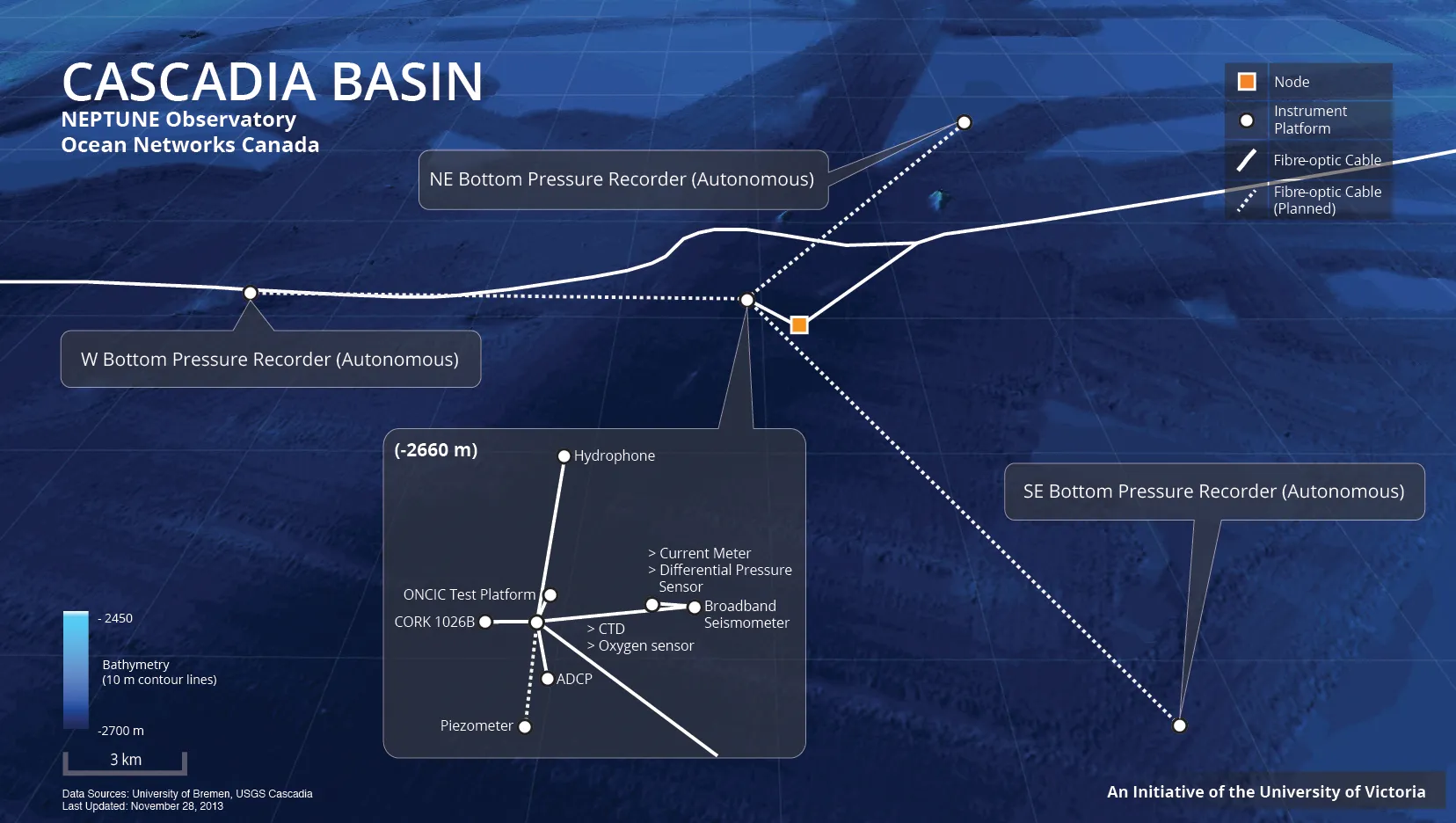
P-ONE is to instrument the Cascadia Basin, about 2.7 km deep off Vancouver Island, with kilometre-long mooring lines of optical modules connected to the NEPTUNE observatory. Two pathfinder missions characterised water transparency and backgrounds. The first line, P-ONE-1, carries 18 optical modules with sixteen 3-inch PMTs each plus two calibration modules; it was assembled in 2026 for deployment, followed by a six-line demonstrator.
Compare all experiments → · World map →
In plain words
High-energy neutrinos from space are so rare that only detectors spanning a cubic kilometre catch a useful number. IceCube uses Antarctic ice; KM3NeT and Baikal-GVD use water in Europe and Siberia. P-ONE aims to add a large telescope in the Pacific, using deep seawater as the detector medium and an existing seafloor power and data network instead of building a new one.
How the detector works
Ocean Networks Canada operates the NEPTUNE observatory, a cabled network that supplies power and fibre-optic data links to instruments on the seafloor hundreds of kilometres off Vancouver Island. In the Cascadia Basin, at about 2.7 km depth, P-ONE will anchor vertical mooring lines about 1 km long. Each line of the first design carries 20 modules: 18 optical modules with sixteen 3-inch photomultipliers each and two calibration modules with light sources. Charged particles from neutrino interactions emit Cherenkov light that the modules record with nanosecond timing. Acoustic positioning tracks how the lines sway in ocean currents.
Progress so far
Two pathfinder missions, STRAW and STRAW-b, measured the optical properties of the water and the background light from radioactive potassium and bioluminescence, and confirmed that the site is suitable. The first full line, P-ONE-1, was integrated at TRIUMF in Vancouver in April 2026 and passed a shallow-water test, with deployment targeted for the 2026 season. A funded demonstrator phase is planned with six lines of the same design.
Plans
The final geometry is still being optimised. Concepts show clusters of about ten lines each, adding up to around a cubic kilometre or more. Combined with telescopes on other continents and at the South Pole, P-ONE would improve sky coverage and help localise sources such as the active galaxy NGC 1068. The international collaboration has been led by Elisa Resconi of the Technical University of Munich as spokesperson.
Frequently asked questions
Why build in the Pacific?
The existing NEPTUNE cable network provides power and data at great depth, which lowers costs. A Pacific site also adds to the global network's view of the sky.
Is P-ONE taking data?
Pathfinder instruments have measured the site. The first detector line was completed in 2026 for deployment, so first neutrino data are still to come.
Original papers
- ProposalM. Agostini et al. (P-ONE Collaboration), The Pacific Ocean Neutrino Experiment, Nature Astron. 4, 913 (2020)arXiv:2005.09493
Related terms
Latest research on this topic
- P-ONE-1: the first detector line of the Pacific Ocean Neutrino ExperimentAghaei, O., Agostini, M., Alexander Wight, A. et al. · 20 October 2026
- Fast Cascade Generator GAN in the P-ONE ExperimentP-ONE Collaboration · May 2026
- Optical calibration systems of the Pacific Ocean Neutrino ExperimentP-ONE Collaboration · 10 March 2026
- Performance Studies for the Pacific Ocean Neutrino Experiment (P-ONE)Twagirayezu, Jean Pierre · 2026
Mentioned in 3 pages
People 1
Last updated: · Editorial standard
Cite this page
Text
Neutrino Atlas (2026). “P-ONE (Pacific Ocean Neutrino Experiment)”. Retrieved 22 November 2026, from https://neutrino-atlas.com/terms/p-one/BibTeX
@misc{neutrinoatlas2026termspone,
  title        = {P-ONE (Pacific Ocean Neutrino Experiment)},
  author       = {{Neutrino Atlas}},
  year         = {2026},
  url          = {https://neutrino-atlas.com/terms/p-one/},
  note         = {Accessed 2026-11-22},
  language     = {english}
}