RNO-G (Radio Neutrino Observatory Greenland)
An array of autonomous radio stations in the Greenland ice sheet searching for ultra-high-energy neutrinos through Askaryan emission.
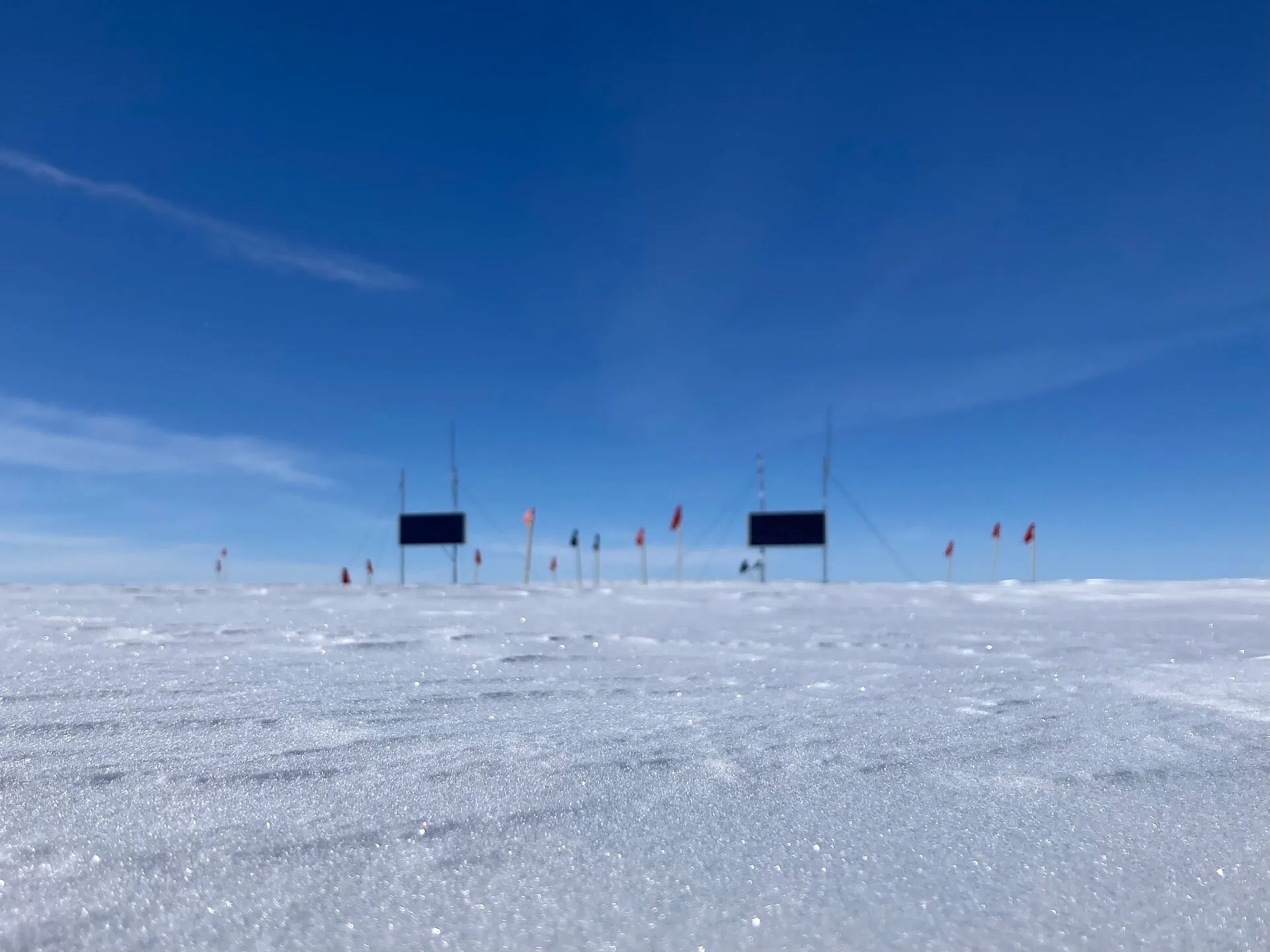
RNO-G is being built at Summit Station on the Greenland ice sheet, with stations spaced 1.25 km apart. Each station combines antennas in boreholes about 100 m deep with surface antennas and a low-threshold phased-array trigger. Construction began in 2021; seven stations were deployed in 2021–22 and eight were built by 2026, out of 35 planned.
Compare all experiments → · World map →
In plain words
At energies above about ten petaelectronvolts, neutrinos are so rare that even IceCube's cubic kilometre collects very few. Radio waves travel more than a kilometre through cold ice, so a sparse grid of antennas can watch hundreds of cubic kilometres. When a neutrino creates a particle shower in the ice, the shower emits a short radio pulse, the Askaryan effect. RNO-G listens for these pulses in the ice sheet of Greenland.
How the detector works
Each RNO-G station is a self-contained unit at Summit Station, high on the ice sheet. Antennas are lowered into boreholes about 100 m deep, where the ice is colder and radio signals travel further. Additional antennas near the surface help reject human-made noise and identify cosmic-ray air showers. A compact phased array of antennas combines signals in real time, steering electronically towards many directions, which lowers the trigger threshold. Stations are solar powered, which ties most of their operation to the long polar summer, and send their data wirelessly.
Progress so far
Construction began in 2021. Seven stations were deployed in the 2021 and 2022 field seasons, and the collaboration reported eight built by 2026. The full array is planned to have 35 stations on a 1.25 km grid. Early data have been used to study backgrounds, calibrate the ice properties and detect radio emission from cosmic-ray air showers.
Why it matters
Above a few tens of PeV, the expected sources are cosmogenic neutrinos produced when ultra-high-energy cosmic rays strike the cosmic microwave background, and the high-energy tail of astrophysical sources. RNO-G is the largest radio array in the Northern Hemisphere and complements ARA at the South Pole. Its hardware and experience feed directly into the radio component planned for IceCube-Gen2.
Frequently asked questions
Why use radio instead of light?
Light is absorbed in ice within about 100 m, while radio signals can travel more than a kilometre. A few antennas therefore cover a far larger volume, which is needed at the highest energies.
Has RNO-G detected a neutrino?
Not yet. The array is still under construction, and the expected rate of ultra-high-energy neutrinos is very low.
Original papers
- ProposalJ. A. Aguilar et al. (RNO-G Collaboration), Design and Sensitivity of the Radio Neutrino Observatory in Greenland (RNO-G), JINST 16, P03025 (2021)arXiv:2010.12279
Related terms
- Radio (askaryan) detection
- Ultra-high-energy neutrinos
- Cosmogenic neutrinos
- ARA (Askaryan Radio Array)
- IceCube-Gen2
People
Latest research on this topic
- The Radio Neutrino Observatory in Greenland (RNO-G) - System Design and InstrumentationRNO-G Collaboration · 29 October 2026
- The beamformed trigger of RNO-G: its design and in-field performanceRNO-G Collaboration · 27 July 2026
Mentioned in 9 pages
Last updated: · Editorial standard
Cite this page
Text
Neutrino Atlas (2026). “RNO-G (Radio Neutrino Observatory Greenland)”. Retrieved 22 November 2026, from https://neutrino-atlas.com/terms/rno-g/BibTeX
@misc{neutrinoatlas2026termsrnog,
  title        = {RNO-G (Radio Neutrino Observatory Greenland)},
  author       = {{Neutrino Atlas}},
  year         = {2026},
  url          = {https://neutrino-atlas.com/terms/rno-g/},
  note         = {Accessed 2026-11-22},
  language     = {english}
}