PUEO
A NASA-funded balloon-borne radio detector, successor to ANITA, that flew over Antarctica in 2025–26 to search for ultra-high-energy neutrinos.
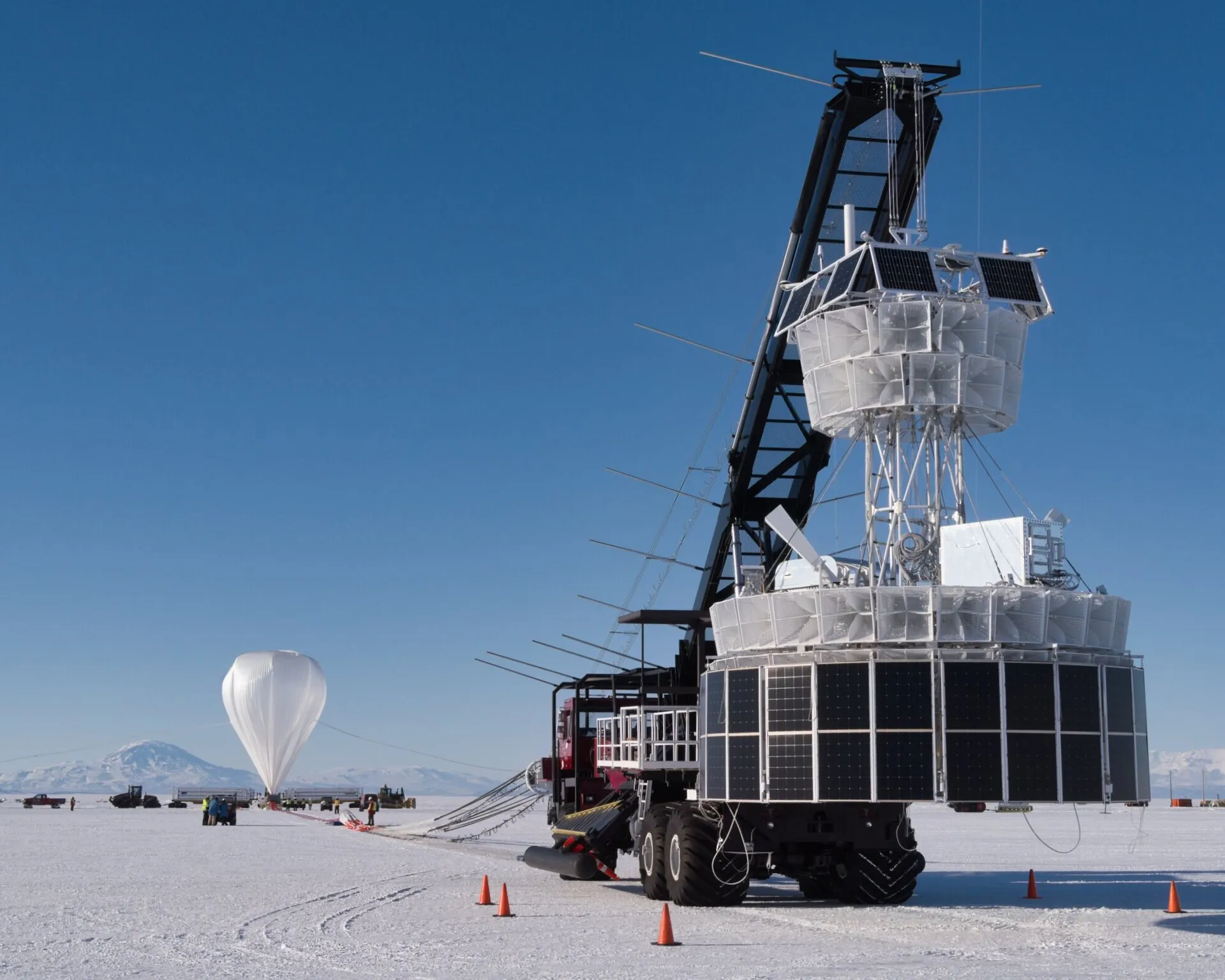
PUEO carries an array of radio antennas to about 120,000 ft above Antarctica and watches the ice below for radio pulses from neutrino-induced showers and from upgoing air showers. Its interferometric phased-array trigger is designed to be considerably more sensitive than ANITA. Led by the University of Chicago, it launched from near McMurdo Station on 19/20 December 2025 and ended its flight on 12 January 2026.
Compare all experiments → · World map →
In plain words
From a balloon high above Antarctica, an antenna can see more than a million square kilometres of ice at once. If an ultra-high-energy neutrino strikes that ice, the resulting particle shower emits a radio pulse that escapes through the surface. PUEO hangs a large set of radio antennas beneath a NASA scientific balloon to catch such pulses. It continues the approach of ANITA, which flew four times between 2006 and 2016.
How the detector works
The gondola carries many radio antennas pointed down towards the horizon and the ice, recording signals in roughly the frequency band where the Askaryan effect is strongest. The main advance over ANITA is the trigger. Instead of requiring a strong signal in a few antennas, PUEO combines signals from many antennas digitally with different delays, forming beams in many directions at once. This interferometric phased-array trigger can pick out weaker pulses, lowering the energy threshold and raising the sensitivity.
PUEO looks for two kinds of signals: radio pulses from showers inside the ice, and pulses from air showers, including those that could be started by tau leptons emerging from the ice after an Earth-skimming tau-neutrino interaction.
The flight
PUEO launched from NASA's Long Duration Balloon facility near McMurdo Station on 20 December 2025 (local time), rose to a float altitude of about 120,000 ft and circled the continent for more than three weeks. The flight ended on 12 January 2026, and the payload and its data were recovered. The University of Chicago leads the project, with collaborators at about a dozen institutions.
Why it matters
ANITA recorded a few unusual upward-pointing events that standard physics struggles to explain. PUEO's higher sensitivity is designed to test such signals and to search for ultra-high-energy neutrinos at levels predicted by some cosmogenic models. Results from the 2025–26 flight are still being analysed.
Frequently asked questions
Why fly a neutrino detector on a balloon?
From high altitude the antennas can monitor an enormous area of ice at once. That compensates for the extreme rarity of neutrinos at EeV energies, even though each flight lasts only weeks.
Has PUEO found any neutrinos?
No results have been published yet. The data from the first flight are being analysed.
Original papers
- ProposalQ. Abarr et al. (PUEO Collaboration), The Payload for Ultrahigh Energy Observations (PUEO): A White Paper, JINST 16, P08035 (2021)arXiv:2010.02892
Related terms
Latest research on this topic
- The design and flight of the Payload for Ultrahigh Energy Observations (PUEO)PUEO Collaboration · 26 October 2026
- Trigger system for the Payload for Ultrahigh Energy Observations (PUEO) balloon-borne neutrino detectorAbarr, Q., Alfaro, J., Allison, P. et al. · 6 July 2026
- Sensitivity of Payload for Ultrahigh Energy Observations to cosmogenic neutrinos and exotic physics scenariosSherman, Angelina, Fang, Ke, Hooper, Dan · 23 December 2025
Mentioned in 2 pages
Last updated: · Editorial standard
Cite this page
Text
Neutrino Atlas (2026). “PUEO”. Retrieved 22 November 2026, from https://neutrino-atlas.com/terms/pueo/BibTeX
@misc{neutrinoatlas2026termspueo,
  title        = {PUEO},
  author       = {{Neutrino Atlas}},
  year         = {2026},
  url          = {https://neutrino-atlas.com/terms/pueo/},
  note         = {Accessed 2026-11-22},
  language     = {english}
}