IceCube Neutrino Observatory
A cubic-kilometre neutrino detector in the Antarctic ice that discovered high-energy cosmic neutrinos.
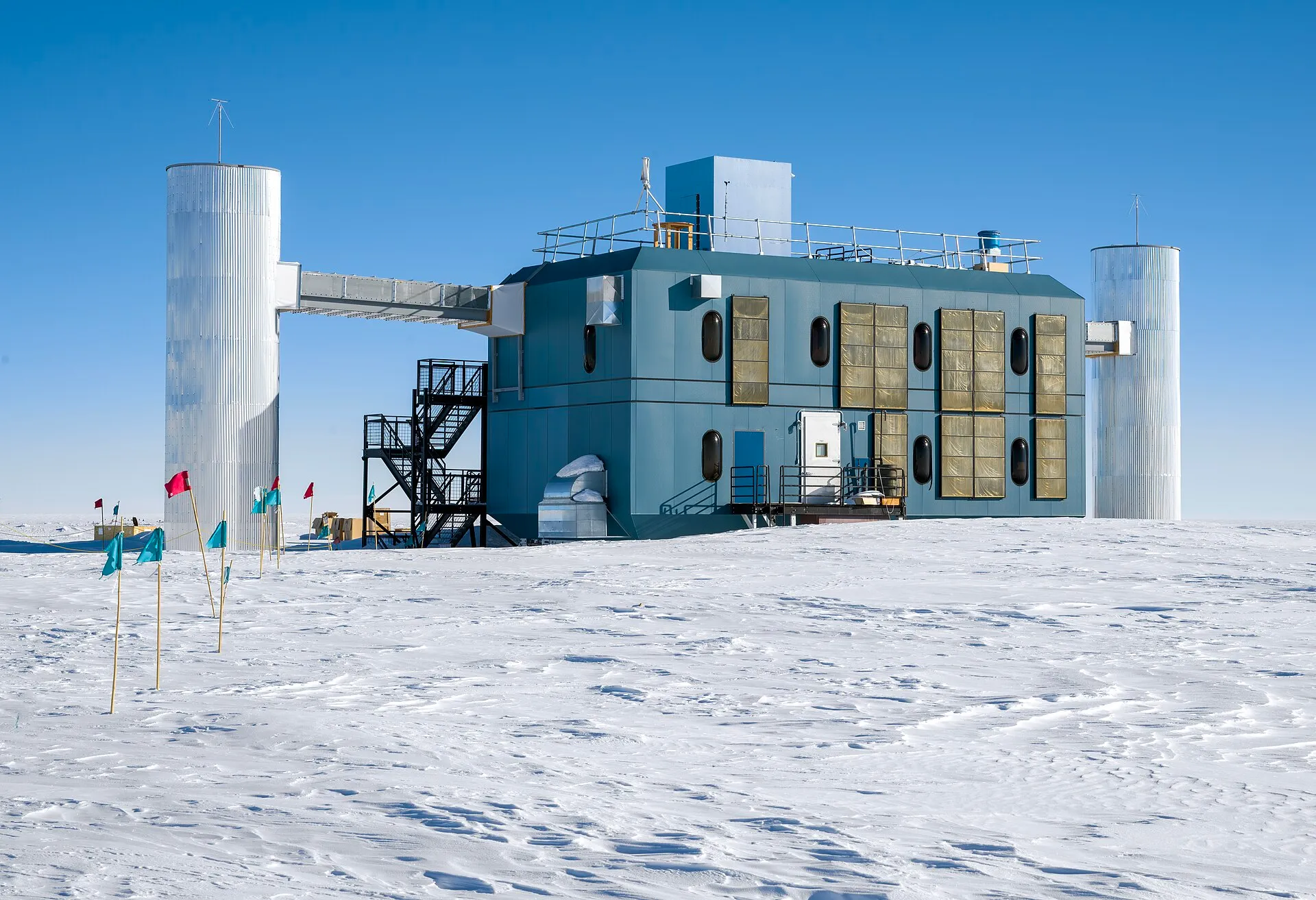
Its 5160 digital optical modules on 86 strings, 1450–2450 m deep, were completed in December 2010. IceCube discovered an astrophysical neutrino flux (2013), associated a neutrino with the flaring blazar TXS 0506+056 (2017–2018), found evidence for emission from the galaxy NGC 1068 (2022) and observed neutrinos from the Milky Way's plane (2023). It also measures atmospheric oscillations with its DeepCore subarray.
Compare all experiments → · World map →
In plain words
IceCube turns one cubic kilometre of Antarctic ice beneath the South Pole into a giant neutrino detector. More than five thousand basketball-sized light sensors hang on cables frozen into the ice between 1.45 and 2.45 km deep. When a high-energy neutrino strikes an atom in or near this volume, the resulting particles emit a blue glow, and the pattern of light across the sensors reveals the neutrino's direction and energy.
How the detector works
Each digital optical module holds a 10-inch photomultiplier and electronics that digitise the signal on the spot. The 86 strings, 60 modules each, are spaced about 125 m apart horizontally with 17 m between modules. Holes were melted with a hot-water drill in about two days each; construction ran from 2005 to December 2010. On the surface, the IceTop array of 81 stations measures cosmic-ray air showers and helps to veto atmospheric muons. The dense DeepCore sub-array lowers the energy threshold for oscillation studies.
IceCube distinguishes long tracks from muon neutrinos, which give the best direction, from compact cascades, which give the best energy. The precisely mapped optical properties of the ice are the largest single source of systematic uncertainty.
Key results
- 2013: discovery of an astrophysical neutrino flux at TeV–PeV energies, starting with the PeV events 'Bert', 'Ernie' and 'Big Bird'.
- 2017–2018: the alert IceCube-170922A and the blazar TXS 0506+056, the first evidence for an individual source.
- 2021: an event at about 6 PeV consistent with the Glashow resonance.
- 2022: evidence (4.2σ) for neutrino emission from the active galaxy NGC 1068.
- 2023: observation of neutrinos from the plane of the Milky Way (4.5σ).
- Precise measurements of atmospheric oscillations and of the neutrino–nucleon cross section at TeV energies, using the Earth's absorption.
Status today
IceCube has been taking data almost continuously since 2011 and issues public real-time alerts within about a minute. In the 2025/26 season the IceCube Upgrade added five densely instrumented strings, and the much larger IceCube-Gen2 is proposed. Francis Halzen of the University of Wisconsin–Madison has been principal investigator since the project's start.
Frequently asked questions
How big is IceCube?
Its sensors fill about one cubic kilometre of ice – roughly a billion tonnes – making it the largest neutrino detector by volume yet built.
How many neutrinos does IceCube detect?
It records on the order of 100,000 atmospheric neutrinos per year, but only a few dozen events per year with energies high enough to stand out as likely astrophysical.
Has IceCube found where cosmic rays come from?
Partly. It has found evidence for neutrinos from the blazar TXS 0506+056 and the galaxy NGC 1068, but most of the measured cosmic flux has not yet been traced to individual sources.
Original papers
- DiscoveryM. G. Aartsen et al. (IceCube Collaboration), Evidence for High-Energy Extraterrestrial Neutrinos at the IceCube Detector, Science 342, 1242856 (2013)DOI 10.1126/science.1242856
- DiscoveryM. G. Aartsen et al. (IceCube, Fermi-LAT, MAGIC et al.), Multimessenger observations of a flaring blazar coincident with high-energy neutrino IceCube-170922A, Science 361, eaat1378 (2018)DOI 10.1126/science.aat1378
- MeasurementR. Abbasi et al. (IceCube Collaboration), Evidence for neutrino emission from the nearby active galaxy NGC 1068, Science 378, 538 (2022)DOI 10.1126/science.abg3395
Go deeper
- DeepCore & IceCube upgradeDenser infill arrays within IceCube that lower its energy threshold to about 10 GeV and below.
- Bert, ernie & Big birdThe nicknamed PeV-energy cascade events that first revealed IceCube's astrophysical neutrinos.
- IceCube-170922A / TXS 0506+056The 2017 neutrino alert that coincided with a gamma-ray flare from a blazar, the first evidence for a cosmic neutrino source.
Related terms
- AMANDA
- Event topologies in neutrino telescopes
- Ice / Deep-water Cherenkov telescope
- IceCube-Gen2
- Digital optical module (DOM)
People
- Francis Halzen
- Moisey Alexandrovich Markov
- Sheldon Lee Glashow
- Christian Spiering
- Georg G. Raffelt
- Georgy Timofeyevich Zatsepin
- Hans-Thomas Janka
- John G. Learned
- M. Concepción (Concha) González-García
- Thomas K. Gaisser
- Veniamin Sergeevich Berezinsky
- Olga Botner
- Janet M. Conrad
- P. Buford Price
- Albrecht Karle
Latest research on this topic
- Scientific Background to the Nobel Prize in Physics 2026: For Decisive Contributions to the IceCube Neutrino Observatory and the Discovery of High-Energy Neutrinos of Astrophysical OriginNobel Committee for Physics Collaboration · 6 October 2026
- Operations of the IceCube Neutrino Observatory at the South PoleKelley, J.L. · 19 August 2026
- Searches for Non-Standard Neutrino Oscillations with The IceCube Neutrino ObservatoryWeigel, Philip Lawrence Rudolf · May 2026
- Latest results from the IceCube Neutrino Observatoryvan Eeden, Thijs Juan · 20 April 2026
- Highlights from the IceCube Neutrino ObservatoryIceCube Collaboration · 20 October 2025
On the timeline
- 1960Markov proposes deep underwater neutrino detection
- 1994AMANDA deploys detectors in the South Pole ice
- 2005IceCube deploys its first string
- 2010IceCube is completed at the South Pole
- 2013IceCube finds high-energy astrophysical neutrinos
- 2018Blazar TXS 0506+056 linked to a neutrino
- 2021IceCube detects a Glashow resonance candidate
- 2022IceCube sees neutrinos from galaxy NGC 1068
- 2023IceCube observes neutrinos from the Milky Way
- 2026IceCube Upgrade strings deployed
- 2026Nobel Prize for Francis Halzen and IceCube
Mentioned in 183 pages
Lessons 14
FAQ 12
- Can neutrinos be stopped or shielded?
- Can neutrinos pass through the whole Earth?
- Can neutrinos warn us of a supernova?
- What is Cherenkov radiation and why do neutrino detectors use it?
- What is IceCube?
- What is the largest neutrino detector?
- Where do neutrinos come from?
- Where do the highest-energy neutrinos come from?
Milestones 27
- 1960 · Glashow predicts a resonance at 6.3 PeV
- 1960 · Markov proposes deep underwater neutrino detection
- 1969 · Cosmogenic neutrinos predicted
- 1975 · Tau lepton discovery implies a third neutrino
- 1976 · DUMAND plans a deep-ocean neutrino telescope
- 1978 · Wolfenstein: matter changes neutrino oscillations
- 1987 · Neutrinos from supernova SN 1987A
- 1993 · First underwater neutrino telescope in Lake Baikal
19 more
- 1994 · AMANDA deploys detectors in the South Pole ice
- 2000 · DONUT observes the tau neutrino
- 2002 · Nobel Prize for neutrino astrophysics
- 2005 · IceCube deploys its first string
- 2008 · ANTARES completes the first deep-sea telescope
- 2010 · IceCube is completed at the South Pole
- 2010 · OPERA sees the first tau from oscillation
- 2013 · IceCube finds high-energy astrophysical neutrinos
- 2015 · OPERA establishes tau-neutrino appearance
- 2018 · Blazar TXS 0506+056 linked to a neutrino
- 2018 · MiniBooNE's excess grows to 4.8σ
- 2021 · IceCube detects a Glashow resonance candidate
- 2022 · IceCube sees neutrinos from galaxy NGC 1068
- 2023 · FASER detects neutrinos from a collider
- 2023 · IceCube observes neutrinos from the Milky Way
- 2025 · KM3NeT detects a 220 PeV neutrino
- 2025 · NOvA and T2K publish a joint analysis
- 2026 · IceCube Upgrade strings deployed
- 2026 · Nobel Prize for Francis Halzen and IceCube
People 22
Terms 106
- Acoustic neutrino detection
- Active galactic nuclei
- AMANDA
- Angular resolution
- ANITA
- ANTARES
- Appearance vs disappearance
- Applications of neutrinos
98 more
- ARA (Askaryan Radio Array)
- ARIANNA
- Astrophysical flavour ratio
- Astrophysical neutrino sources
- Atmospheric & Large water Cherenkov experiments
- Atmospheric mass splitting Δm²31
- Atmospheric neutrinos
- Atmospheric Self-veto
- Baikal-GVD
- Bert, ernie & Big bird
- Blind analysis
- Calibration
- Cascade (shower) events
- Charged lepton
- Cherenkov radiation
- Cherenkov radiation (detection)
- Collider neutrinos
- Core-collapse supernova mechanism
- Cosmic-ray air showers
- Cosmogenic neutrinos
- Dark rate
- Deep inelastic scattering
- DeepCore & IceCube upgrade
- Digital optical module (DOM)
- Double Bang
- DUMAND
- Earth absorption of high-energy neutrinos
- Earth density profile (PREM)
- Earth matter effects
- Earth-skimming tau neutrinos
- Electronvolt
- Electronvolt & energy scales
- Event topologies in neutrino telescopes
- Experiments & detectors
- FASER / FASERν
- Galactic plane neutrino emission
- Gamma-ray bursts and neutrinos
- Glashow resonance
- High-energy astrophysical neutrinos
- HUNT (High-energy Underwater Neutrino Telescope)
- Ice / Deep-water Cherenkov telescope
- IceCube-170922A / TXS 0506+056
- IceCube-Gen2
- Interaction cross section
- KM3-230213A
- KM3NeT
- Look-elsewhere effect
- Lorentz and CPT violation in neutrinos
- LVD (Large Volume Detector)
- MACRO
- Mass-ordering sensitivity
- Mean free path
- Mixing angle θ23
- Multi-messenger astronomy
- Muon neutrino
- Muon veto
- Neutrino astronomy
- Neutrino decay
- Neutrino self-interactions beyond the SM
- Neutrino telescopes
- Neutrino tomography
- Neutrinos from dark matter annihilation
- Neutron-star mergers and neutrinos
- NGC 1068
- Non-standard interactions
- Open questions in oscillations
- Oscillation observables
- Oscillogram
- P-ONE (Pacific Ocean Neutrino Experiment)
- Parametric resonance in the Earth
- Particle identification (PID)
- Photodetection
- Prompt atmospheric neutrinos
- Pseudo-Dirac neutrino
- Quantum coherence in oscillations
- RNO-G (Radio Neutrino Observatory Greenland)
- SNEWS (SuperNova Early Warning System)
- Sources of neutrinos
- Starting tracks & HESE
- Statistical significance (σ)
- Sterile neutrino
- Supernova early warning
- Supernova neutrino detection
- Supernova neutrino signal phases
- Supernova neutrinos
- Tau neutrino
- Tau neutrino appearance
- Tau regeneration
- TeV–PeV–EeV scale
- Tidal disruption events
- Track events
- TRIDENT (Hailing)
- Trigger & data acquisition
- Ultra-high-energy neutrinos
- W boson
- Wave-packet decoherence
- Waxman–Bahcall bound
- Zenith angle
Last updated: · Editorial standard
Cite this page
Text
Neutrino Atlas (2026). “IceCube Neutrino Observatory”. Retrieved 22 November 2026, from https://neutrino-atlas.com/terms/icecube/BibTeX
@misc{neutrinoatlas2026termsicecube,
  title        = {IceCube Neutrino Observatory},
  author       = {{Neutrino Atlas}},
  year         = {2026},
  url          = {https://neutrino-atlas.com/terms/icecube/},
  note         = {Accessed 2026-11-22},
  language     = {english}
}