1993Experiment
First underwater neutrino telescope in Lake Baikal
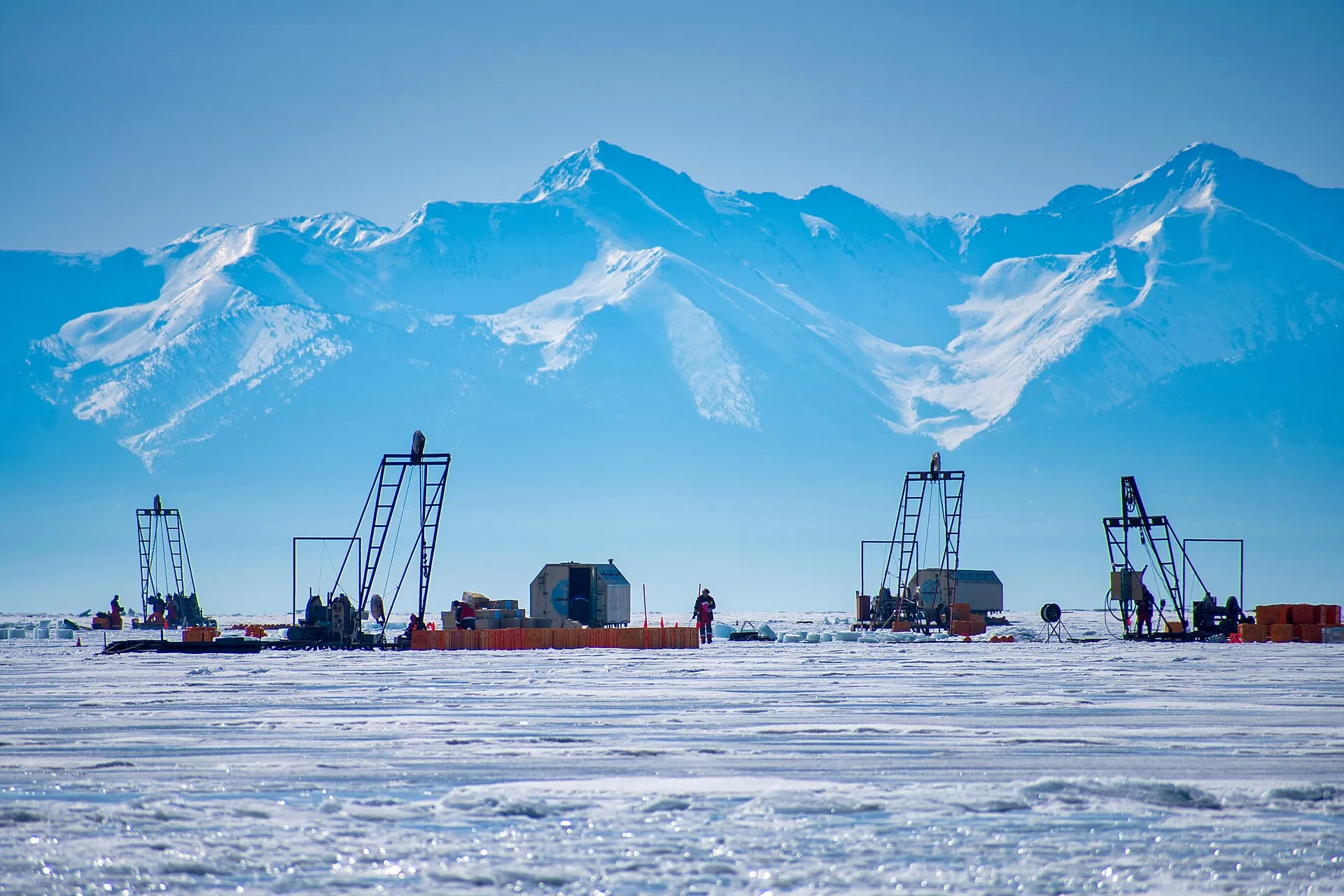
In April 1993 the Baikal collaboration, founded by Grigory Domogatsky's group at the Institute for Nuclear Research and joined by DESY Zeuthen, deployed the NT-36 array with 36 optical modules at about 1.1 km depth in Lake Baikal, installed from the winter ice cover. In 1996 it recorded the first clear upward-going neutrino-induced muons underwater. The array grew to NT-200 in 1998 and later to the cubic-kilometre-scale Baikal-GVD.
- Date
- 1993
- Kind of event
- Experiment
- People involved
- Grigory Vladimirovich Domogatsky, Christian Spiering
- Experiments
- Baikal-GVD
The situation before
In 1960 Moisey Markov suggested detecting high-energy neutrinos by placing light sensors deep in a lake or the ocean, using the water both as target and as shield. The muon produced in a neutrino interaction would emit Cherenkov light along its track, and an array of sensors could reconstruct its direction. Upward-going muons could only come from neutrinos that had crossed the Earth. The American DUMAND project off Hawaii pioneered the technique in the deep Pacific from the late 1970s, but it struggled with operating cables and connectors at great depth and was cancelled in 1995 before a full string was in operation.
What happened
Lake Baikal in Siberia offered unusual advantages. It is more than 1.3 km deep a few kilometres from its southern shore, its water is clear, and from February to April it freezes thick enough to carry trucks, winches and people. The ice could serve as a stable platform for lowering and recovering strings without ships. A group at the Institute for Nuclear Research in Moscow under Grigory Domogatsky began site studies in the early 1980s and developed a large hemispherical photomultiplier, the Kvasar, for its optical modules. From 1988 the DESY Zeuthen group, with Christian Spiering, joined the effort.
In April 1993 the collaboration deployed NT-36: 36 optical modules on three short strings at a depth of about 1.1 km, cabled to shore. It was the first underwater array that worked as a stand-alone neutrino detector. It took data until March 1995, and by searching for upward-going muon tracks the collaboration identified its first two neutrino candidates.
Reaction
NT-36 was small – its sensitive area for muons was only of order a few hundred square metres – but it showed that the Cherenkov detection technique worked in natural water and could be maintained year after year. Each winter the array could be serviced and extended from the ice. In 1996 the four-string NT-96 recorded clear upward-going muons from atmospheric neutrinos, the first such tracks observed underwater.
Consequences
- On 6 April 1998 NT-200 began operating, with 192 optical modules on eight strings; it ran for more than a decade and set limits on diffuse high-energy neutrino fluxes and on magnetic monopoles.
- Its experience fed into the design of the Mediterranean telescopes ANTARES and KM3NeT.
- From 2015 the collaboration began building Baikal-GVD, a modular array of clusters aiming at the cubic-kilometre scale, which has since reported astrophysical neutrino candidates.
- In parallel the AMANDA experiment at the South Pole took the same idea into ice, leading to IceCube.
Frequently asked questions
What was the first underwater neutrino telescope?
NT-36 in Lake Baikal, deployed in April 1993 with 36 optical modules at about 1.1 km depth.
Why Lake Baikal?
It is deep and clear, and its winter ice cover serves as a platform for installing and repairing detector strings without ships.
What came after NT-36?
NT-96 in 1996, NT-200 in 1998 and, from 2015, the much larger Baikal-GVD.
Original papers
- First resultI. A. Belolaptikov et al. (Baikal), The Baikal underwater neutrino telescope: Design, performance, and first results, Astropart. Phys. 7, 263 (1997)
Concepts
Mentioned in 1 page
Lessons 1
Last updated: · Editorial standard
Cite this page
Text
Neutrino Atlas (2026). “1993: First underwater neutrino telescope in Lake Baikal”. Retrieved 22 November 2026, from https://neutrino-atlas.com/timeline/1993-baikal-nt36/BibTeX
@misc{neutrinoatlas2026timeline1993baikalnt36,
  title        = {1993: First underwater neutrino telescope in Lake Baikal},
  author       = {{Neutrino Atlas}},
  year         = {2026},
  url          = {https://neutrino-atlas.com/timeline/1993-baikal-nt36/},
  note         = {Accessed 2026-11-22},
  language     = {english}
}