1991Experiment
SAGE begins the gallium measurements
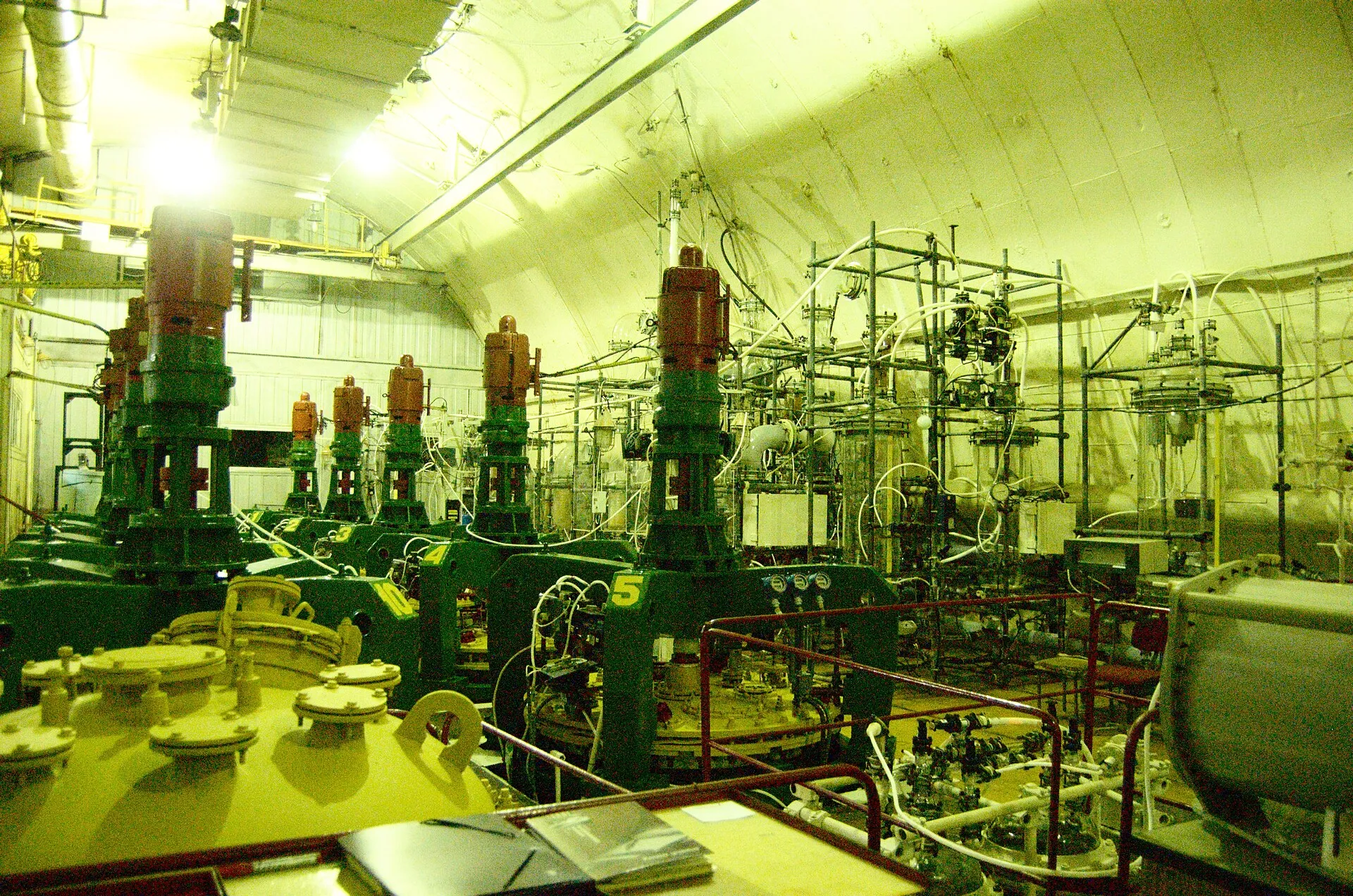
The Soviet-American Gallium Experiment at the Baksan Neutrino Observatory, using several tens of tonnes of metallic gallium, began solar measurements in 1990 and reported its first results in 1991. Gallium-71 captures neutrinos down to 233 keV and is therefore sensitive to the dominant pp neutrinos. Its first results showed far fewer neutrinos than predicted; from 1994 SAGE measured about half the expected rate, showing that the deficit extends to low energies. It ran for over two decades.
- Date
- 1991
- Kind of event
- Experiment
- People involved
- Vladimir N. Gavrin (Vladimir Nikolaevich Gavrin)
The situation before
Both Homestake and Kamiokande saw too few solar neutrinos, but both were sensitive only to the rarer, higher-energy part of the solar spectrum. The bulk of the flux comes from the pp reaction, in which two protons fuse to deuterium; these pp neutrinos have energies below 0.42 MeV, and their rate is fixed fairly directly by the Sun's luminosity. If they too were missing, either the Sun was not burning hydrogen as thought or the neutrinos themselves were behaving unexpectedly. In the 1960s Vadim Kuzmin had proposed gallium-71 as a detector: it absorbs electron neutrinos above 233 keV and turns into germanium-71, which decays with a half-life of about 11 days.
What happened
The Soviet-American Gallium Experiment, SAGE, was built at the Baksan Neutrino Observatory in the North Caucasus, in a hall more than 2 km into Mount Andyrchi. It used metallic gallium, kept liquid just above its melting point of about 30 °C, and was led on the Soviet side by the Institute for Nuclear Research in Moscow, with Vladimir Gavrin as a central figure, and on the American side by groups including Los Alamos. Every few weeks a few germanium atoms were chemically extracted from tens of tonnes of gallium and counted in small proportional counters as they decayed back – the gallium-germanium method.
Measurements started in January 1990 with about 30 tonnes; the mass was later increased to about 57 tonnes. The first results, from the 1990 runs, were published in Physical Review Letters in December 1991. They showed a rate consistent with zero, with an upper limit far below the solar model prediction of about 130 SNU. As Physics Today summarised, SAGE had seen 'no clear evidence of any solar neutrinos' in its first months of operation.
Reaction
The result caused concern, because even the most conservative solar models required at least about 80 SNU from pp and pep neutrinos alone. Some suspected that germanium was not being extracted as efficiently as assumed. With more gallium and more runs, SAGE's rate rose: results published in 1994 gave about 70 SNU, roughly half of the prediction, in agreement with the European GALLEX experiment, which had reported its first signal in 1992.
Consequences
- SAGE ran for more than two decades; its combined result of about 65 SNU confirmed that the deficit extends to the lowest solar neutrino energies.
- Calibrations with intense chromium-51 and argon-37 sources gave somewhat fewer events than expected. Together with GALLEX, this became the gallium anomaly, later tested by the BEST experiment at Baksan.
- Together with GALLEX, the gallium measurements showed that the deficit is energy dependent, a pattern later explained by the large-mixing-angle MSW effect.
- The experiment continued through the political upheaval of the Soviet Union's dissolution in 1991, a notable example of East-West scientific cooperation.
Frequently asked questions
What is SAGE?
The Soviet-American Gallium Experiment at the Baksan Neutrino Observatory, which measured low-energy solar neutrinos with liquid gallium from 1990.
What did SAGE first find?
Its first results, published in 1991, showed far fewer neutrinos than predicted. Later data gave a rate of roughly half the prediction.
Why was gallium useful?
Gallium-71 captures neutrinos above 233 keV, so it is sensitive to the pp neutrinos that make up most of the solar flux.
Original papers
- First resultA. I. Abazov et al. (SAGE), Search for neutrinos from the Sun using the reaction 71Ga(νe,e−)71Ge, Phys. Rev. Lett. 67, 3332 (1991)DOI 10.1103/PhysRevLett.67.3332
Concepts
Mentioned in 1 page
Lessons 1
Last updated: · Editorial standard
Cite this page
Text
Neutrino Atlas (2026). “1991: SAGE begins the gallium measurements”. Retrieved 22 November 2026, from https://neutrino-atlas.com/timeline/1991-sage-first-results/BibTeX
@misc{neutrinoatlas2026line1991sagefirstresults,
  title        = {1991: SAGE begins the gallium measurements},
  author       = {{Neutrino Atlas}},
  year         = {2026},
  url          = {https://neutrino-atlas.com/timeline/1991-sage-first-results/},
  note         = {Accessed 2026-11-22},
  language     = {english}
}