1989Discovery
LEP shows there are three light neutrinos
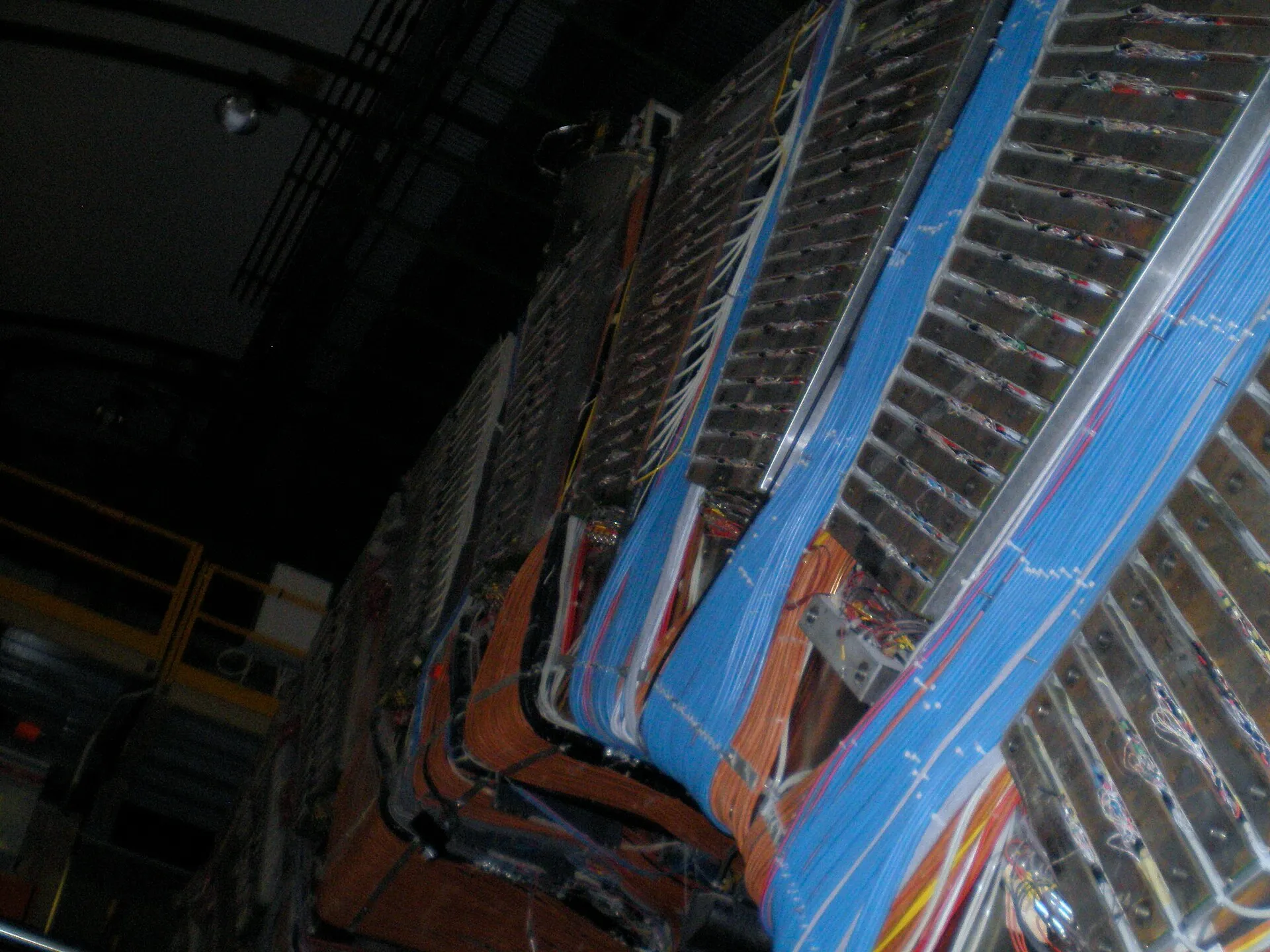
On 13 October 1989 the four experiments at CERN's Large Electron-Positron collider, ALEPH, DELPHI, L3 and OPAL, presented their first measurements of the Z boson line shape, following an earlier result from SLAC's Mark II. The width of the Z resonance depends on how many light neutrino species it can decay into. The data showed three, and the final LEP combination gave 2.9840 ± 0.0082. There are therefore exactly three light neutrinos that couple to the Z.
- Date
- 13 October 1989
- Kind of event
- Discovery
- People involved
- Jack Steinberger
The situation before
By the 1980s three generations of matter were known: the electron, muon and tau with their neutrinos, and three pairs of quarks, although the top quark and the tau neutrino had not yet been observed directly. Nothing in the Standard Model said why there should be three, and a fourth or fifth generation seemed possible. Indirect limits existed. Big Bang nucleosynthesis allowed at most about four light neutrino species, and measurements at CERN's proton-antiproton collider gave a limit of roughly five or six. A direct count needed many Z bosons.
What happened
The Z boson can decay into any pair of particles lighter than half its mass, including every light neutrino-antineutrino pair. Each additional neutrino species adds about 0.17 GeV to the total width of the Z resonance, which is about 2.5 GeV, and lowers the height of the peak in the visible decay channels. Measuring the shape of the resonance – the 'line shape' – while scanning the collision energy across it therefore counts the neutrinos, including those that are never seen.
Two machines raced to make Z bosons by colliding electrons and positrons. At SLAC, the Stanford Linear Collider began delivering Z events to the Mark II detector in 1989, and in early October Mark II reported a value of Nν close to three, with a sizeable uncertainty. CERN's Large Electron-Positron collider (LEP), 27 km in circumference, saw its first collisions on 13 August 1989. Exactly two months later, on 13 October 1989, the four LEP experiments ALEPH, DELPHI, L3 and OPAL presented their first line-shape measurements at a special seminar at CERN. Each experiment had recorded a few thousand Z decays, and each found a number of light neutrino species consistent with three and incompatible with four.
Reaction
The result was quickly regarded as a landmark: after fewer than two months of operation, LEP had shown that there are three, and only three, generations of fundamental particles with a light neutrino. Jack Steinberger, a 1988 Nobel laureate for the muon neutrino, led ALEPH at the time. The papers appeared in Physics Letters B before the end of 1989.
Consequences
- Over the following years LEP collected about 17 million Z decays. The final combination of the four experiments, published in 2006, gave Nν = 2.9840 ± 0.0082.
- Any fourth-generation neutrino coupling to the Z must be heavier than about 45 GeV, half the Z mass, which would make it very different from the known three.
- Sterile neutrinos do not couple to the Z, so the result does not rule them out; it only limits how strongly they could mix with active neutrinos.
- The tau neutrino, implied by the count, was observed directly by DONUT in 2000, and cosmological measurements of Neff agree with three species.
The precise count of light neutrinos remains one of the cleanest numbers in particle physics.
Frequently asked questions
How many types of neutrinos are there?
There are three light neutrinos that couple to the Z boson, as shown by LEP in 1989. The final value is 2.9840 ± 0.0082.
How did LEP count neutrinos it could not see?
By measuring the width of the Z resonance. Each light neutrino species adds a fixed amount to the invisible decay width.
Could there still be more neutrinos?
Only if they are heavier than about 45 GeV or do not couple to the Z, like hypothetical sterile neutrinos.
Original papers
- DiscoveryD. Decamp et al. (ALEPH), Determination of the number of light neutrino species, Phys. Lett. B 231, 519 (1989)DOI 10.1016/0370-2693(89)90704-1
- Final resultALEPH, DELPHI, L3, OPAL, SLD Collaborations et al., Precision electroweak measurements on the Z resonance, Phys. Rept. 427, 257 (2006)
Concepts
Mentioned in 4 pages
Last updated: · Editorial standard
Cite this page
Text
Neutrino Atlas (2026). “1989: LEP shows there are three light neutrinos”. Retrieved 22 November 2026, from https://neutrino-atlas.com/timeline/1989-lep-three-neutrino-families/BibTeX
@misc{neutrinoatlas2026lepthreeneutrinofamilies,
  title        = {1989: LEP shows there are three light neutrinos},
  author       = {{Neutrino Atlas}},
  year         = {2026},
  url          = {https://neutrino-atlas.com/timeline/1989-lep-three-neutrino-families/},
  note         = {Accessed 2026-11-22},
  language     = {english}
}