1988Discovery
Kamiokande finds an atmospheric neutrino anomaly
Analysing contained events, Kamiokande, with Takaaki Kajita playing a central role, found that the ratio of muon-like to electron-like atmospheric neutrino events was only about 60 percent of the expected value. IMB saw a similar deficit. The result was initially suspected to be an experimental artefact, but it persisted in later data. Super-Kamiokande resolved it in 1998 as muon-neutrino oscillation.
- Date
- 1988
- Kind of event
- Discovery
- People involved
- Takaaki Kajita, Masatoshi Koshiba
- Experiments
- Kamiokande, IMB (Irvine–Michigan–Brookhaven)
The situation before
Cosmic rays hitting the upper atmosphere produce pions and kaons, which decay into muons and neutrinos. Because a pion decays into a muon and a muon neutrino, and the muon then into an electron, an electron neutrino and a muon neutrino, one expects roughly two muon-type neutrinos for each electron-type neutrino at energies around 1 GeV. For proton-decay experiments these atmospheric neutrinos were the main background, and they had to be simulated carefully. Absolute fluxes were uncertain by about 20 percent, but the flavour ratio was thought to be known to about 5 percent.
What happened
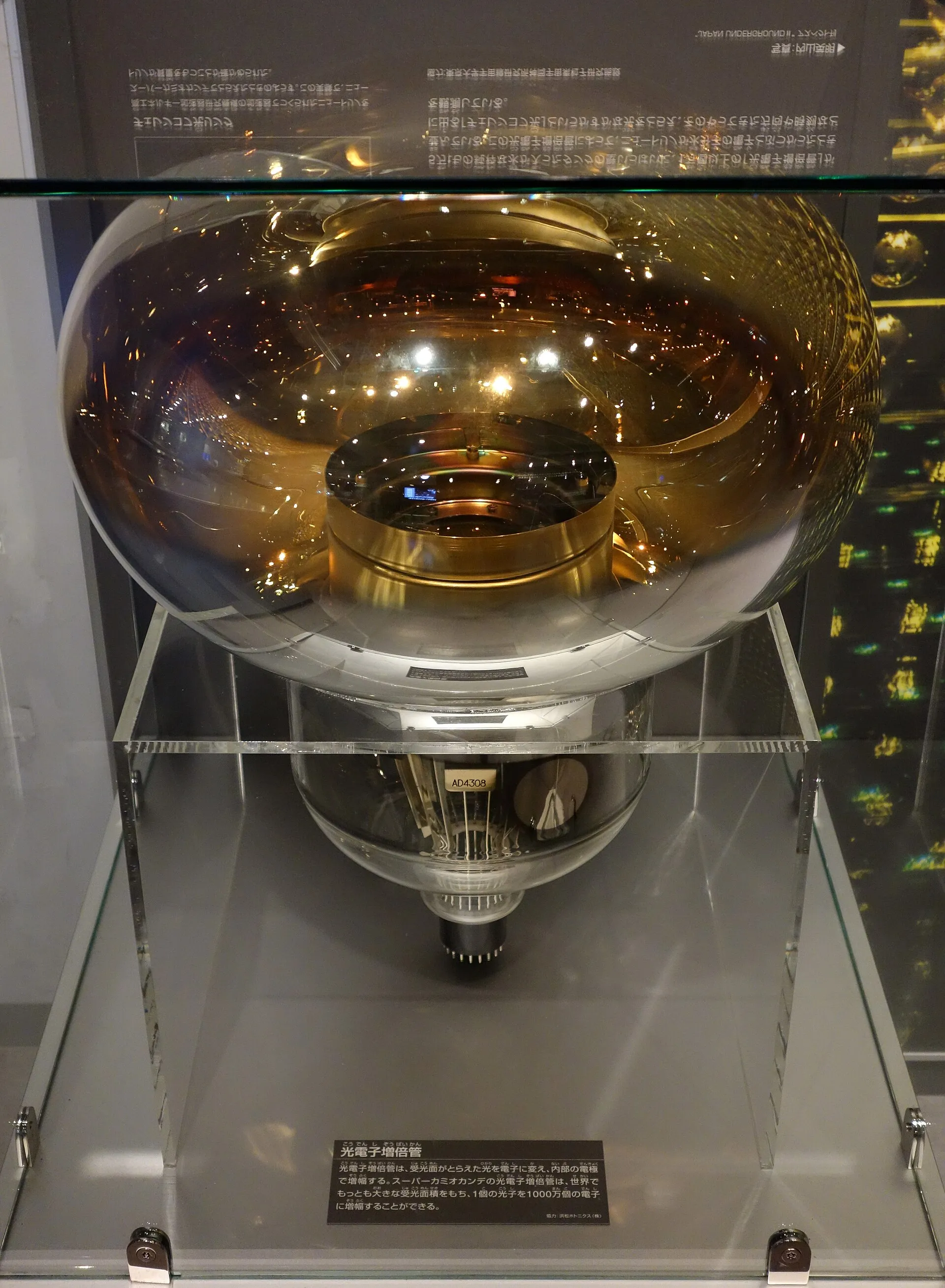
At Kamiokande, Takaaki Kajita, then a young researcher in Masatoshi Koshiba's group, worked on particle identification in the water Cherenkov detector. Muons produce sharp Cherenkov rings, while electrons shower and give fuzzy ones. Applying his method to contained neutrino events, Kajita and colleagues found that the number of electron-like events matched expectation, but muon-like events were clearly too few. In 1988 the collaboration published 'Experimental study of the atmospheric neutrino flux' in Physics Letters B, signed by Hirata and colleagues. Only 59 percent of the expected muon-like events were observed. The ratio of the measured to the simulated muon-to-electron ratio was about 0.6.
Kajita later recalled that he first noticed the shortfall in 1986 and assumed at first that he had made a mistake in his own software. The group checked the reconstruction, the event selection and the simulation for many months before going public. The paper discussed possible explanations, including systematic errors and neutrino oscillation, and stated the deficit plainly, without claiming a discovery.
Reaction
Many physicists suspected a problem in the flux calculation, the simulation of interactions or the particle identification. Some support came from IMB: it had reported in 1986 that too few of its events were followed by a muon-decay electron, and in 1991 and 1992 it published a reduced muon-to-electron ratio as well. Doubt came from the iron-calorimeter experiments NUSEX in the Mont Blanc tunnel and Fréjus in the Alps, which saw no deficit, although with fewer events. Kamiokande later tested its particle identification with electron and muon beams at KEK and found it reliable.
In 1992 Kamiokande confirmed the ratio with more data. In 1994 it analysed higher-energy events and found a hint that the deficit depended on the zenith angle, that is, on the distance the neutrinos had travelled, as expected for oscillation.
Consequences
- In the late 1990s Soudan 2, an iron tracking calorimeter in Minnesota, also measured a reduced ratio, removing the suspicion that only water detectors were affected.
- The anomaly motivated the design of Super-Kamiokande, which started in 1996 with a fiducial mass about twenty times larger.
- On 5 June 1998 Super-Kamiokande presented clear evidence that upward-going muon neutrinos disappear, establishing neutrino oscillation.
- The reactor experiment CHOOZ ruled out in 1998 that electron neutrinos were involved, pointing to muon-to-tau oscillation.
- Kajita shared the 2015 Nobel Prize in Physics with Arthur McDonald for the discovery of neutrino oscillations.
Frequently asked questions
What was the atmospheric neutrino anomaly?
Kamiokande found that only about 60 percent of the expected muon-neutrino events from the atmosphere were present, while electron-neutrino events matched predictions.
Who found it?
The Kamiokande collaboration, with Takaaki Kajita playing a central role through his particle identification analysis; the paper appeared in 1988.
How was the anomaly explained?
As oscillation of muon neutrinos into tau neutrinos, demonstrated by Super-Kamiokande in 1998.
Original papers
- DiscoveryK. S. Hirata et al. (Kamiokande-II), Experimental study of the atmospheric neutrino flux, Phys. Lett. B 205, 416 (1988)
- ReviewT. Kajita, History of "Anomalous" Atmospheric Neutrino Events: A First Person Account (2016)arXiv:1606.00665
Concepts
Mentioned in 1 page
Lessons 1
Last updated: · Editorial standard
Cite this page
Text
Neutrino Atlas (2026). “1988: Kamiokande finds an atmospheric neutrino anomaly”. Retrieved 22 November 2026, from https://neutrino-atlas.com/timeline/1988-atmospheric-anomaly/BibTeX
@misc{neutrinoatlas2026ne1988atmosphericanomaly,
  title        = {1988: Kamiokande finds an atmospheric neutrino anomaly},
  author       = {{Neutrino Atlas}},
  year         = {2026},
  url          = {https://neutrino-atlas.com/timeline/1988-atmospheric-anomaly/},
  note         = {Accessed 2026-11-22},
  language     = {english}
}